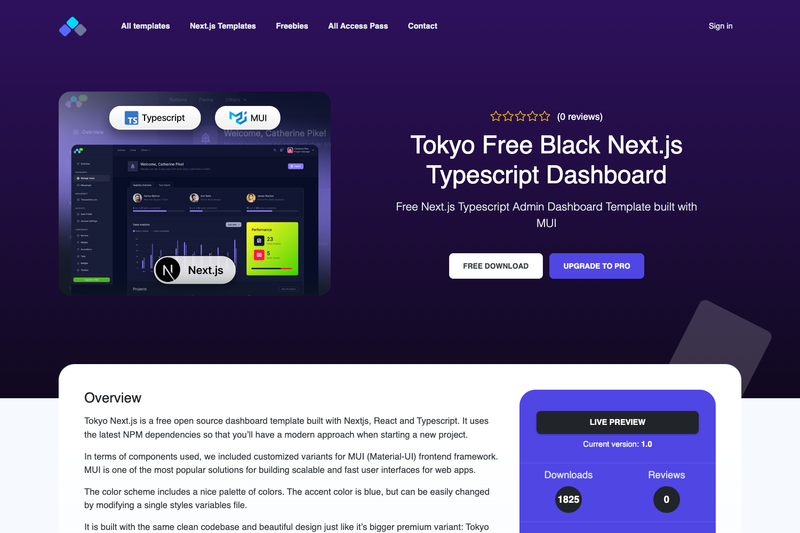
Tokyo Free Black Typescript Next.js Admin Dashboard is a free, open-source admin dashboard template from BloomUI that combines Next.js, TypeScript, and Material-UI (MUI v5) in a dark color scheme.
What is Tokyo Free Black Typescript Next.js Admin Dashboard?
Tokyo Free Black Typescript Next.js Admin Dashboard is a free admin dashboard template for building React-based back-office interfaces. It ships as a Next.js project scaffold containing pre-built dashboard pages and customized Material-UI components, so developers get a functional front-end instead of an empty boilerplate. The template is published by BloomUI under the MIT license and is available on GitHub for cloning.
Key Features
- Next.js + TypeScript stack — Built on the Next.js React framework with TypeScript for type-safe component development and modern React patterns.
- Material-UI v5 customization — Uses MUI v5 components customized with a dark color scheme, including colors and accents designed to improve the user experience across included flows.
- Dark theme by default — The entire dashboard uses a dark color palette, which is the template's defining visual style.
- Free and MIT licensed — You can use it in personal and commercial projects without licensing fees; the GitHub repository shows version 1.0.0.
- Up-to-date dependencies — BloomUI keeps all dependencies updated to their latest stable versions and notifies users by email when a new version is released.
- Quick local startup — Clone the repository, run npm install, then yarn dev to view the dashboard at http://localhost:3000.
- Live preview available — A live preview is set up on the BloomUI product page so you can inspect pages before downloading.
- Free JavaScript version — A non-TypeScript version exists for developers who prefer plain JavaScript.
Who is it for?
- React developers who need a pre-built admin dashboard scaffold with Next.js and TypeScript, saving hours of initial setup.
- Product teams building internal tools or data dashboards that fit a dark theme and Material-UI's component library.
- Developers evaluating BloomUI — the free template serves as a starting point, with a premium "PRO" version sold on bloomui.com that adds more components and features.
What can you do with it?
- Create admin panels: Use the included dashboard pages and components as a foundation for customer portals, analytics views, or management consoles.
- Customize the theme: Modify the Material-UI theme variables to change colors and accents while keeping the dark scheme.
- Learn Next.js and MUI integration: Follow the project structure to see how Next.js pages, TypeScript types, and Material-UI components are wired together.
How do you get started?
The Quick Start section on the repository page lists four steps: ensure Node.js and npm are installed, clone the repository with git clone, run npm install in the project folder, then start the dev server with yarn dev. A browser window will open at http://localhost:3000 showing the live preview.
Pricing
The template is free and released under the MIT license. BloomUI also sells a premium "PRO" version of Tokyo with more components, features, and options; pricing is available on bloomui.com.
FAQ
Is Tokyo Free Black Typescript Next.js Admin Dashboard really free?
Yes. The template is distributed under the MIT license, so you can use it in personal and commercial projects without paying licensing fees. BloomUI monetizes the premium PRO version, not this free tier.
What tech stack does it use?
It uses Next.js, TypeScript, and React, with Material-UI v5 as the UI component library. The template is styled with a dark color scheme by default, and the repository metadata lists topics like nextjs, typescript, mui, and dark-theme.
How do I run the dashboard locally?
Clone the repository, run npm install to install dependencies, then run yarn dev. The dev server will start and your browser will open to http://localhost:3000 with the live preview.
Is there a JavaScript version?
Yes. BloomUI also offers a free JavaScript version of the Tokyo dashboard for developers who prefer JavaScript over TypeScript.