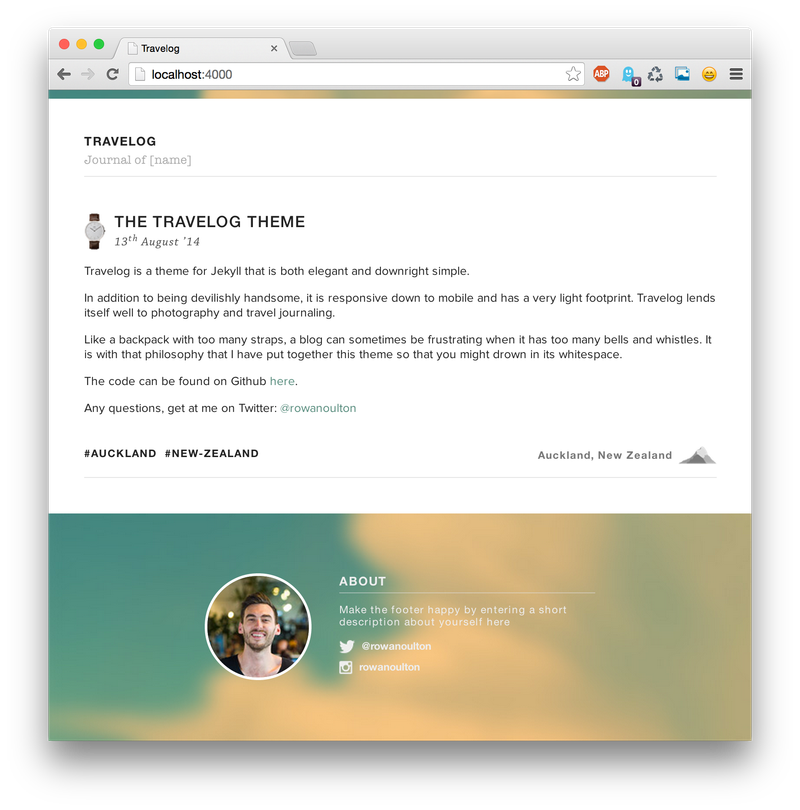
Travelog is an open-source Jekyll theme designed for elegant, mobile-responsive travel journals and photography blogs, built by Rowan Oulton and hosted on GitHub.
What is Travelog?
Travelog is a theme for Jekyll, the static site generator. It takes Markdown posts and YAML configuration files as input and produces a lightweight static HTML website. The theme is designed to be simple and easy to modify, making it a solid starting point for a personal blog. It is maintained by Rowan Oulton, who provides the source under an MIT license.
Key Features
- Responsive design — the layout adapts cleanly down to mobile screen sizes, so travel journals read well on phones and tablets.
- Light footprint — the theme keeps CSS and assets minimal, resulting in fast page loads without heavy frameworks.
- Easy customization — core site settings like your name, Twitter username, and other details are centralized in the _config.yml file.
- GitHub Pages ready — the theme is designed to deploy directly to GitHub Pages, with no extra build steps beyond a standard Jekyll setup.
- MIT licensed — you can use, modify, and redistribute the theme freely; attribution is not required.
- Blog-oriented layout — the structure prioritizes clean reading of posts, with an emphasis on written and photographic content.
Who is it for?
- Travel bloggers who want a clean, uncluttered journal format for writing trip updates and stories.
- Photographers looking to pair captioned images with minimal text in a simple blog layout.
- Jekyll beginners who want a lightweight starting point to learn how Jekyll themes are structured, since the codebase is small and well-documented.
What can you do with Travelog?
- Travel journaling: publish daily or per-trip posts with a clean reading layout, and the responsive design makes it presentable on mobile browsers.
- Photography blogging: use the open layout and minimal chrome to let images take focus, while still being able to add contextual text around them.
- Personal blogging: repurpose the theme for any writing need by editing the central _config.yml file and writing Markdown posts.
How does Travelog work?
To get started, install Jekyll via gem install jekyll, fork the repository on GitHub, clone your fork locally, and run jekyll serve -w to preview the site at localhost:4000. Customize your site's name, Twitter username, and other settings in _config.yml, then commit and push to a GitHub Pages branch to deploy.
FAQ
Is Travelog free?
Yes. Travelog is released under the MIT license, which means it is free to use, modify, and even redistribute commercially. Attribution is not required, though the author appreciates a shoutout.
What do I need to run Travelog?
You need Ruby and Jekyll installed on your computer. The installation instructions call for running gem install jekyll and then using jekyll serve -w to launch a local development server.
Can I deploy Travelog to GitHub Pages?
Yes. Travelog is explicitly designed for GitHub Pages deployment. After customizing _config.yml, you can push the repository to GitHub and enable Pages in the repository settings to publish your site.
Does Travelog include a contact form or comments?
The page does not mention any comment system or contact form. It focuses on a minimal blog layout, so interactive features like comments or forms are not included out of the box.