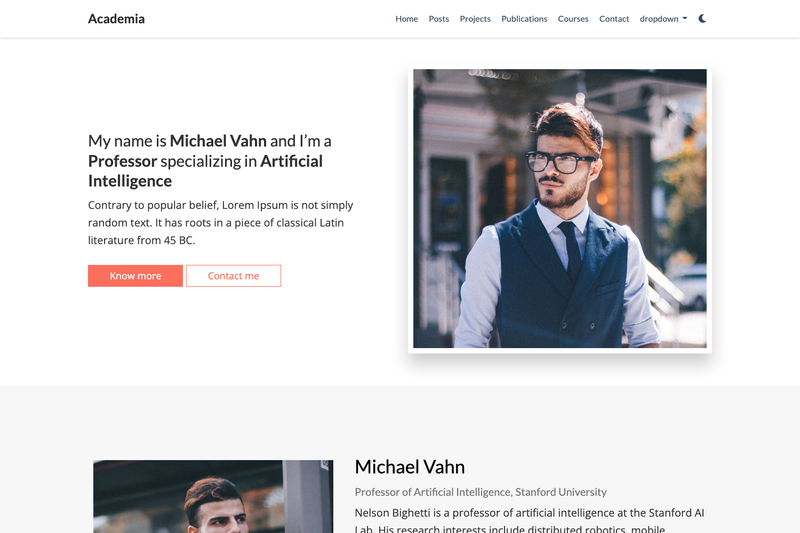
Academia Hugo is a free, open-source Hugo theme for building academic portfolio websites that showcase resumes, publications, courses, and talks.
What is Academia Hugo?
Academia Hugo is a free, open-source Hugo theme built for academic and research portfolios. It takes Markdown content files as input and produces a static website with pages for a homepage, publications, courses, posts, and categories. The theme is developed and maintained by Gethugothemes (Themefisher), requires Hugo version 0.124.1 or above, and is licensed under MIT.
Key Features
- Bootstrap-based layout — The theme is styled with Bootstrap, making the responsive grid and components familiar to front-end developers.
- 6+ pre-designed pages — Includes Home, Single Post, Single Publication, Courses, Single Course, and Category pages, covering the core sections of an academic site.
- Multiple authors — The theme supports several author profiles, allowing team or lab sites to attribute posts and publications to different people.
- Google Analytics integration — Add your tracking ID to measure site traffic without writing custom code.
- Contact form and Google Maps — A built-in contact form and map embed let visitors reach you directly from the site.
- Reading time calculator — Post pages automatically show estimated reading time based on word count.
- SEO meta tags — Open Graph and Twitter Card meta tags are included so links shared on social media display proper titles and images.
- Sitepins CMS support — The template is pre-configured to work with Sitepins, a Git-based headless CMS, so content can be edited visually without touching code.
Who is it for?
- Academics and researchers — Present your publications, courses, and talks in a structured portfolio without building a site from scratch.
- Graduate students — Create a professional personal website to list your CV, research interests, and blog posts.
- University labs and departments — Use the multiple author support to feature several team members on one site.
- Freelance developers — Use this theme as a starting point for client projects that need a clean academic or personal brand site.
What can you do with it?
- Publish academic publications — Add publication entries with details and links; they appear on the Single Publication page.
- List and present courses — Create course pages with syllabi, schedules, and materials using the Courses and Single Course templates.
- Write a research blog — Author posts that display reading time and are categorized via the Category page.
- Manage content visually — Connect the pre-configured Sitepins CMS to edit text, images, and configuration without Git knowledge.
How does Academia Hugo work?
The theme works like any Hugo site. Clone the repository, run npm run project-setup to install dependencies, then run npm run dev to start a local development server. Write or edit content in Markdown and Hugo builds the static site; the result can be deployed to any static host. Full documentation is available at docs.gethugothemes.com.
FAQs
Is Academia Hugo free?
Yes. The theme is released under the MIT license, so you can use, modify, and distribute it freely, including in commercial projects. The images shown in the demo are for demonstration only and have their own licenses.
What Hugo version does it require?
The minimum Hugo version is 0.124.1. Using an older version may break the theme, so check your installed Hugo version before setup.
Can I edit the theme without writing code?
Yes. The template is pre-configured for Sitepins, a Git-based headless CMS. You can clone the repository into Sitepins and edit text, images, and settings through a visual interface.
Does the theme include a contact form?
Yes, contact form support is listed as one of the key features, and the theme also supports Google Maps integration out of the box.