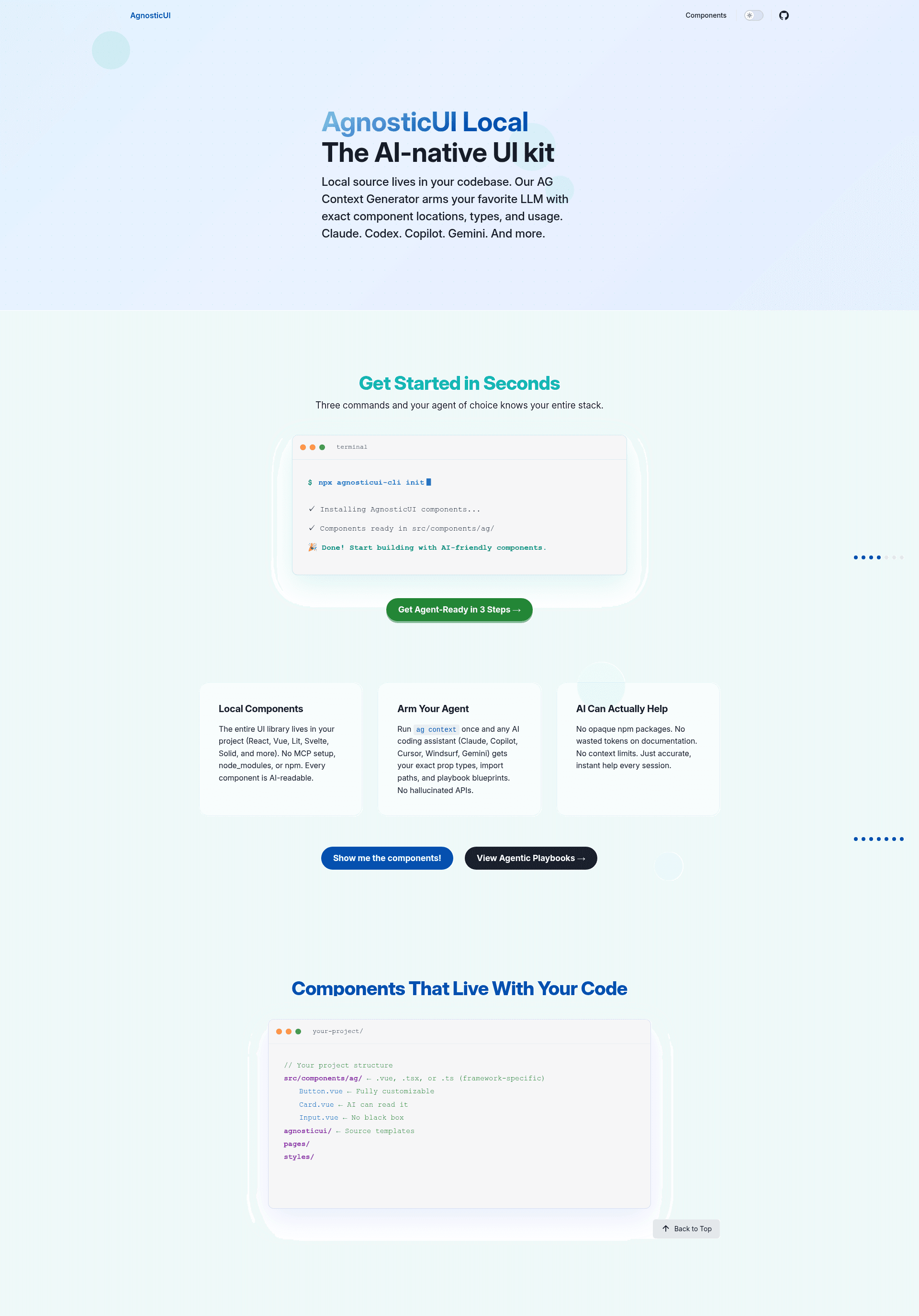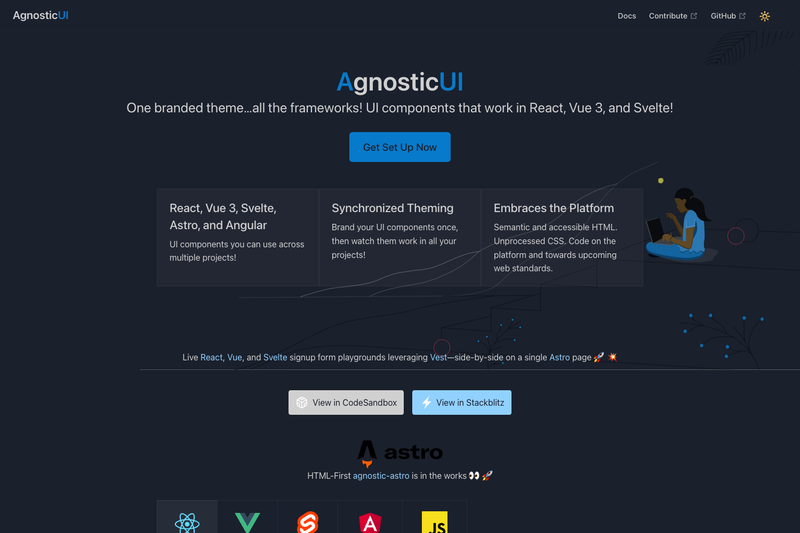
AstroAgnosticUIStarter is a publicly available GitHub experiment that combines the Astro starter with AgnosticUI to render React, Vue 3, and Svelte components on the same .astro page.
What is AstroAgnosticUIStarter?
AstroAgnosticUIStarter is a starter project that pairs the official Astro starter with AgnosticUI, a set of framework-agnostic UI primitives. Its purpose is to demonstrate how components written in React, Vue 3, and Svelte can be rendered together on a single .astro page. The project is hosted on GitHub with repository topics including react, svelte, and vue, and currently has 31 stars. It follows the standard Astro command workflow, making it easy to run and build.
Key Features
- Multi-framework rendering — The project shows React, Vue 3, and Svelte components coexisting on one .astro page, leveraging Astro's support for multiple UI frameworks.
- AgnosticUI integration — It uses AgnosticUI components, which are designed to work across frameworks, to provide consistent markup and behavior.
- Standard Astro commands — The starter includes
npm installfor dependencies,npm run devfor the development server,npm run buildfor a production build, andnpm run previewfor local preview. - Local development server — Running
npm run devstarts a server atlocalhost:3000. - Production build to ./dist —
npm run buildoutputs the final static site to the./distdirectory. - Documentation references — The readme links to Astro's GitHub documentation and the Astro Discord server for further learning.
Who is it for?
- Astro developers who want a minimal reference setup for using multiple UI frameworks in one project.
- UI library maintainers who need a working example of how AgnosticUI components can be embedded through React, Vue 3, or Svelte.
- Frontend engineers who are evaluating framework interoperability and want to see concrete code examples in a single starter.
What can you do with it?
- Try a multi-framework page — Run the starter and navigate to the rendered page to see React, Vue 3, and Svelte components working side by side.
- Use it as a blueprint — The project structure shows how to set up an Astro site that imports components from different frameworks, which you can extend in your own applications.
- Learn Astro's build flow — By running the standard commands, you can observe how a mixed-framework Astro project compiles and outputs a static site.
How does it work?
After cloning the repository, run npm install to install dependencies. Use npm run dev to launch the development server at localhost:3000, then open that URL in a browser to view the page. When the site is ready, npm run build generates the production output in ./dist, and npm run preview serves that build locally for final checks.
FAQ
Is AstroAgnosticUIStarter free to use?
The repository is publicly available on GitHub, so the source code can be viewed and used according to its license (if any). The readme does not explicitly state a license, so you should check the repository files before deploying it commercially.
What frameworks does it support?
The starter renders components from React, Vue 3, and Svelte in the same .astro page. It relies on AgnosticUI for the shared UI primitives.
How do I run the project locally?
Run npm install, then npm run dev. The development server will be available at localhost:3000.
Where do I go for help?
The readme points to Astro's documentation on GitHub and the Astro Discord server, where you can ask questions about Astro and the starter.