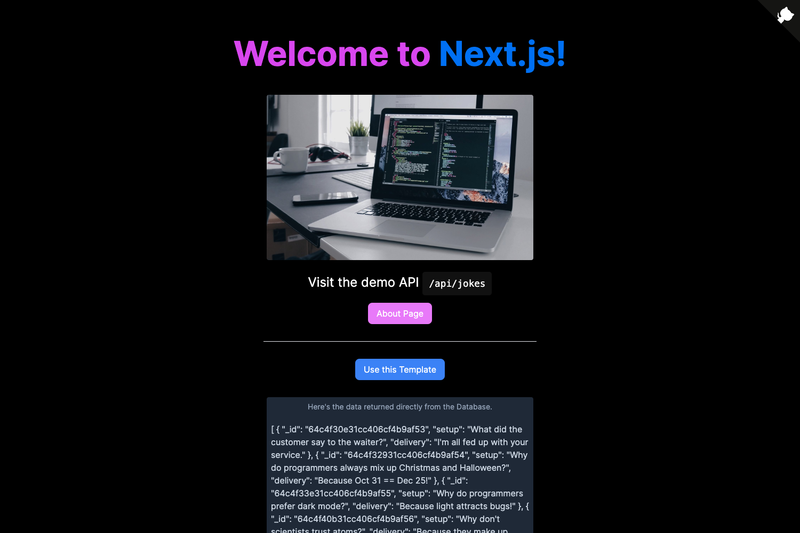
Fullstack Next Template is a TypeScript and React boilerplate that scaffolds a full-stack Next.js application with modular packages for frontend and backend code, pre-configured Tailwind CSS, SVGR, ESLint, and path aliases.
What is Fullstack Next Template?
Fullstack Next Template is a starter repository bootstrapped with create-next-app, designed to give developers a full-stack TypeScript project structure for Next.js using the App Directory. It takes a minimal Next.js app and layers on modular packages/ folders for base components, server code, and shared utilities, so both frontend and backend logic have a defined home from day one. The template runs on Node.js and is configured for deployment on the Vercel platform, as described in the README.
Key Features
- App Directory routing — Built on Next.js with the App Directory, using file-based routing and automatic page reloads when you edit
app/page.tsx. - Tailwind CSS pre-setup — Tailwind is configured with PostCSS Nesting and Import, so styling utilities work without extra setup.
- SVGR component import — Import SVG files directly as React components, with TypeScript definitions generated automatically.
- Path aliases — Use the
@/prefix for modules undersrcand#/for assets inpublic. - ESLint integration — Linting is configured to find and fix problems across the codebase.
- Pre-built base components — The
packages/components/basefolder includes components for dynamic lazy-loading, images, and SVG handling. - Backend scaffolding —
packages/server/provides pre-setup backend files plus utilities for common server-side tasks. - Font optimization —
next/fontis used to automatically optimize and load the Inter Google Font.
Who is it for?
- Full-stack TypeScript developers — Teams that want a single codebase with both React frontend and Node backend organized in separate packages.
- Developers building modular applications — The
packages/structure makes it easy to separate components, server code, and utilities into reusable modules. - Next.js beginners — A working starter with Tailwind and ESLint already configured removes the typical setup friction before building features.
What can you do with Fullstack Next Template?
- Start a new full-stack application — Clone the repo, run
npm run dev, and get a running Next.js server at localhost:3000 with hot reload. - Add custom API routes — Extend the included
/api/jokesendpoint inapp/api/jokes/route.tsto build your own serverless functions. - Import SVG assets as code — Use the SVGR setup to turn any SVG file into a typed React component without extra config.
- Deploy to Vercel — The README references one-command deployment to Vercel, the platform built for Next.js.
How does the template work?
Run npm run dev (or yarn dev / pnpm dev) to start the development server. Edit app/page.tsx and the page auto-updates. API routes are handled through Next.js Route Handlers, with an example at app/api/jokes/route.ts. The template also recommends installing Tailwind CSS IntelliSense and enabling CSS module auto-completion in VS Code.
FAQ
How do I start the development server?
Use npm run dev, yarn dev, or pnpm dev from the project root, then open http://localhost:3000 in your browser.
Does the template include TypeScript?
Yes, TypeScript is included and configured, and the SVGR setup generates type definitions for imported SVG components.
Where should I put my backend code?
Backend logic can live in the packages/server/ folder, which comes pre-setup with server files and utilities, or in API routes under app/api/.
How do I import SVG files?
Thanks to the pre-configured SVGR setup, you can import an SVG file directly as a React component with TypeScript support.