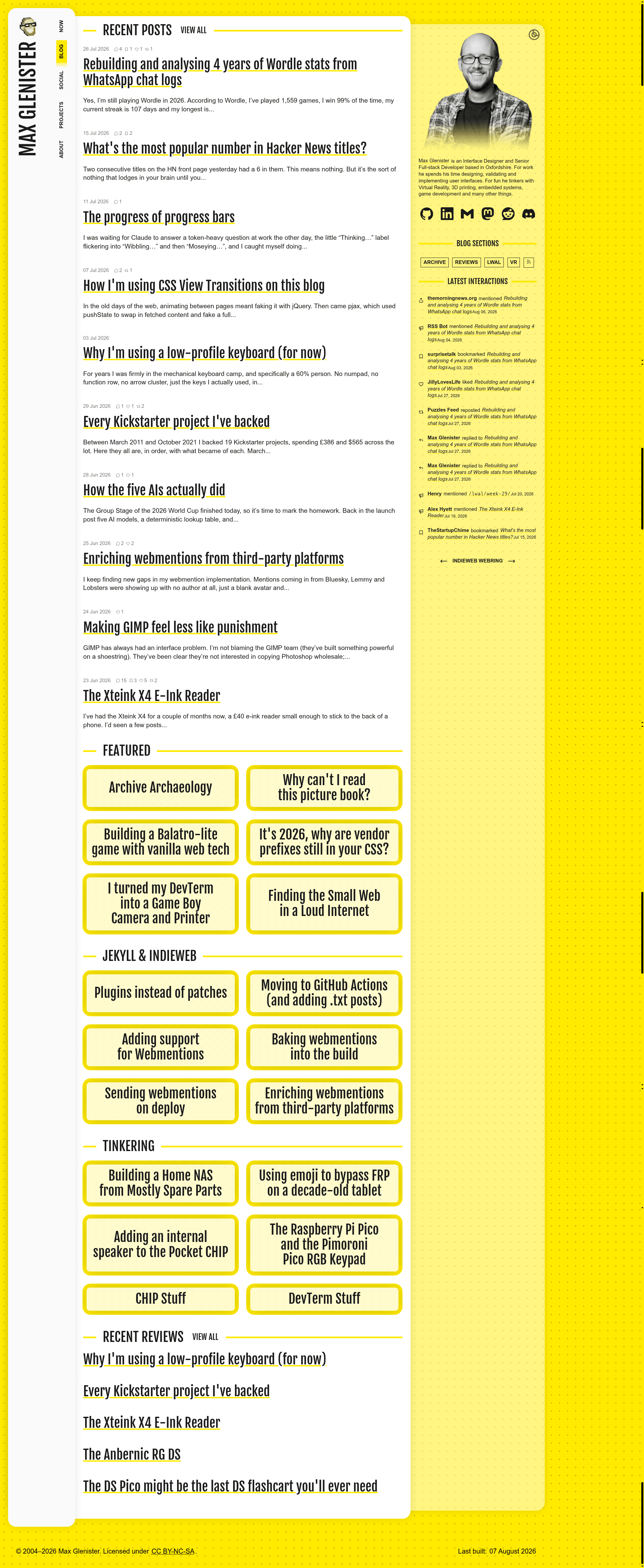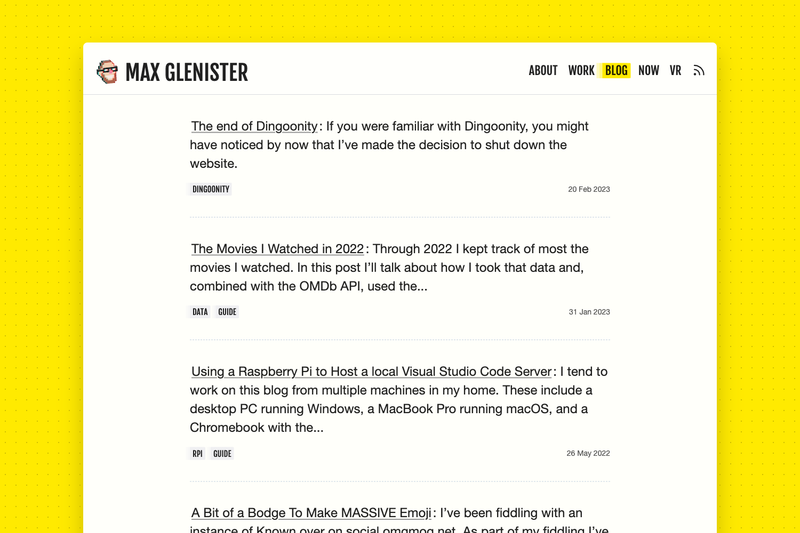
Blomg is a Jekyll-powered personal blog by interface designer and senior full-stack developer Max Glenister, built to publish writing on front-end development, hardware tinkering, and retro computing.
What is Blomg?
Blomg is the personal Jekyll-powered blog of Max Glenister, an interface designer and senior full-stack developer from Oxfordshire, UK. The site takes Markdown posts and compiles them into a static blog, hosted at blog.omgmog.net and open-sourced on GitHub under the repository omgmog.github.com, which currently has 42 stars. Because it runs on Jekyll, it requires no database and serves pages as static HTML, making it simple to host on GitHub Pages or any static host. The public source code lets anyone inspect the Jekyll configuration, including how Webmentions and GitHub Issues-based comments are implemented.
Key Features
- Jekyll-powered static generation — Posts are written in Markdown and compiled by Jekyll into static HTML, so the blog is fast and hosting-friendly.
- GitHub Issues comments — Posts can accept comments through GitHub Issues on the omgmog.github.com repository, giving commenters a GitHub-based workflow.
- Webmentions for external replies — The blog supports Webmentions, so replies from other IndieWeb sites can appear on posts, as described in the author's post "Adding support for Webmentions".
- IndieWeb participation — Repository topics include indieweb and webmentions, and the blog reflects the small web philosophy in posts like "Finding the Small Web in a Loud Internet".
- Sample content covering hardware and coding — Example posts include "Building a Home NAS from Mostly Spare Parts", "The Bigme B6 Color E-Ink Tablet", and "Building an emoji-only chat app", showing the range of technical writing.
- Author social links — The homepage links to the author's GitHub, Mastodon (indieweb.social/@omgmog), LinkedIn, and Reddit profiles.
Who is it for?
- Front-end developers — Readers interested in front-end development can follow for articles and project write-ups.
- Hardware tinkerers — People who enjoy retro computing and DIY builds will find posts about constructing a home NAS from spare parts and reviews of e-ink tablets.
- IndieWeb enthusiasts — Those building an IndieWeb-connected site can study how Blomg implements Webmentions and GitHub Issues comments, with the source on GitHub.
- Jekyll bloggers — Bloggers using or considering Jekyll can use the repository as a real-world example of configuration and content structure.
What can you do with Blomg?
- Read technical posts — Browse articles like "Building an emoji-only chat app" and "Why can't I read this picture book?" for insights on front-end and hardware topics.
- Explore IndieWeb integration — See how Webmentions are added to a Jekyll site by reading the author's post "Adding support for Webmentions" and checking the source code.
- Engage via comments — Leave feedback using GitHub Issues on the repository, or send a Webmention from an IndieWeb-compatible site.
- Follow the author — Connect with Max Glenister on Mastodon, LinkedIn, or Reddit using the links on the homepage.
How does Blomg work?
The blog is built with Jekyll: content is written in Markdown files, then Jekyll compiles them into a static site. Comments are handled externally: readers can create a GitHub Issue on the omgmog.github.com repository to comment on a post, and Webmentions bring in replies from other sites. The generated site is served at blog.omgmog.net.
FAQ
Is Blomg open source?
Yes, the site's source code is public in the GitHub repository omgmog.github.com, which includes the Jekyll configuration, posts, and comments setup. The repository currently has 42 stars.
How do comments work on Blomg?
Comments are managed through GitHub Issues. Each post can have an associated Issue on the omgmog.github.com repository, and Webmentions also display replies from other websites on the posts.
What topics does Blomg cover?
Blomg covers front-end development, hardware tinkering, retro computing, and other subjects the author gets curious about. Sample posts include a home NAS build, an e-ink tablet review, and an emoji-only chat app.
Who writes Blomg?
Blomg is written by Max Glenister, an interface designer and senior full-stack developer from Oxfordshire, UK. He connects on GitHub, Mastodon, LinkedIn, and Reddit.