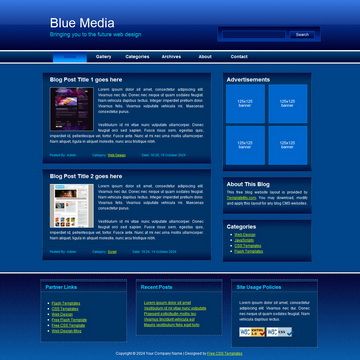
Blue Media is a free HTML CSS blog template published by TemplateMo that provides a W3C-validated, downloadable layout for personal blogs and content-focused mini-sites.
What is Blue Media?
Blue Media is a free blog template built with HTML and CSS, validated by the W3C, and offered for download as a ZIP archive from TemplateMo's website at templatemo.com/tm-064-blue-media. It was added to the catalog on 18 February 2009, and the listing shows 60,888 views and 14,354 downloads. The template's core function is to deliver a static website layout that users can edit and reuse on both commercial and non-commercial projects.
Key Features
- W3C-validated HTML CSS — The layout passes W3C validation checks, which helps ensure consistent rendering across browsers and provides a clean codebase for learning.
- Free for any use — TemplateMo states the template is 100% free to download and allows use for commercial or non-commercial websites without payment.
- Editable source files — The ZIP download contains HTML and CSS files that users are permitted to edit, so you can restyle colors, swap content, and adapt the structure.
- Blog-oriented layout — The official description identifies Blue Media as a blog template, making it suitable for posts, articles, and media-related content.
- Live preview and direct download — The template page includes a Live View link and a Download button, letting you inspect the design and retrieve the files in one step.
- Proven community track record — With more than 14,000 downloads and 60,000 views on the listing, the template has been used by a substantial number of site builders.
Who is Blue Media for?
Blue Media is aimed at bloggers, small-site owners, and web design learners who need a simple static HTML and CSS starting point. Bloggers can publish a personal blog without installing a content management system. Freelancers can use the free layout as a base for minimal client sites. Students and self-taught developers can study the validated code to learn standards-compliant markup.
What can you do with Blue Media?
- Personal bloggers: download the template, replace the sample content with your own posts, and upload the static files to any hosting service to launch a blog.
- Web design learners: inspect and modify the W3C-validated HTML and CSS files to practice coding techniques and see how a complete layout is assembled.
- Freelancers: reuse the free, editable layout for small commercial projects without paying license fees, per TemplateMo's stated usage terms.
How does Blue Media work?
Visit the Blue Media page on TemplateMo, click the Download button to get a ZIP archive, then extract the HTML and CSS files and open them in a text editor or HTML editor. After making edits, upload the files to a web server to publish the static site. No database or server-side processing is required.
Pricing
Blue Media is 100% free to download and use. TemplateMo does not require payment, registration, or attribution to use this template on commercial or non-commercial sites, though the page requests that you share the template with friends.
FAQ
Is Blue Media free to use commercially?
Yes. TemplateMo states the template is 100% free to download and that users are allowed to edit and use it for commercial or non-commercial websites. There is no stated payment requirement or attribution clause on the template page.
What files are included in the Blue Media download?
The Download button provides a ZIP archive containing the HTML and CSS files for the layout. Because the template is described as HTML CSS, you can expect static markup and stylesheets that you edit with a text editor and host as plain web files.
Does Blue Media require a CMS or backend?
No. Blue Media is a static HTML CSS template, so it does not need a content management system, database, or server-side processing. You can edit the HTML files directly and upload them to any web host.
How old is the Blue Media template?
The template was added to TemplateMo's catalog on 18 February 2009. That makes it an early-generation HTML CSS template, which is reflected in its simple static approach without modern JavaScript frameworks.