Newsletter
Join the Community
Subscribe to our newsletter for the latest news and updates

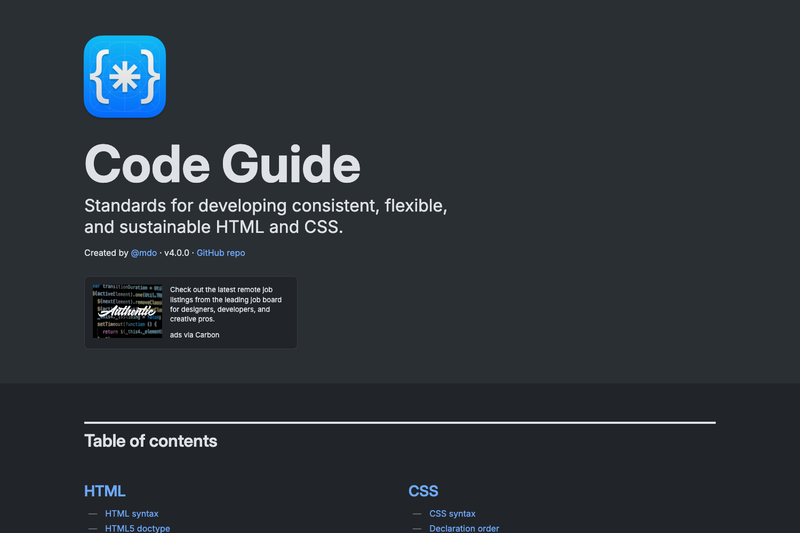
Standards for developing consistent, flexible, and sustainable HTML and CSS.
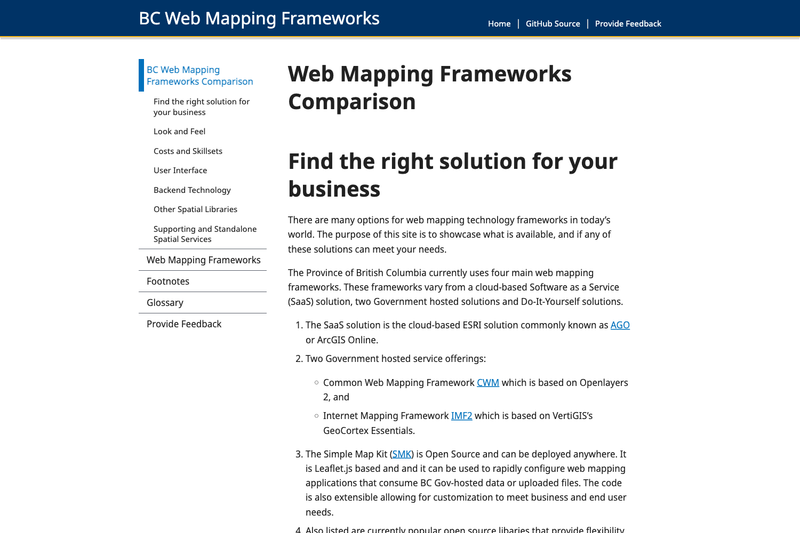
BC Web Mapping Technological Solutions And Experiences
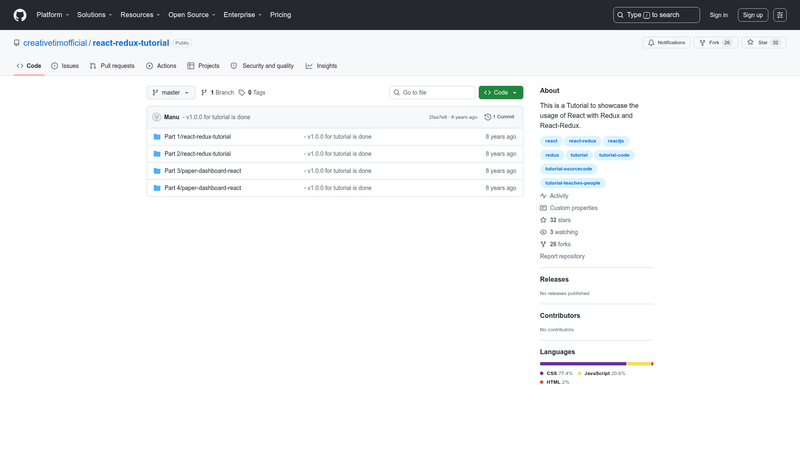
A tutorial repository showing how to use React with Redux and React-Redux through example code.

Material for MkDocs is a documentation framework on top of MkDocs that turns Markdown into a professional static site.

A free, production-ready Astro theme for documentation sites, help centers, and knowledge bases. Static, fast, and fully customizable.
Code Guide is a free, open-source documentation site, built on Jekyll and hosted on GitHub Pages, that defines a set of standards for writing consistent, flexible, and sustainable HTML and CSS.
Code Guide is a collection of front-end coding standards created by Mark Otto (@mdo), the designer and developer known for leading the Bootstrap project. It provides specific rules for writing HTML and CSS, covering syntax, formatting, and organization, all presented as a simple static website. The guide is released under the MIT license, so it can be freely used, modified, and redistributed. The canonical version is published at https://codeguide.co, and the source code lives in a GitHub repository that has accumulated more than 8,400 stars.
gem install jekyll, then start the server with jekyll serve and visit localhost:4000 in your browser.Code Guide is structured as a static Jekyll site. After cloning the repository, you install Jekyll with the gem install jekyll command, run jekyll serve to start a local server, and open localhost:4000 to read the guide in the browser. Because it is a Jekyll project, you can edit the content files in Markdown, re-render the site, and deploy it to GitHub Pages by pushing to the repository.
Yes, Code Guide is released under the MIT license, so it is free to use, modify, and distribute, including for commercial purposes. The source code and all content are available on GitHub, and there are no paid tiers or premium content.
The guide focuses on HTML and CSS standards—specifically syntax, formatting, and code organization. It offers practical rules such as omitting trailing slashes in self-closing elements, using lowercase tags and attributes, and grouping related CSS properties with comments. It does not cover JavaScript or other web technologies.
You need Jekyll, which you can install on macOS, Linux, or Windows by running gem install jekyll in a terminal. Once installed, run jekyll serve from the project directory and open localhost:4000 in your browser. The server will rebuild automatically as you edit content.
Yes, the repository lists community-maintained translations in at least 15 languages, including Chinese (Simplified and Traditional), Dutch, French, German, Hindi, Indonesian, Japanese, Korean, Persian, Polish, Portuguese, Romanian, Russian, and Spanish. Each translation is hosted separately and maintained by its own translators, so the content may lag behind the English version.