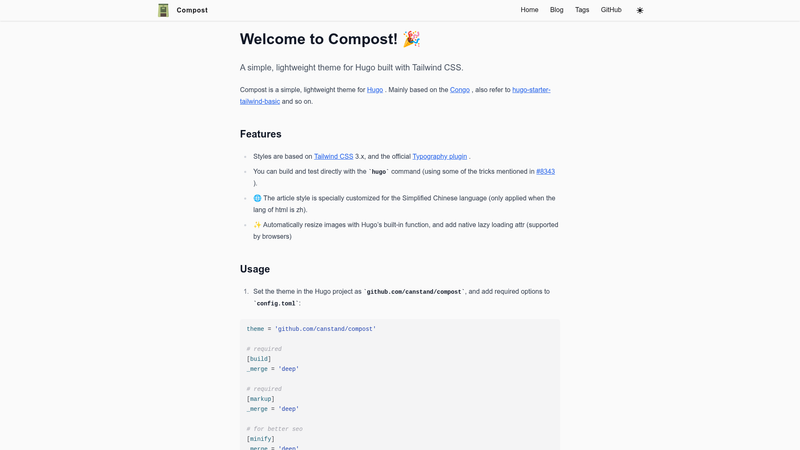
Compost is a free Hugo theme that pairs Tailwind CSS 3.x with Simplified Chinese article typography to generate lightweight static blogs.
What is Compost?
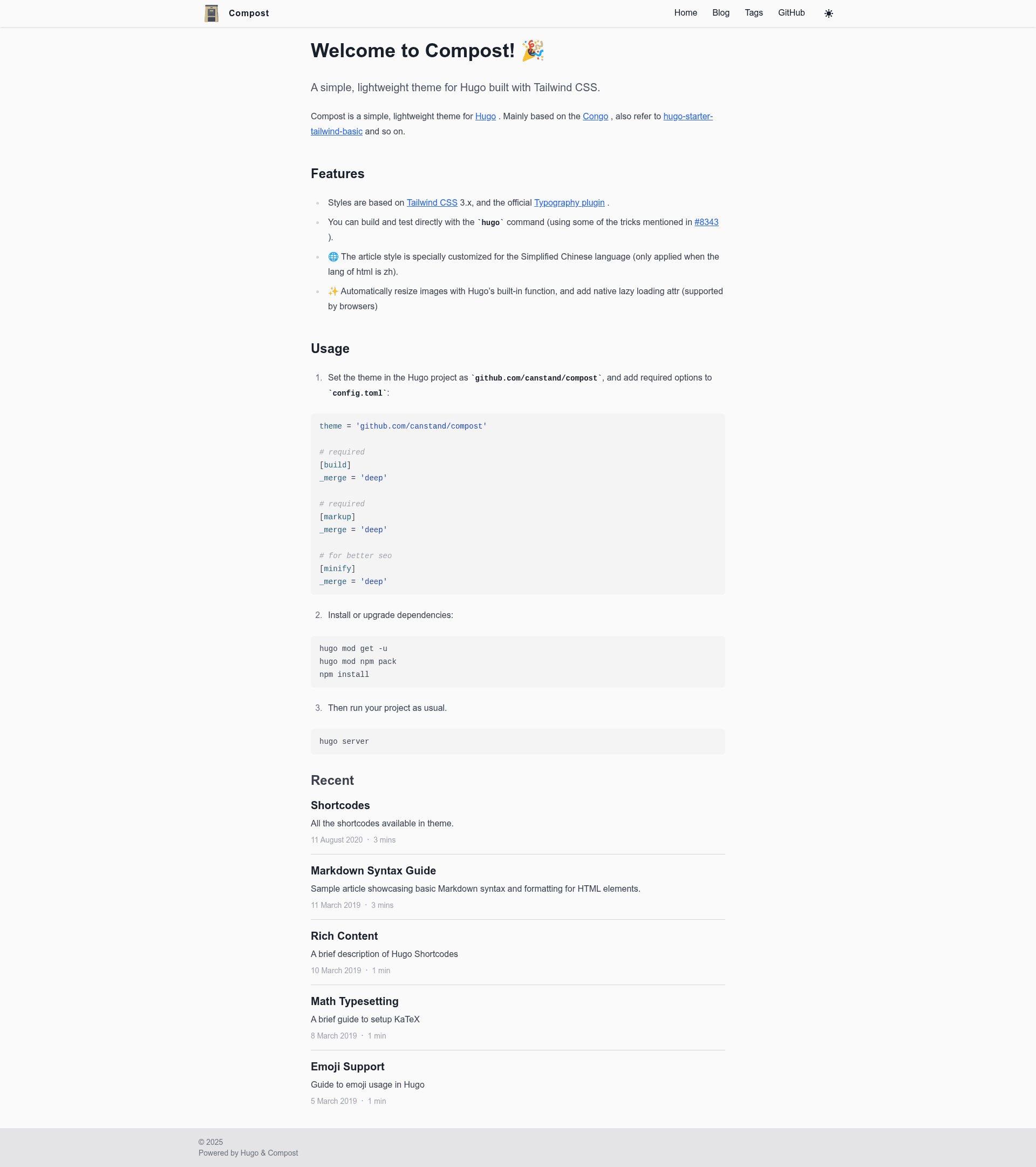
Compost is a simple, lightweight Hugo theme for building static websites, primarily blogs. It takes Hugo content written in Markdown and, using Hugo's built-in pipeline and Tailwind CSS, outputs a static site with automatically resized images and native lazy loading. The theme is developed by Canstand, listed on the Hugo theme index, and draws on the Congo theme plus techniques from hugo-starter-tailwind-basic.
Key Features
- Tailwind CSS 3.x — Styles are based on Tailwind CSS 3.x and the official tailwindcss-typography plugin, giving a utility-first, customizable CSS foundation.
- Simplified Chinese typography — Article styles are specially customized for the zh language and applied automatically when the HTML lang attribute is set to zh.
- Automatic image resizing — Uses Hugo's built-in image processing function to resize images, and adds native browser lazy loading attributes for better performance.
- Go module installation — The theme is installed via Hugo modules, not git submodules, with the exact TOML configuration documented in the README.
- Direct preview — You can build and test the site directly with the
hugocommand, using tricks referenced in Hugo issue #8343. - SEO minification — The README recommends merging a minify block into the site config "for better seo".
Who is it for?
Compost is aimed at Hugo users who want a fast, uncluttered blog theme without adopting a heavy UI framework. It suits developers and writers publishing in Simplified Chinese who need typography tuned for zh text, and static-site maintainers who prefer module-based Hugo setups over submodule-based themes.
What can you do with Compost?
- Chinese-language bloggers: publish Markdown articles with typography refined for Simplified Chinese and images resized automatically during the Hugo build.
- Hugo developers: install the theme as a Go module and run
hugo serverdirectly to preview the site, with dependencies resolved throughnpm install. - Performance-focused publishers: ship a lightweight static site with lazy-loaded images and the recommended minify configuration for cleaner HTML output.
How does Compost work?
Installation follows the Hugo module workflow: set the module import path to github.com/canstand/compost and add required build, markup, minify, and module mount entries to hugo.toml. After running hugo mod get -u, hugo mod npm pack, and npm install, you start the site with the usual hugo server command.
FAQ
Does Compost use git submodules?
No, Compost is installed as a Hugo module using Go modules. The README explicitly states it does not use git submodule, and links to Hugo's module documentation for prerequisites and initialization.
What CSS framework does Compost use?
Compost uses Tailwind CSS 3.x along with the official tailwindcss-typography plugin. The theme relies on Tailwind's utility classes for its layout and article styling.
Does Compost support Simplified Chinese?
Yes, the article style is specially customized for the Simplified Chinese language, and the custom styling is only applied when the HTML lang attribute is zh.
How do I install Compost?
Add the module import path to hugo.toml along with the required build, markup, minify, and module mount settings, then run hugo mod get -u, hugo mod npm pack, and npm install. Finally, start the site with hugo server.
Does Compost resize images automatically?
Yes, Compost uses Hugo's built-in image processing function to automatically resize images and adds native browser lazy loading attributes to reduce initial page load.