Newsletter
Join the Community
Subscribe to our newsletter for the latest news and updates

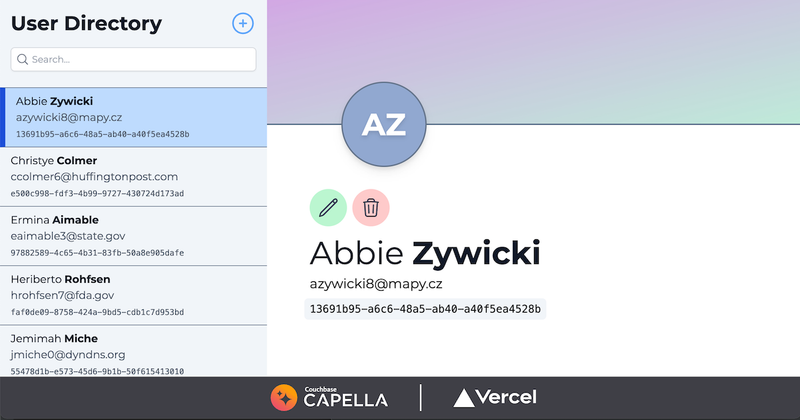
Next.js application that enables you to create, read, update, and delete user profiles stored in a Couchbase Capella database.
Run a Model Context Protocol server on Vercel using Next.js, the Vercel mcp-handler, and Descope's Node SDK for bearer-token session validation.
Community-maintained Turborepo example that scaffolds a React component library, a Storybook docs site, and Changesets-driven npm publishing in one monorepo.
Vercel example wiring OpenFeature providers into the Flags SDK, with two 50/50 banner flags and Flags Explorer overrides.
Vercel example showing feature flags in Next.js with the Flags SDK's Hypertune adapter and Flags Explorer overrides.
Couchbase Capella Starter with Next.js is an open-source quickstart from the Couchbase examples organization that demonstrates a working create-read-update-delete (CRUD) application for user profiles, with a Next.js front end and a Couchbase Capella or Couchbase 7+ database as the data store.
It is a deployable sample application, not a theme: it ships a Next.js UI plus the backend code needed to read and write user profile documents in Couchbase. You supply database credentials through environment variables (CB_USERNAME, CB_PASSWORD, CB_CONNECT_STRING, CB_BUCKET), and the app returns a running profile manager where you can create, update, and delete records. It runs locally on Node.js 24 LTS at localhost:3000, or on Vercel via a one-click clone-and-deploy link that opens the Couchbase Capella integration flow to pick database resources. The code is maintained by Couchbase under the couchbase-examples GitHub organization.
CB_CONNECT_STRING at couchbase://localhost for a local or Docker database.MOCK_DATA.json file holds 15 mocked user documents; npm run load-sample-data inserts them, and the build step also attempts to create the collection and load data.npm run init-db:local, npm run build-indexes, and npm run init-db:default create the bucket, collection, and required indices.npm test after database setup..env.default file keeps testing and GitPod instances working, and build scripts have :no-env variants for Vercel-style system environment injection.npm run init-db:local plus npm run load-sample-data.npm run build-indexes to see which indices a query needs on Capella.On Vercel you click the Deploy link, follow the integration prompts to select Capella resources, then explore the deployed app. Locally you clone the repo, run npm install, copy .env.local.example to .env.local and fill in the credentials, create the bucket and collection, run the setup scripts, and start with npm run dev.
It expects a bucket named user_profile and, inside the _default scope, a collection named profile. On Capella you create both manually before running npm run build-indexes, because the initialization script only provisions these automatically for local databases.
That error means no data is being returned from the database. Check that CB_BUCKET names the right bucket, that the scope is _default, and that a collection named profile exists.
It usually means the app cannot reach the database. Verify the environment variables, allow the client IP addresses, confirm the database user credentials match, and check whether the database was deleted.
Yes. The Vercel deployment steps are Vercel-specific, so other platforms should adapt the local run instructions instead, using the package.json build scripts that are not postfixed with :no-env.
Running locally needs Node.js 24 LTS with npm, a Couchbase Capella database or a local Couchbase 7+ instance, and a code editor.
The starter code is free and open source, and the Vercel integration flow lets you sign up for a free Couchbase Capella database if you do not already have one.
Supabase offers a Next.js quickstart template that pairs the same framework with a Postgres backend instead.