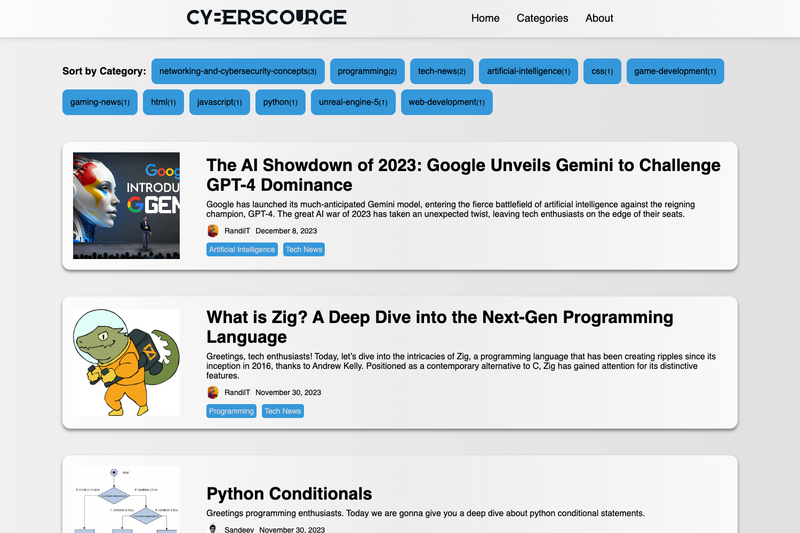
CyberScourge Hub Blog is a Hugo-based static-site blog template for publishing tech articles on networking, cybersecurity, web development, coding tips, and game development.
What is CyberScourge Hub Blog?
CyberScourge Hub Blog is an open-source blog project built with Hugo, the Go-based static site generator. It converts Markdown files into static HTML pages, and it includes a live demo at https://rtharusha.tech/. The repository is maintained by randilt and released under the MIT License.
Key Features
- Hugo static site generator — The blog compiles Markdown content into fast, database-free static HTML pages using Hugo's build system.
- Markdown-based publishing — New posts are created with the command
hugo new content your-new-post.mdand written in plain Markdown files inside the content directory. - Giscus topic — The repository lists giscus among its GitHub topics, which points to a GitHub Discussions-backed comment system for reader engagement.
- Local development server — Running
hugo server -Dstarts a local preview at http://localhost:1313/ for testing changes before deployment. - Customizable theme — The README instructs users to modify styles, layouts, and other theme files to match their own visual identity.
- MIT License — The entire project is freely usable, modifiable, and redistributable under the MIT license.
Who is CyberScourge Hub Blog for?
- Tech bloggers — Publish articles on networking, cybersecurity, and web development without managing a database or server-side framework.
- Cybersecurity writers — Use a straightforward Markdown workflow to share tutorials and threat analyses.
- Hugo beginners — Learn how a minimal static site generator blog is structured, from content folders to theme customization.
What can you do with CyberScourge Hub Blog?
- Create a new post — Run
hugo new content your-new-post.md, then fill in the Markdown file with your article and generate the site with Hugo. - Preview changes locally — Start the built-in server and view the blog at localhost:1313 while editing.
- Customize the blog design — Edit the theme's layouts and CSS to change colors, typography, and page structure.
- Use it as a learning reference — Study how a Hugo project organizes content, templates, and static assets to build your own static sites.
How does CyberScourge Hub Blog work?
The README gives a three-step start: clone the repository, run hugo server -D, and open the local preview. To add content, you run hugo new content your-new-post.md, edit the generated Markdown file, and Hugo renders it into the site's HTML output.
FAQ
Is CyberScourge Hub Blog free to use?
Yes, the repository is licensed under the MIT License, meaning you can use, copy, modify, and distribute it freely for personal or commercial projects.
What technology does it use?
It uses Hugo as the static site generator and Markdown as the content format. The repository's topics also include giscus, indicating support for GitHub Discussions-powered comments.
How do I create a new blog post?
Run hugo new content your-new-post.md from your terminal, then open the new Markdown file in the content directory and write your article using Markdown syntax.
Can I customize the theme?
Yes, the README explicitly says you can modify the theme's styles, layouts, and other components. The files are in the Hugo project's theme and layout directories.
Where can I see a live example?
The repository links to a running demo at https://rtharusha.tech/, which showcases the blog's default look and structure.