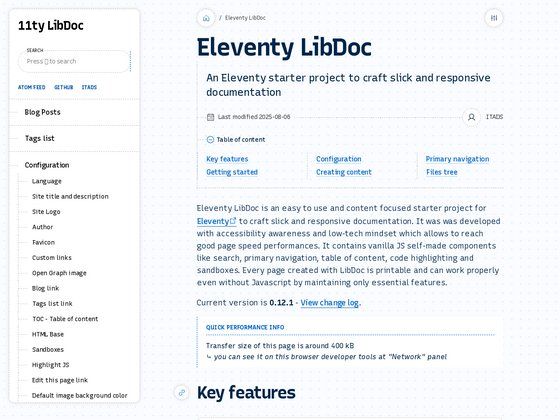
Eleventy LibDoc is an open-source Eleventy starter template for building responsive, content-focused documentation websites with accessible, low-dependency, vanilla-JS components.
What is Eleventy LibDoc?
Eleventy LibDoc is a starter project for the Eleventy static site generator (11ty) that turns Markdown content and a configuration file into a static HTML documentation site. It includes self-made vanilla JavaScript components for search, navigation, table of contents, code highlighting, sandboxes, and an Atom feed for blog content. The project is hosted on GitHub under the ita-design-system organization and is actively developed; it has not yet reached v1.0.0, so full backward compatibility is not guaranteed between releases.
What makes Eleventy LibDoc stand out?
- Eleventy-based — Built directly on Eleventy, using the standard
.eleventy.jsconfiguration andnpmscripts for building and serving. - Search with two modes — Fuzzy and standard search are both built in; a keyboard shortcut focuses the search field, and fuzzy search enables keyboard-based navigation.
- Accessibility and no-JS fallback — The interface was developed with accessibility awareness, and essential features remain usable when JavaScript is disabled.
- Smart table of contents — A floating TOC shows the current scroll position in addition to a static TOC.
- Image transcoding — Source images are automatically resized and transcoded to production-ready web formats during the build.
- Light and dark modes — Ready-made color schemes for both light and dark preferences.
- Sandboxes — Embed small demos or full HTML pages in a responsive dual-pane view.
- Atom feed — A built-in Atom feed lets visitors subscribe to post blog content.
Who is Eleventy LibDoc for?
- Technical writers — Can spin up a searchable documentation site from Markdown without touching build tooling.
- Open-source maintainers — Get a fast, accessible, printable documentation site for their project with minimal maintenance.
- Front-end developers — Can customize the vanilla JS components and styles to match a brand or add new features.
- Teams that need print-friendly docs — Every page is designed to be printed cleanly.
Use cases
- Product teams — Publish API references, user guides, and onboarding documentation with a consistent layout and built-in search.
- Developers — Embed live code sandboxes so readers can interact with examples directly in the documentation.
- Bloggers — Combine blog posts with documentation, using the Atom feed to syndicate new content to subscribers.
How does Eleventy LibDoc work?
The getting-started workflow is straightforward: clone or fork the repository from GitHub, run npm install, edit settings.json to enter your own configuration, then build with npx @11ty/eleventy --serve for local development or npx @11ty/eleventy for a production build. The starter includes _data, _includes, and core folders that you can customize.
FAQ
Is Eleventy LibDoc free?
Yes, Eleventy LibDoc is an open-source starter template on GitHub, so you can clone, modify, and deploy it at no cost to any static hosting service.
Does Eleventy LibDoc work without JavaScript?
Yes, it includes a fallback that keeps essential features accessible when JavaScript is disabled, though some enhancements like fuzzy search and the floating TOC require JS.
What version is Eleventy LibDoc?
The project is under active development and has not yet reached v1.0.0. Until then, full backward compatibility is not guaranteed and features are subject to change; the current version is visible at the bottom of each page.
What kind of content can I create with Eleventy LibDoc?
It is content-focused and supports standard Eleventy content such as Markdown pages and blog posts. You can add custom front matter settings for each page, and the documentation covers configuration, SEO, primary navigation, and more.
Does Eleventy LibDoc require a CSS framework?
No, it uses low front-end dependencies and vanilla JavaScript components; there is no mention of a specific CSS framework in the starter, keeping the footprint small.