
Template details
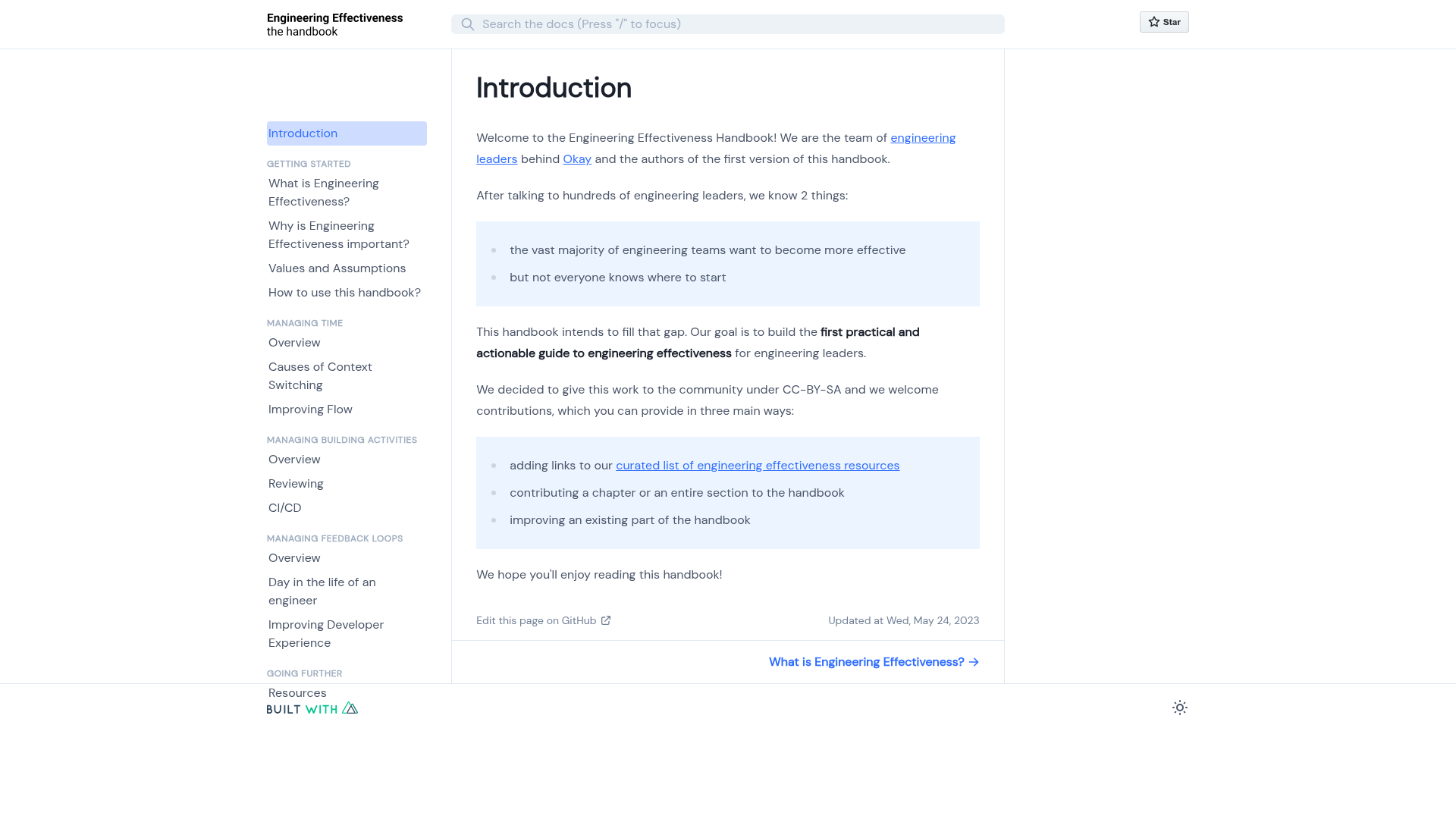
Engineering Effectiveness Handbook
Open-source handbook and Nuxt documentation site for engineering effectiveness, with Markdown content and static generation.
About this template
Engineering Effectiveness Handbook is an open-source documentation site template built with Nuxt and Nuxt Content, designed to publish a practical, community-maintained guide to engineering effectiveness as a static website. It was created by the engineering leaders behind Okay and released under CC-BY-SA.
What is the Engineering Effectiveness Handbook?
The Engineering Effectiveness Handbook is a documentation starter that renders a collection of Markdown files into a navigable static site. It takes Markdown content stored under the content/en folder and produces a static site using Nuxt's content module. The handbook itself addresses how engineering teams can become more effective, based on conversations with hundreds of engineering leaders. The project's repository includes the full source code, along with setup instructions for local development and static generation.
Key Features
- Built with Nuxt Content — Uses the Nuxt framework with the
@nuxt/contentmodule and theme-docs, enabling Markdown-based documentation with a built-in navigation and search experience. - Markdown-first content — All chapters and resources live as Markdown files under the
content/endirectory, making contributions straightforward via pull requests. - Static site generation — Running
yarn generateoutputs adist/folder ready for publishing to any static host. - Curated resource list — Includes a
resources.mdfile that aggregates links to external engineering effectiveness resources. - Open license — Published under CC-BY-SA, allowing reuse and remixing with attribution.
- Local development workflow — Install with
yarn install, start a dev server withyarn dev, and preview the generated site withyarn start.
Who is it for?
- Engineering leaders — They can use the handbook as a starting point for building a culture of effectiveness in their own teams, or fork it to create an internal version.
- Engineering teams — Teams looking to improve their workflows can read the practical guidance and share it with new members.
- Community contributors — Anyone can contribute by adding links to the curated list, writing a new chapter, or improving existing sections.
What can you do with it?
- Publish a documentation site — Clone the repo, write Markdown, and generate a static site in minutes.
- Create an internal effectiveness handbook — Fork the project and adapt the content to your organization's practices.
- Contribute back — Improve the official handbook by submitting revised chapters or new resources.
How does the handbook work?
The project follows a straightforward workflow: clone the repository, run yarn install, and start the dev server with yarn dev. Content is edited in Markdown files; the Nuxt Content module parses them and renders them as pages. For production, yarn generate builds a static dist/ directory.
FAQ
Is the Engineering Effectiveness Handbook free?
Yes. The source repository is public and the content is released under CC-BY-SA, so it is free to read, use, and distribute with attribution.
What technology does it use?
It is built with Nuxt and the Nuxt Content module. The repository also uses Yarn for dependency management.
Can I use it as a template for my own docs?
Yes. The repository is structured as a theme-docs Nuxt application, so you can fork it and replace the Markdown content with your own documentation.