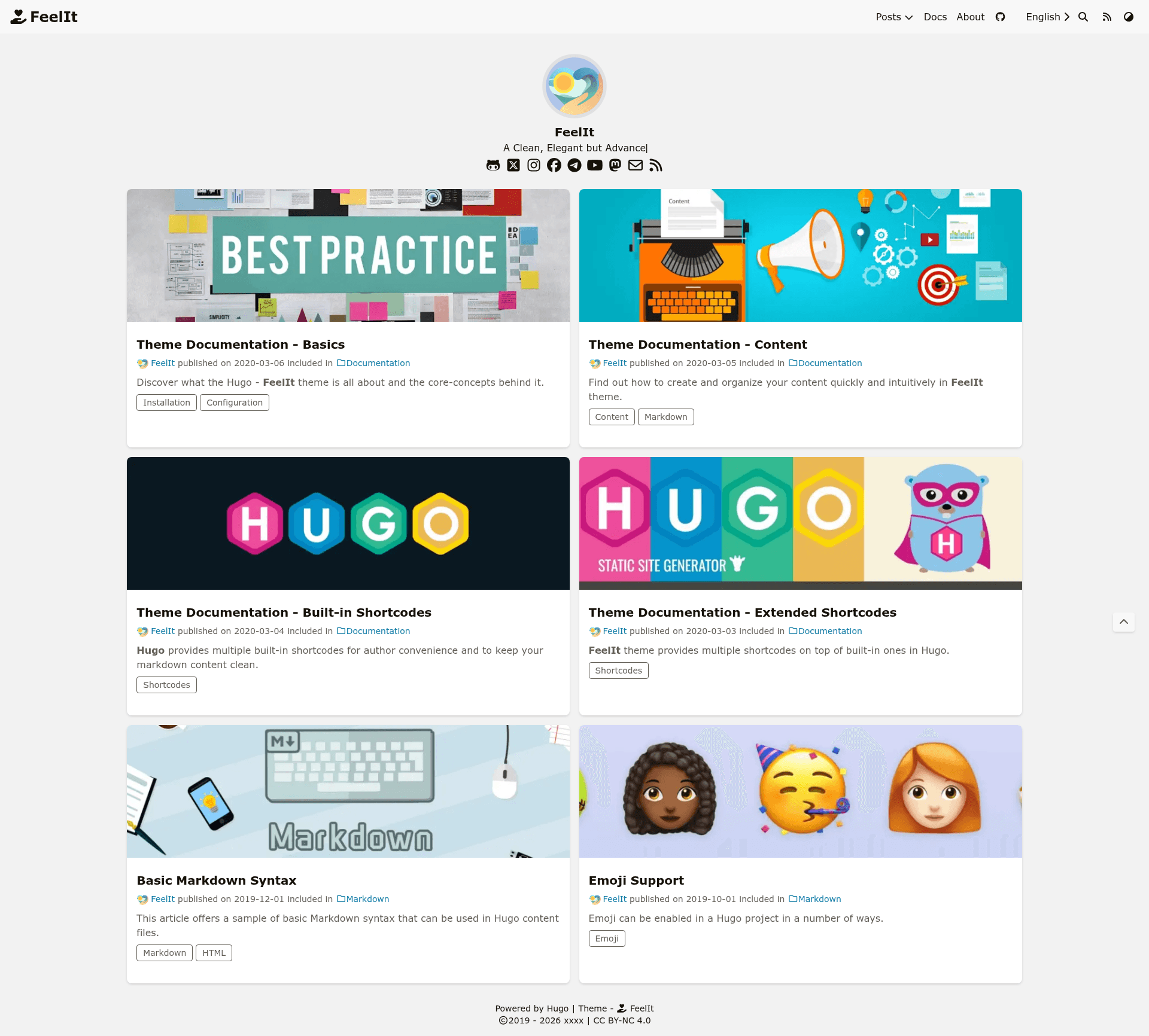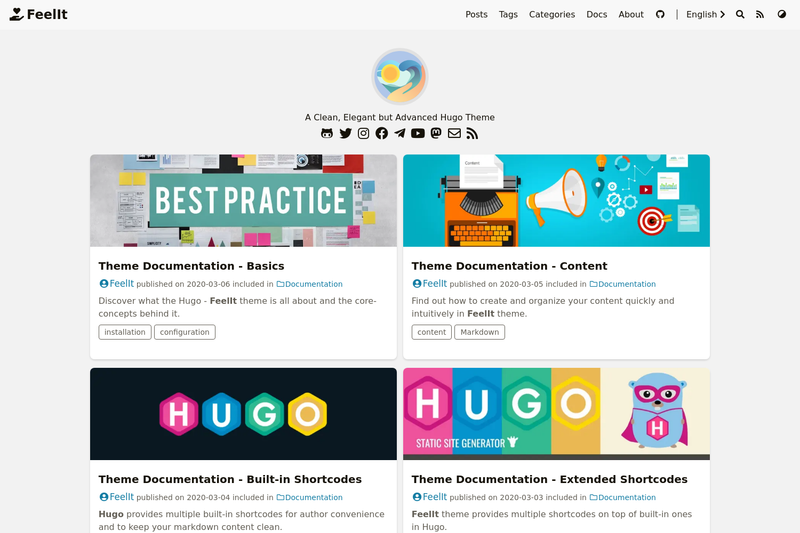
FeelIt is a clean, elegant but advanced blog theme for Hugo that adds custom styling, extended shortcodes, and a wider range of social/comment integrations than its parent themes. Built by Khusika as a fork of LoveIt, LeaveIt, and KeepIt, it turns Hugo Markdown content into a responsive static blog with dark mode, client-side search, and built-in support for math, diagrams, maps, music, and video. The theme targets Hugo 0.160.0 or later and is distributed under the MIT license.
What is FeelIt Theme?
FeelIt is a Hugo theme — a set of templates and assets you drop into a Hugo site to generate its front-end. It takes Markdown content, Hugo configuration, and front matter as input, and outputs a static HTML blog with pagination, taxonomies, multilingual support, and a full-page layout. The theme is maintained by Khusika and contributors on GitHub, with a live demo at feelit.khusika.id.
Key Features
- Performance and SEO — Scores 100/100 on desktop and 99/100 on mobile in Google PageSpeed Insights, uses a JSON-LD SEO schema, and supports Google Analytics, Fathom Analytics, and GoatCounter Analytics.
- Appearance and layout — Responsive design, automatic light/dark mode, pagination, a self-expanding table of contents, and CSS animations. The theme is i18n-ready with 17 built-in languages, from English and Chinese to Indonesian and Romanian.
- Social and comment systems — Integrates Gravatar or local avatars, up to 64 social links, 28 share sites, and seven comment engines: Disqus, Gitalk, Valine, Facebook Comments, Telegram Comments, Commento, and Utterances.
- Search and extended content — Search is powered by Lunr.js or Algolia; Twemoji, code highlighting with one-click copy, and lightgallery.js image galleries are included out of the box.
- Math and diagrams — KaTeX renders mathematical formulas, mermaid renders flowcharts and diagrams, ECharts renders interactive data visualizations, and Mapbox GL JS renders maps.
- Media shortcodes — APlayer with MetingJS embeds music players, a dedicated shortcode embeds Bilibili videos, and TypeIt adds animated typing effects.
- Markdown extensions — Extended syntax supports Font Awesome icons, ruby annotation, and fractions, plus admonitions and custom style/script shortcodes.
- Multilingual and CDN — All third-party libraries can be served from a CDN, and the theme includes a cookie consent banner via cookieconsent.
Who is it for?
- Tech bloggers and developers who want to publish posts containing equations, code, diagrams, and charts without copying HTML by hand.
- Multilingual content creators who need one theme that ships translations for 17 languages and lets them contribute more via pull requests.
- Self-hosted writers who want a free, MIT-licensed Hugo theme with built-in support for Disqus, Utterances, or Gitalk comments and Google, Fathom, or GoatCounter analytics.
What can you do with FeelIt Theme?
- Tutorial writers: add KaTeX equations and mermaid flowcharts directly in Markdown to explain math or architecture concepts.
- Music and video hobbyists: embed a Bilibili player or an APlayer/MetingJS music player inside a post to complement written content.
- International bloggers: switch the entire UI between 17 languages and show localized sidebar, TOC, and post metadata without extra plugins.
- Owners of personal sites: enable dark mode, lazy-loaded images, and a lightgallery.js image gallery to make photo posts faster and more pleasant to browse.
How does FeelIt Theme work?
Install the theme into a Hugo project and run npm commands from the repository to get a local environment: npm run reinstall installs dependencies, npm run start-production starts a production build for debugging, and npm run build compiles the theme documentation. After configuration, Hugo generates the static site from your Markdown content.
FAQ
Is FeelIt Theme free?
Yes, FeelIt is licensed under the MIT license, so it is free to use, modify, and redistribute. The license file is available in the GitHub repository.
What are the differences between FeelIt, LoveIt, LeaveIt, and KeepIt?
FeelIt is based on those three themes and adds a custom header, custom CSS style, a new home page compatible with recent Hugo versions, more readable dark mode, extra social/share/comment integrations, and more shortcodes such as ECharts, Mapbox, and Bilibili.
Does FeelIt support multiple languages?
Yes, it ships with German, English, Spanish, French, Indonesian, Italian, Polish, Brazilian Portuguese, Romanian, Russian, Serbian, Vietnamese, Simplified Chinese, Hungarian, Czech, Persian, and Ukrainian. New languages can be contributed via pull requests.
Which analytics services does FeelIt support?
Google Analytics, Fathom Analytics, and GoatCounter Analytics are supported, along with search engine verification for Google, Bing, Yandex, and Baidu.