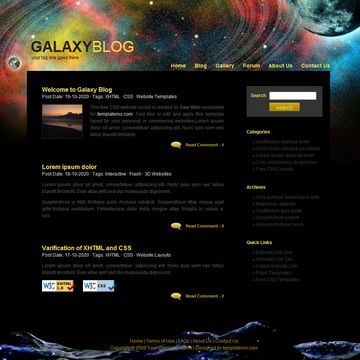
Galaxy is a free one-page HTML CSS template from TemplateMo, published on 24 August 2008, that provides a simple two-column layout in a black and yellow color scheme for any website. This static template runs entirely in the browser with no build tools or backend dependencies, making it a straightforward starting point for quick web projects.
What is the Galaxy Template?
Galaxy is a free HTML CSS website template provided by TemplateMo, designed as a one-page layout with two columns and a distinct black-and-yellow palette. It takes plain text and images from a designer and renders them into a static web page that can be hosted on any server without a CMS or build step. The template is built with only hand-written HTML and CSS, so editing requires nothing more than a text editor.
Key Features
- Free commercial use — Galaxy is 100% free for anyone to download, edit, and use on commercial or non-commercial websites without any licensing fee.
- One-page layout — The design compacts all content into a single scrollable page, eliminating the need for separate internal pages.
- Two-column structure — Content is organized into two side-by-side columns, suitable for pairing text with images, navigation, or secondary information.
- Black and yellow color scheme — The template uses a high-contrast black background with yellow accents, giving it a distinctive visual identity.
- No build step — Because it is plain HTML and CSS, the template loads directly in a browser and requires no Node.js, bundler, or server-side processing.
- Long-standing usage — Added in August 2008, Galaxy has received 92,202 views and 17,219 downloads on TemplateMo, indicating continued interest.
Who is it for?
Galaxy is aimed at individuals and small teams who need a functional web page quickly without learning modern frameworks. A student or beginner can download the ZIP, open the HTML file, and replace placeholder content to create a personal homepage. A small business owner can use the two-column layout to present services and contact information on a single page. Web design learners can study the source to understand how a basic two-column page is structured in plain CSS.
What can you do with it?
- Personal profile: Create a one-page portfolio or bio page with the yellow-on-black style, adding your own text, links, and images.
- Small business landing page: Publish a simple promotional page that highlights your products or services and provides contact details.
- Learning project: Reverse-engineer the HTML and CSS to learn how to build a two-column layout, then customize the colors, fonts, and column widths as a hands-on exercise.
How does the Galaxy Template work?
You download the ZIP file from TemplateMo and unzip it to your computer. The archive contains HTML and CSS files that you can edit in any text editor. After updating the content, you upload the files to a static web host, and the page appears in the browser immediately with no installation or configuration.
Pricing
Galaxy is free to download and use. TemplateMo offers no paid upgrades or premium tiers for this template.
Alternatives
- Tooplate, which also provides free HTML templates but as a separate template directory.
FAQ
Is the Galaxy Template free?
Yes, the Galaxy Template is 100% free. You can download, edit, and use it for both commercial and non-commercial websites without paying anything.
What does the Galaxy Template include?
The download is a ZIP archive containing HTML and CSS files that form a one-page, two-column layout with a black and yellow design. It does not include JavaScript libraries, images, or a content management system.
Can I use Galaxy for a commercial project?
Yes. TemplateMo grants permission to use Galaxy on commercial websites. You are also allowed to modify the template to suit your needs.
When was the Galaxy Template released?
Galaxy was added to TemplateMo on 24 August 2008. Over its lifetime, it has accumulated more than 92,000 views and over 17,000 downloads.
Does Galaxy require a web framework?
No. Galaxy is built with plain HTML and CSS only, so it has no dependency on frameworks like Bootstrap, React, or a CMS. Any text editor is enough to make changes.