Gridsome Airtable Starter is a boilerplate for building a static site with the Gridsome framework that uses Airtable bases as a content source. The template pairs a Vue.js-powered static site generator with a flexible cloud database, letting developers query Airtable data through GraphQL and automatically generate pages based on base records. Created by GitHub user 12vanblart, this starter is a minimal, configurable starting point published as an open-source repository.
What is the Gridsome Airtable Starter?
The Gridsome Airtable Starter is a pre-configured project that demonstrates how to connect an Airtable base to a Gridsome site. It takes an Airtable API key, a base ID, and a table configuration as input, and produces a static website with dynamic pages for each Airtable record. The starter runs on Gridsome, a Vue.js static site generator, and relies on the @gridsome/source-airtable plugin to fetch data. It includes sample templates and queries that show how to list events and display individual event details.
Key Features
- Gridsome + Airtable integration — Uses the @gridsome/source-airtable plugin to pull tables from any Airtable base into the Gridsome GraphQL data layer.
- Configurable table mapping — In gridsome.config.js, developers define tables with a name, typeName, optional select, and links, allowing multiple tables to be connected.
- GraphQL query layer — Data is exposed through Gridsome's GraphQL API; the starter includes queries in pages/Events.vue that fetch all events sorted by startDate, and templates/Event.vue that pulls a single record by id.
- Content-based routing — A Vue file named after the Airtable type (for example, Event.vue) in the templates folder generates a route per record, such as /events/:id.
- Environment variable handling — API key and base ID are read from a .env file through process.env.AIRTABLE_KEY and process.env.AIRTABLE_BASE, keeping credentials out of source control.
- Netlify deployment ready — The repository includes a Netlify deployment button and instructions to configure the same environment variables under Build & Deploy settings.
- Moment.js date formatting — Sample event templates use Moment.js to handle start and end dates; the dependency can be removed if custom formatting is not needed.
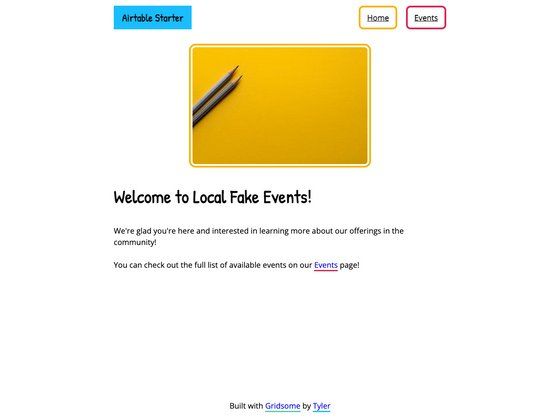
- Minimalist design — The starter ships with a simple layout focused on events, with components such as EventCard and page templates.
Who is it for?
- Developers building static sites — Anyone familiar with Gridsome and Vue.js can use this starter to skip the initial setup and immediately connect an Airtable base as the CMS.
- Content teams using Airtable — Teams that already maintain content in Airtable can publish it as a fast static website without building a custom backend.
- Developers learning GraphQL in Gridsome — The starter provides a clear, minimal example of querying Airtable data through GraphQL and generating pages, so it works as a learning reference.
What can you do with the Gridsome Airtable Starter?
- Event listing site — Use the provided Events table with columns for name, header image, start date, end date, excerpt, notes, and attachments to generate a list page and individual event pages sorted by date.
- Multiple content types — Add more tables (such as Parties) by uncommenting the example entry in gridsome.config.js and creating a matching template file, allowing the same site to publish different record types.
- Rapid prototyping — Spin up a Netlify deployment with the one-click Deploy to Netlify button, pre-configured for Airtable environment variables.
How does the Gridsome Airtable Starter work?
The workflow starts by installing the Gridsome CLI globally with npm. After creating a project from this starter, you create a .env file containing AIRTABLE_KEY and AIRTABLE_BASE, then configure your tables in gridsome.config.js. Running gridsome develop starts a local server at localhost:8080, where Gridsome pulls Airtable data via the source plugin, makes it queryable in GraphQL, and builds static pages at the defined routes. For production, the deploy to Netlify process rebuilds the site using the same environment variables.
FAQ
Is the Gridsome Airtable Starter free?
The starter is an open-source GitHub repository, so it is free to use and modify. You still need a Gridsome project and an Airtable account, and Airtable's free tier may apply depending on your data usage.
What do I need to get started?
You need Node.js and npm for the Gridsome CLI, an Airtable base with a table that includes the fields referenced in the event template, and a generated API key plus the base ID from Airtable. The README explains where to find these values.
Can I use multiple Airtable tables?
Yes, the starter's configuration supports multiple tables by adding entries to the tables array in gridsome.config.js. Each table needs a unique typeName and a corresponding Vue file in the templates folder.
Does the template use Tailwind or any CSS framework?
No, the starter uses a minimalist custom design. The repository metadata mentions a minimalist design, and the README does not list any CSS framework dependencies.