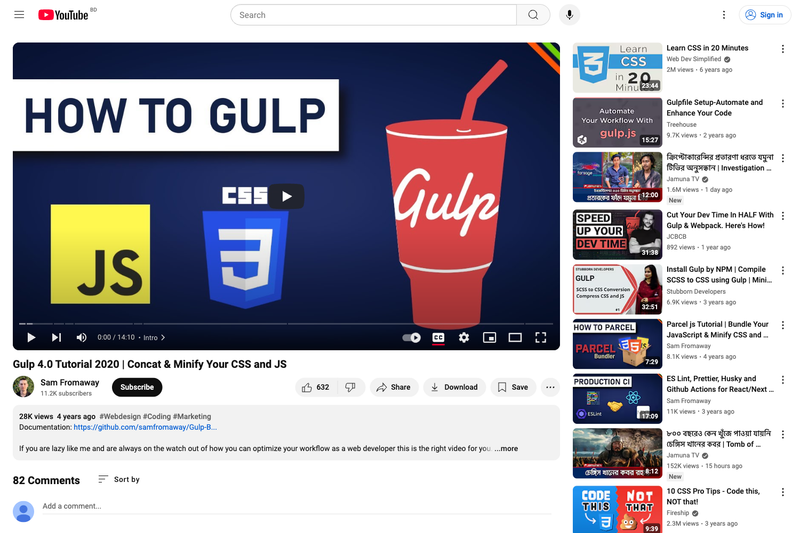
Gulp-Boilerplate01 is a boilerplate for a Gulp 4 task-runner workflow that automates repetitive HTML, CSS, and JavaScript build steps for web developers.
What is Gulp-Boilerplate01?
Gulp-Boilerplate01 is a starter project for a Gulp 4 workflow built around a Gulpfile.js that processes a static website's source files into a deployable build. It takes an HTML/CSS/JavaScript project as input and runs tasks that compile, prefix, minify, concatenate, and optimize the output, all from a single terminal command. The boilerplate was created for a YouTube video that teaches Gulp 4, and it runs on Node.js with the Gulp toolkit.
Key Features
- Gulp 4 syntax — The boilerplate uses modern Gulp 4 exported task functions, unlike outdated Gulp 3 code that relies on the
gulp.taskmethod with a callback function. - Sass compilation —
gulp-sassprocesses SCSS files into plain CSS during the build. - Sourcemaps —
gulp-sourcemapsgenerates inline source maps so you can debug the original Sass in browser DevTools. - PostCSS processing —
gulp-postcssruns a pipeline that includesautoprefixerfor vendor prefixes andcssnanofor minification. - JavaScript concatenation —
gulp-concatjoins multiple JS files into one bundle, reducing HTTP requests. - JavaScript minification —
gulp-tersercompresses the bundled JavaScript to shrink file size. - Image optimization —
gulp-imageminautomatically compresses raster and SVG images without visible quality loss. - Single-command automation — All tasks are triggered by running a single Gulp command in the terminal, eliminating manual repetitive steps.
Who is it for?
- Web developers who deploy static HTML/CSS/JavaScript sites and want to automate asset processing instead of running manual minification and copying.
- Developers learning Gulp 4 — the boilerplate accompanies a YouTube tutorial and shows correct version-4 syntax, avoiding deprecated Gulp 3 patterns.
- Freelancers and small teams looking for a lightweight build setup without a full framework like React or Vue, keeping the output as plain HTML plus processed assets.
What can you do with Gulp-Boilerplate01?
- Production-ready builds: Compile Sass, add vendor prefixes, minify CSS and JS, and optimize images with one command.
- Cleaner debugging: Use sourcemaps to trace compiled CSS back to SCSS source files directly in the browser.
- Quick start for tutorials: Follow the included npm install list and Gulpfile setup to get a working Gulp 4 pipeline in minutes.
How does the Gulp workflow work?
The boilerplate requires Node.js and npm. After running npm init, you install Gulp globally and then as a dev dependency in your project folder, create a Gulpfile.js, import Gulp and its plugins, and define task functions that watch or build your assets. The exact plugins are installed via npm install --save-dev gulp gulp-sass gulp-sourcemaps gulp-postcss autoprefixer cssnano gulp-concat gulp-terser gulp-imagemin, and then you run the appropriate Gulp command to execute the pipeline.
Alternatives
- Grunt — a task runner with a configure-based approach that uses Gruntfiles instead of Gulp's streaming code.
- Webpack — a module bundler that also handles asset processing for single-page applications and JavaScript-heavy projects.
- npm scripts — plain scripts in
package.jsonthat can chain commands without a dedicated task runner.
FAQ
What Gulp version does Gulp-Boilerplate01 use?
Gulp-Boilerplate01 uses Gulp 4. The boilerplate's tasks are written as exported functions this is the syntax required by Gulp 4. Code you find online that uses the old gulp.task method with a callback function is Gulp 3 syntax and will most likely not work with this boilerplate.
What plugins are included in the boilerplate?
The boilerplate includes gulp-sass, gulp-sourcemaps, gulp-postcss, autoprefixer, cssnano, gulp-concat, gulp-terser, and gulp-imagemin. Together they handle SCSS compilation, sourcemaps, PostCSS transformations, JavaScript concat and minification, and image compression.
How do I install the boilerplate?
First run npm init to create a package.json, then install Gulp globally with npm install --global gulp-cli. Navigate into your project folder, install Gulp and the plugins as dev dependencies using the npm command above, and create a Gulpfile.js from the repository. After that you can start the workflow with the gulp command.
Does this boilerplate work with Gulp 3?
No. The boilerplate is written for Gulp 4 and follows the modern exported-function syntax. Gulp 3 uses a different task definition style that is not compatible with this codebase, so you would need either to use Gulp 4 or adapt the Gulpfile to the old syntax.
What do I need to run this boilerplate?
You need Node.js and npm installed on your machine. Gulp 4 runs on Node, and all plugins are installed via npm. The boilerplate is meant for static site projects that output plain HTML, CSS, and JavaScript.