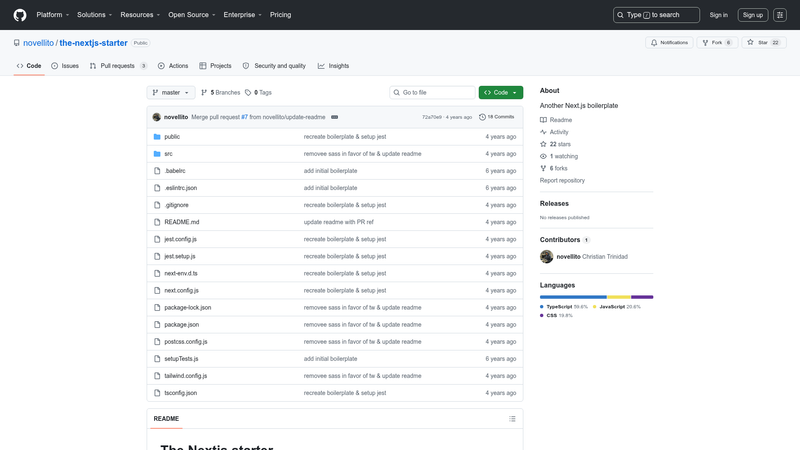
The Nextjs Starter is a boilerplate repository that scaffolds a Next.js web application with TypeScript, styled-components, Tailwind CSS, Font Awesome icons, and react-testing-library preconfigured. It is a community starter, hosted on GitHub under the name "the-nextjs-starter", and pitched by its author as "Hopefully the last one you'll need" for spinning up a new front-end project.
What is The Nextjs Starter?
The Nextjs Starter is a Next.js project skeleton based on the official create-next-app output, extended with TypeScript and a set of common front-end tools. The template takes a developer's empty project directory and produces a runnable Next.js app with a single home page, an example API route, and pre-written unit test dependencies. It runs on the Next.js framework and the source lives in the the-nextjs-starter GitHub repository.
The project uses the pages directory convention: pages/index.tsx is the editable home page, and pages/api/hello.ts is an example API route that responds at /api/hello. The pages/api directory is mapped to /api/*, so any file added there becomes a serverless function endpoint rather than a React page.
Key Features
- Next.js with TypeScript — The template pins the latest Next.js version and includes TypeScript so pages and components can be written with static types.
- Dual styling setup — Both styled-components and Tailwind CSS are included, giving developers the option to use CSS-in-JS or utility-first classes, or combine them.
- Font Awesome icons — The react-fontawesome library is configured, making icon components available without additional setup.
- Unit testing with react-testing-library — Testing dependencies and the testing-library API are included so component and integration tests can be written immediately.
- Example API route — A prebuilt pages/api/hello.ts endpoint demonstrates how the pages/api directory becomes an API route.
- Vercel deployment path — The README links directly to the Vercel Platform and Next.js deployment docs for one-command hosting.
Who is it for?
- Next.js developers starting a side project who want a minimal, typed foundation without spending time wiring together TypeScript and a test runner.
- Developers who prefer Tailwind CSS but also want styled-components as an escape hatch — this starter includes both, so the styling stack does not lock you in.
- Learners of Next.js API routes who want a small working example of the pages/api convention to experiment with.
What can you do with it?
- Bootstrap a new app quickly by cloning the repo, installing dependencies, and running npm run dev or yarn dev to get a local server on localhost:3000.
- Experiment with Next.js API routes by editing the hello endpoint at pages/api/hello.ts, which is mapped to /api/hello.
- Write your first component tests using the included react-testing-library setup, since test dependencies are already declared.
- Deploy to Vercel directly by importing the repository into the Vercel Platform, which is the deployment path documented in the README.
How does it work?
The template follows the standard Next.js workflow. After installing dependencies with npm install or yarn, you start the development server with npm run dev or yarn dev, then open localhost:3000. Edits to pages/index.tsx reload automatically, and the API route at /api/hello is served by the dev server. The README also links to the Next.js documentation and interactive tutorial for further learning.
Alternatives
- create-next-app — the official Next.js boilerplate generator, which gives you a plain TypeScript or JavaScript starter without the preconfigured Tailwind, styled-components, or react-testing-library setup.
FAQ
Does it use TypeScript?
Yes, TypeScript is listed as a dependency in the features section. The template includes pages/index.tsx and pages/api/hello.ts, so all starter code is typed.
Does it include Tailwind CSS?
Yes, Tailwind CSS is listed as one of the styling dependencies alongside styled-components. This means you can write utility-first classes and CSS-in-JS compounds in the same project.
How do I start the development server?
Run npm run dev or yarn dev from the project root, then open http://localhost:3000. The dev server serves the home page and the /api/hello API route, and it hot-reloads when you edit files.
Can I deploy it to Vercel?
Yes, the README includes a link to the Vercel Platform and points to Next.js deployment documentation. The project is a standard Next.js app, so it can be deployed to Vercel or any platform that supports Next.js.
What is in the pages directory?
The pages directory contains pages/index.tsx, the home page, and pages/api/hello.ts, the example API route. Files added to pages/api become API endpoints, while other files under pages become React routes.