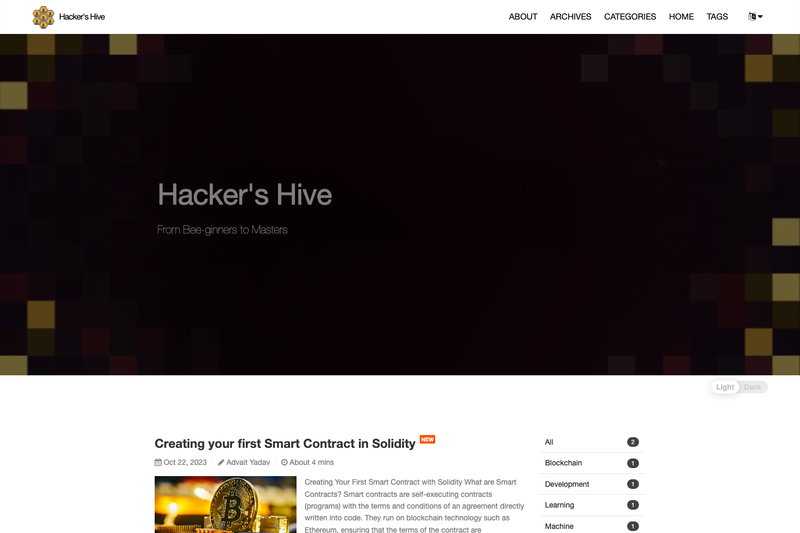
Hacker's Hive is an open-source programming blog repository hosted on GitHub and built with Jekyll, designed to serve as the central hub for publishing community-written tutorials, insights, and technical content.
What is Hacker's Hive?
Hacker's Hive is a GitHub repository that acts as the source and collaboration hub for an open-source programming blog. It takes article drafts, tutorial ideas, and bug reports from contributors through pull requests and issues, and produces published blog content for a community of programming enthusiasts. The repository is built on Jekyll, a static site generator, and explicitly lists jekyll and jekyll-blog among its topics. The project is maintained by a volunteer community ranging from students to seasoned developers.
Key Features
- Jekyll-based static blog — The repository uses Jekyll, so content is written in Markdown and rendered into static HTML pages that can be hosted on any static web host.
- Hacktoberfest participation — The project actively supports Hacktoberfest 2023, the event started by DigitalOcean, and encourages contributors to make four valid pull requests to participating repositories for digital rewards.
- Low-code and non-code contribution tracks — Contribution categories explicitly include technical documentation, user experience testing, case studies, writing, translating, copy editing, social media, blog posts, and graphic design.
- Structured contribution workflow — Contributors are directed to fork the repository, create a new branch, and submit a pull request; more detailed guidelines live in CONTRIBUTING.md.
- Open issue tracker for suggestions and bugs — Ideas for blog posts and reports of content or code errors are collected through GitHub issues.
- Community-focused topics — Repository topics include blog, hacktoberfest, hacktoberfest2023, jekyll, low-code, no-code, open-source, and programming, signaling the project's dual focus on coding and non-technical collaboration.
Who is it for?
- Programming students and enthusiasts — They can read tutorials and also submit their own articles to build a portfolio and share knowledge.
- Technical writers — They can contribute documentation, tutorials, and case studies through the low-code contribution path.
- Non-technical contributors — Translators, copy editors, graphic designers, and social media managers can support the blog through explicitly listed non-code contribution roles.
- Open-source beginners — Hacktoberfest offers a structured, low-pressure way to make first pull requests and earn digital rewards.
What can you do with Hacker's Hive?
- Content creators: Fork the repo, write a tutorial on a new branch, and open a pull request to get it published on the blog.
- Hacktoberfest participants: Submit four valid pull requests to the repository during the event to qualify for reward eligibility.
- Community managers: Help spread the word by sharing blog posts, or write social media copy as a non-code contribution.
- Translators: Translate existing articles to make the blog accessible to non-English-speaking readers.