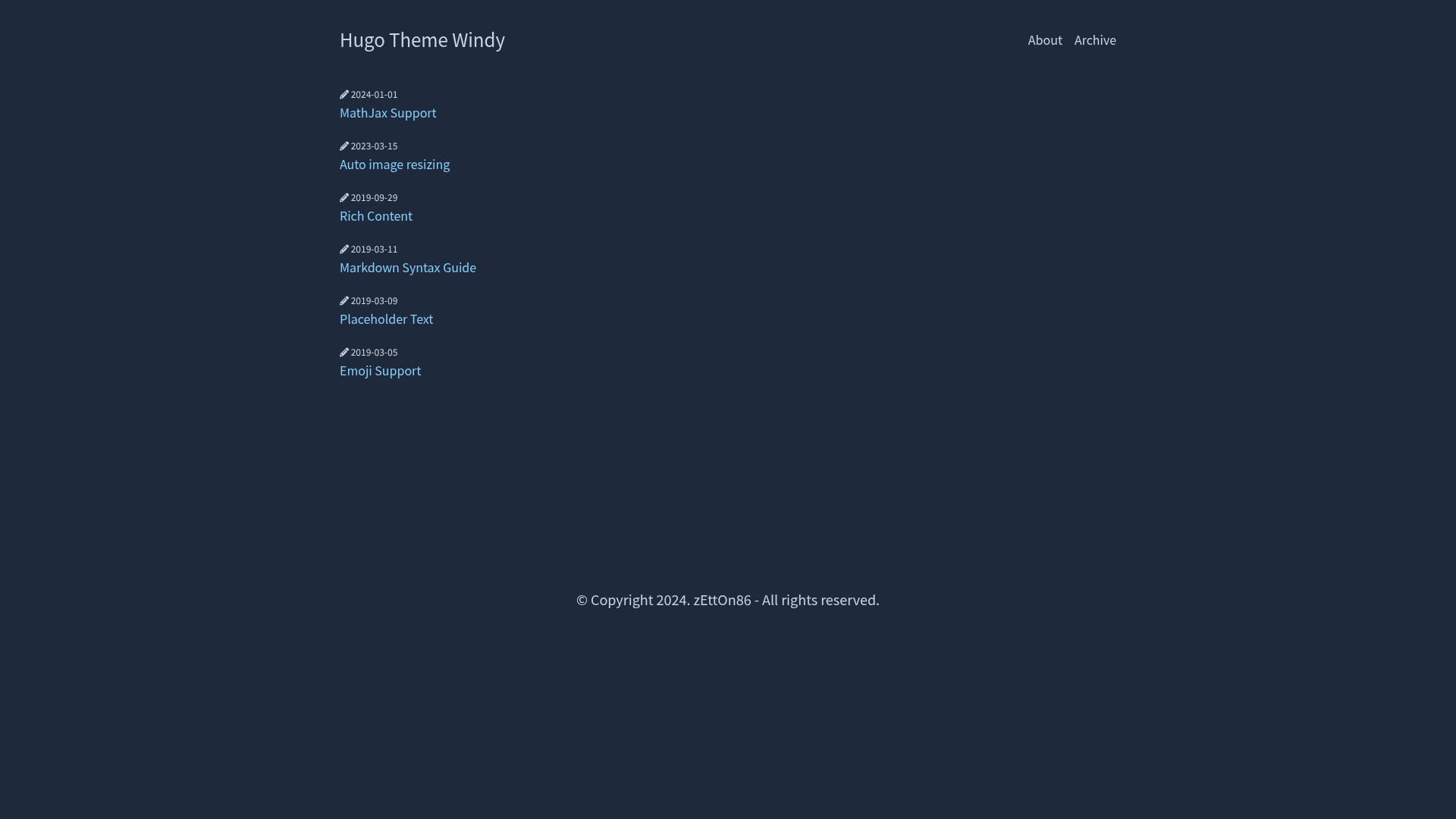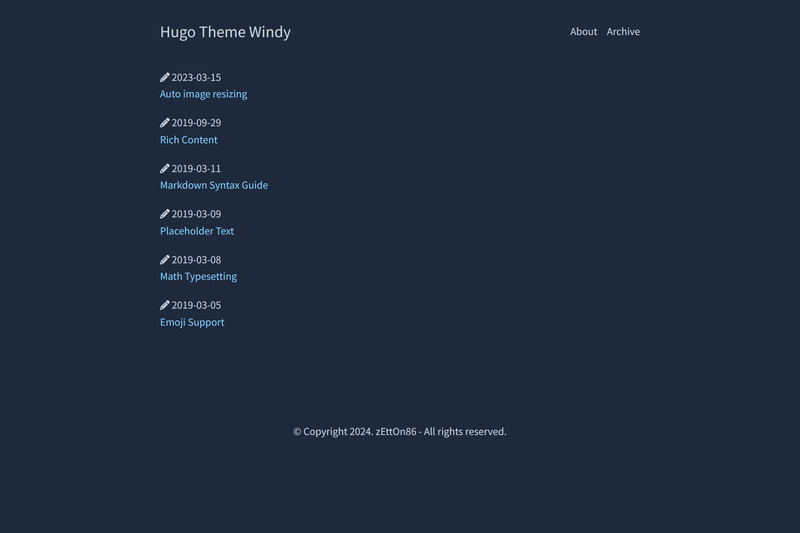
Hugo Theme Windy is a Hugo blog theme that pairs Tailwind CSS styling with built-in dark mode, MathJax rendering, and table of contents navigation.
What is Hugo Theme Windy?
Hugo Theme Windy is a blog theme for Hugo, the static site generator, created by zEttOn86 and licensed under Apache-2.0. It accepts standard Hugo Markdown content plus configuration files and renders a responsive static website with automatic table of contents, JSON-LD structured data, and dark mode toggling. The theme requires Hugo extended version v0.128.2 or newer and Node.js for building CSS and JavaScript assets.
Key Features
- Responsive layout — The theme scales across screen sizes using Tailwind CSS utility classes, with no separate mobile-specific templates.
- Dark mode — Built-in theme toggle lets visitors switch between light and dark color schemes.
- Table of contents — Each post automatically generates a table of contents from its Markdown headings.
- JSON-LD structured data — Included JSON-LD markup helps search engines understand page content and enables rich results.
- MathJax support — MathJax integration renders LaTeX math formulas in posts, useful for technical or academic writing.
- Disqus and Google Analytics integration — Configuration options in hugo.toml enable Disqus comments and Google Analytics tracking.
- i18n support — The theme ships with an i18n directory and supports multi-language sites, with a default content language of English and Japanese locale options.
Who is it for?
- Hugo users — Bloggers already using Hugo can install the theme as a Git submodule and copy the provided directories into their site.
- Math-heavy writers — Academics and tech bloggers who need LaTeX formula rendering get MathJax support out of the box.
- Bilingual bloggers — The theme's i18n and hasCJKLanguage settings make it suitable for English/Japanese mixed-language sites.
- Developers who use Node.js tooling — Since the theme relies on npm for asset building, developers already comfortable with Node.js will find setup straightforward.
What can you do with Hugo Theme Windy?
- Launch a personal tech blog — Use an exampleSite and dev server to preview posts locally with live reload at localhost:1313.
- Publish a math tutorial site — Write posts with inline and display LaTeX formulas that MathJax renders in the browser.
- Add comments to your posts — Enable Disqus by setting your shortname in the hugo.toml services section.
- Set up a multilingual blog — Change language settings and use the included i18n strings to present content in English and Japanese.
How does Hugo Theme Windy work?
To create a new site with the exampleSite, clone the repository, run npm install, then make dev to start a Hugo server on http://localhost:1313. To add the theme to an existing Hugo site, add it as a Git submodule, copy its static, assets, i18n, layouts, and exampleSite config directories into your project, and update the module.mounts in hugo.toml so node_modules points to the correct location. After running hugo server, your site is served locally.
FAQ
Is Hugo Theme Windy free?
Yes. The theme is licensed under Apache-2.0, so you can use, modify, and distribute it freely with attribution and preservation of the license notice.
What are the system requirements for Hugo Theme Windy?
You need Hugo extended version v0.128.2 or newer because the theme uses Hugo's Sass/SCSS processing, and Node.js installed to compile Tailwind CSS assets.
Does Hugo Theme Windy support multilingual sites?
The theme includes an i18n directory and the sample config sets hasCJKLanguage to true, making it straightforward to create English and Japanese content.
Can I add a table of contents to every post?
Yes. The theme automatically generates a table of contents from the heading structure of each Markdown file, with no extra front matter needed.