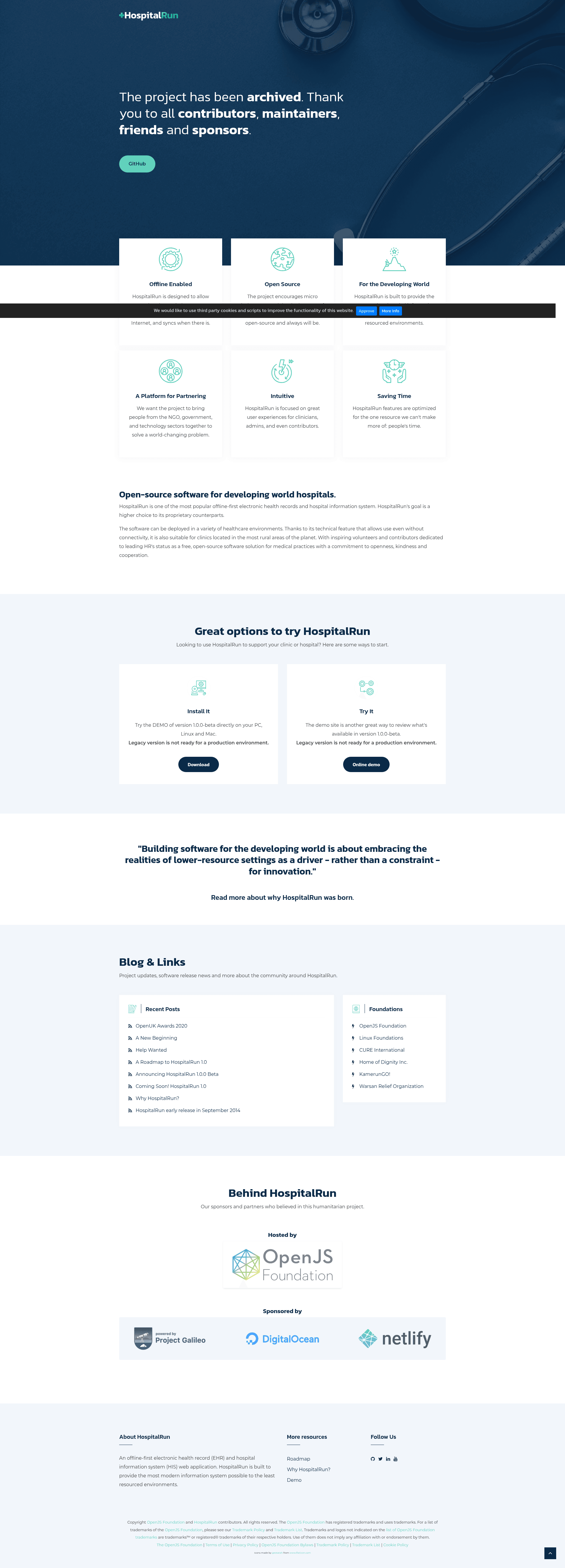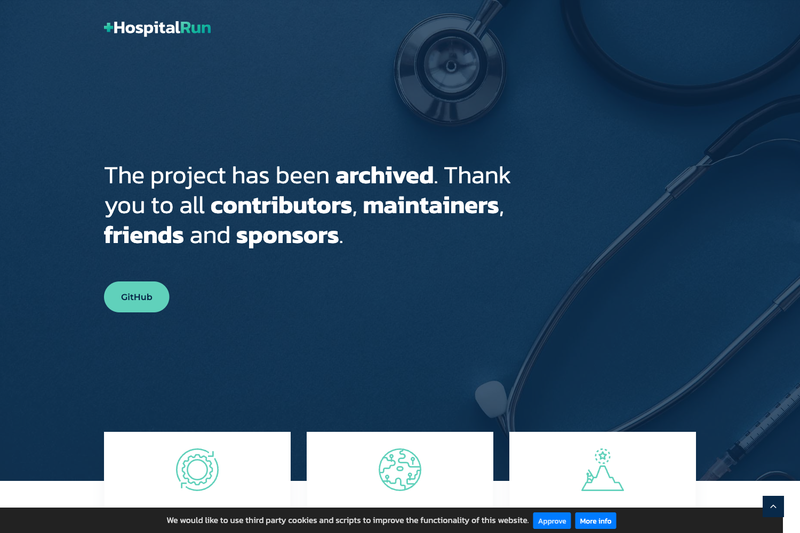
HospitalRun website is a Jekyll 3.8.7 static site that serves as the official marketing and information website for the HospitalRun open-source hospital information system, designed for deployment on Netlify.
What is the HospitalRun website?
It is the source code repository for the HospitalRun project's public website. The site takes Markdown posts and YAML data files as input, then Jekyll's Liquid renderer converts them into a complete static website with HTML, CSS, and JavaScript. The website is maintained by the HospitalRun community and is available on GitHub. It includes 13 pages covering features, roadmap, team, downloads, and blog.
Key Features
- Jekyll 3.8.7 static site generation — Converts Markdown and Liquid templates into static HTML suitable for Netlify hosting.
- 13 content pages — Blog, contacts, contribute, demo, download, FAQ, features, map, privacy policy, roadmap, standards, team, and try-it pages.
- Data-driven content — YAML data files in the
_datadirectory manage FAQ items, roadmap, navigation, slider, sponsors, team members, testimonials, and trending items, so content can be edited without touching HTML. - Modular includes — Reusable components like cookie consent, Google Analytics and GTM scripts, social share buttons, pagination, team area, timeline, call to action, and sponsor area.
- Five layout templates — Blank, default, page, post, and tag page layouts support both standalone pages and blog posts.
- SCSS styling workflow — Assets include a
scssfolder for editing CSS, plus agulpfile.jsandpackage.jsonfor automated build tasks. - Blog and post loop — A
_postsdirectory with dated Markdown files, pagination include, and asearch.jsonendpoint for client-side search. - Netlify readiness — The repository includes a Netlify status badge and deploy configuration, and the project moved from GitHub Pages to Netlify because Jekyll 3 required it.
Who should use the HospitalRun website?
- HospitalRun project maintainers — Need an official site to publish announcements, roadmap updates, and feature descriptions.
- Open-source contributors — Want to contribute to the website using Jekyll; they can clone the repo, run
bundle install, and edit YAML or Markdown files. - Healthcare organizations evaluating HospitalRun — Can visit the site's demo, download, features, and standards pages to assess the system.
- Conference or partner event teams — Can use the site's team, sponsor, and testimonials sections to communicate community activity.
What can you do with the HospitalRun website?
- Showcase the product — Use the features, standards, and roadmap pages to explain HospitalRun's capabilities and future direction.
- Publish project news — Write blog posts in
_postsusing Markdown, and they automatically appear in the blog section with pagination. - Collect user interest — The demo and try-it pages give visitors a way to request trial access; contacts page provides contact details.
- Manage community content — Edit YAML files to update team members, sponsors, testimonials, and FAQ without touching templates.
How does the HospitalRun website work?
The site is built with Jekyll. To work locally, run bundle install to install dependencies, then bundle exec jekyll build to generate the site, and bundle exec jekyll serve to start a local server. Jekyll processes Markdown and Liquid templates in the _includes, _layouts, and _posts directories, and outputs a static website ready for Netlify.
FAQ
Is the HospitalRun website free to use?
Yes, the HospitalRun website source code is open-source and hosted on GitHub. Anyone can clone, fork, and reuse it under the project's license.
What version of Jekyll does the website use?
The website uses Jekyll 3.8.7. The README notes that with Jekyll 3 it was necessary to switch from GitHub Pages to Netlify for deployment.
How do I run the website locally?
Clone the repository and run bundle install to install dependencies, then bundle exec jekyll build to build the site and bundle exec jekyll serve to start a local development server.
What pages are included in the website?
The pages directory contains blog, contacts, contribute, demo, download, FAQ, features, map, privacy-policy, roadmap, standards, team, and try-it pages.
Does the website have blog support?
Yes, the site has a _posts directory with dated Markdown posts, a blog page, post loops, pagination includes, and a search.json endpoint for search.