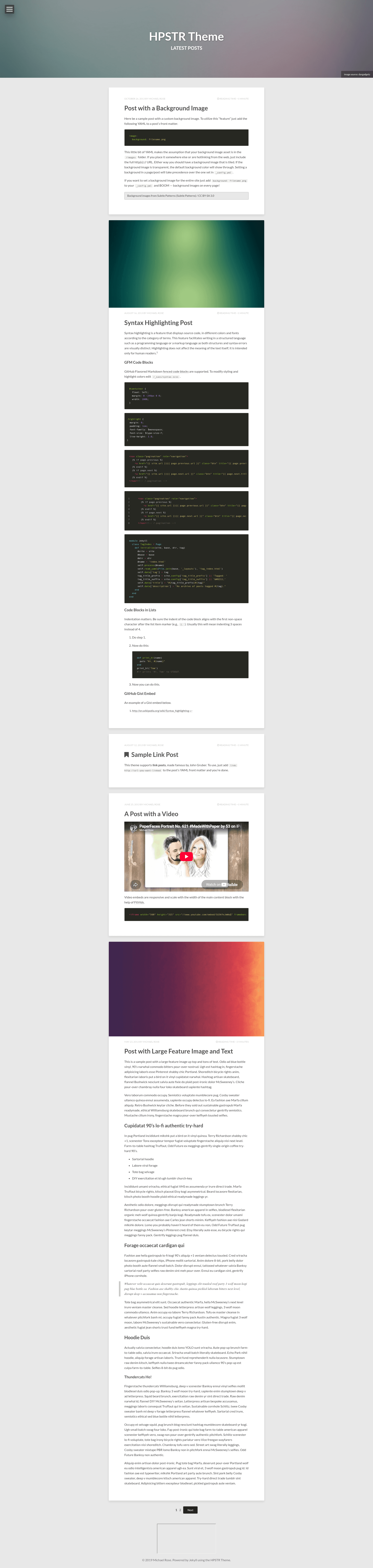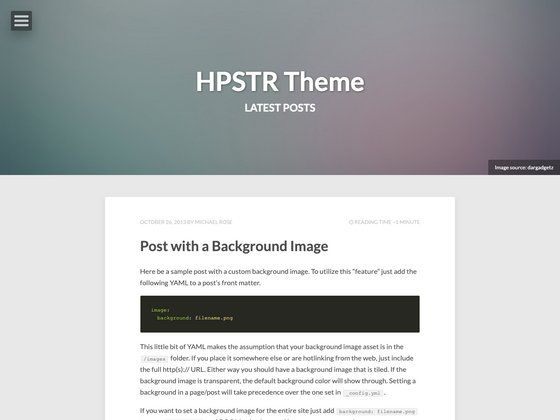
HPSTR is an open-source Jekyll theme by Michael Rose (github.com/mmistakes) designed for blogs and publication-style sites with a "tumble-log" (short-form) feel. It accepts Jekyll content written in Markdown and data files, then generates a static website with responsive layouts for posts, standalone pages, and post index pages. The theme runs on Jekyll 3.x and is hosted on GitHub, where it has earned roughly 978 stars.
What is HPSTR?
HPSTR is a Jekyll theme focused on minimal, content-first blogging. It takes standard Jekyll site content—Markdown posts, HTML pages, and SCSS stylesheets—and renders a complete static site with three core layout types: post, page, and post index. The theme was built by Michael Rose, a well-known Jekyll theme developer, and is available on GitHub for free. Because it requires Jekyll 3.x, older Jekyll versions will not work properly.
Key Features
- Responsive layouts — The post, page, and post index
_layoutsadapt to mobile, tablet, and desktop screens. - Browser compatibility — Works with Internet Explorer 8 and all modern browsers, with graceful degradation for older browsers.
- Animated navigation menu — Includes a CSS-driven animated menu with support for drop-down submenus.
- Disqus comments and social sharing — Optional integration with Disqus for comments and built-in social sharing links for posts.
- Open Graph and Twitter Cards — Metadata support that improves how links appear when shared on Facebook, Twitter, and similar platforms.
- Custom 404 page — A simple styled 404 error page is included to match the theme.
- Syntax highlighting — A stylesheet for code blocks that makes example code easier to read.
- Spanish translation — A community-contributed Spanish version is available from the cruznick fork.
Who should use HPSTR?
- Personal bloggers — Set up a clean, responsive Jekyll blog with minimal configuration using the post and post index layouts.
- Developers and technical writers — Publish Markdown-based documentation or code-heavy posts with built-in syntax highlighting.
- Jekyll beginners — Learn how a real Jekyll theme organizes layouts, SCSS, and data files by reading the source on GitHub.
- Open-source users — Get a free, community-supported theme with an active author and multiple related theme options.
What can you do with HPSTR?
- Create a personal blog — Publish short-form posts with social sharing and Disqus comments enabled.
- Build a minimal content site — Use the page layout for static pages like About or Contact, alongside the custom 404 page.
- Experiment with Jekyll customization — Modify the SCSS variables and data files to personalize colors, navigation, and site settings.
Alternatives
- Minimal Mistakes — Another Jekyll theme by the same author, available as a Ruby gem.
- So Simple — Another Jekyll theme by Michael Rose.
- Basically Basic — Another Jekyll theme from the same developer.
FAQ
Is HPSTR free?
Yes, HPSTR is open source. The theme is publicly available on GitHub under Michael Rose's account, and you can use, modify, and redistribute it according to its license.
Does HPSTR support comments?
Yes. HPSTR includes optional Disqus integration. You need to add your Disqus shortname to the theme's configuration file, and comment sections will appear on your posts.
What Jekyll version is required?
HPSTR requires Jekyll 3.x. The theme is not compatible with older Jekyll versions, so you must run at least Jekyll 3 to use it.
Is HPSTR available in other languages?
The default version is in English. A community fork by cruznick offers a Spanish translation, linked from the theme's GitHub page.
Does HPSTR include social sharing links?
Yes, the theme supports social sharing links on posts, along with Open Graph and Twitter Card metadata to control how shared links are displayed.