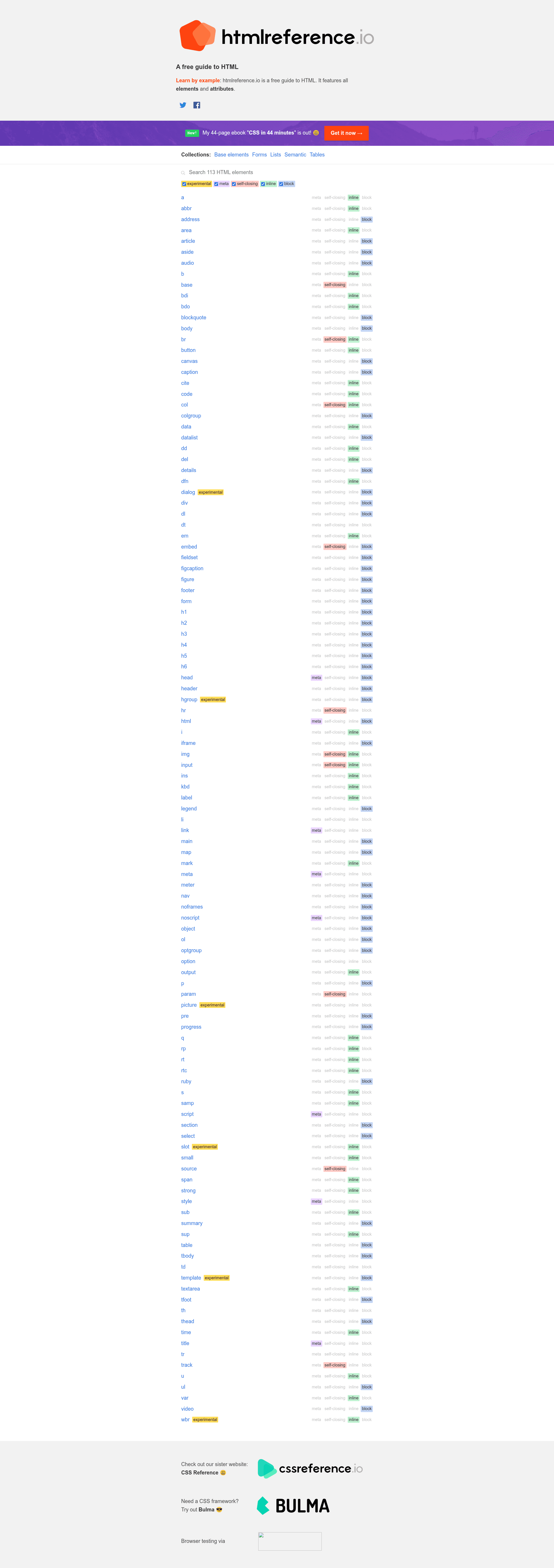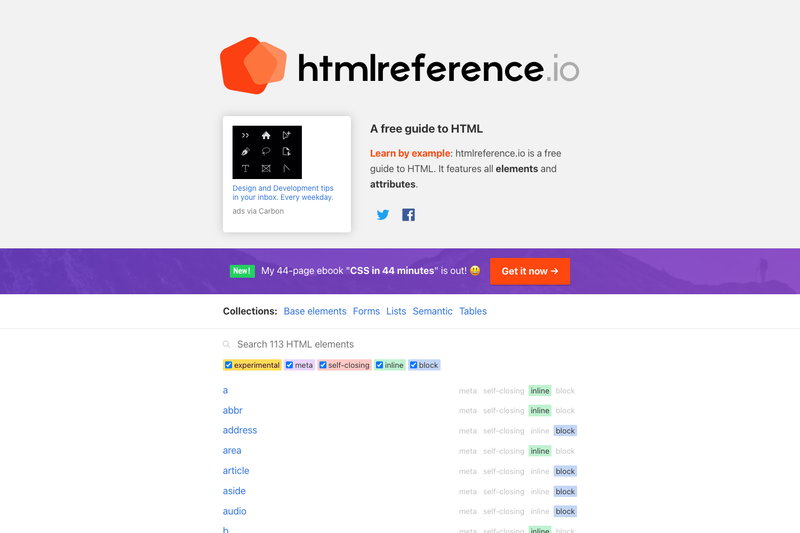
HTML Reference (htmlreference.io) is a free visual guide to HTML5 elements and attributes, built as a Jekyll static site and published as an open-source GitHub repository. Pairing each element with a rendering example and its markup, it answers the core front-end question of what a tag actually looks like in the browser.
What is HTML Reference?
HTML Reference is a visual documentation site that presents each HTML5 element and attribute with an example of its default browser rendering alongside the source code. Visitors browse the guide at htmlreference.io to see what a tag looks like before using it, without needing to set up a test page. The site is generated with the Jekyll static site generator, styled with SCSS, and hosted on GitHub under the jgthms account. The content is licensed under Creative Commons Attribution-NonCommercial-ShareAlike 4.0, while the underlying source code is licensed under the MIT license.
Key Features
- Full HTML5 coverage — The guide documents all HTML5 elements and attributes, matching the project's stated scope as a reference for the complete language.
- Visual renderings — Each element is displayed as it actually renders in a browser, giving an immediate visual answer alongside the code.
- Free and open content — The entire guide is free to use; content is shared under CC BY-NC-SA 4.0, so you can reuse it with attribution.
- MIT-licensed code — The site source code is available under the MIT license, allowing developers to fork and build their own reference sites.
- Jekyll + SCSS stack — Built with Jekyll for static page generation and SCSS for styling, making the site fast to serve and easy to maintain.
- Community traction — The repository has 1,002 stars, indicating a well-established resource among developers.
- LambdaTest cross-browser testing — The project credits LambdaTest for browser testing support.
Who is it for?
- Front-end developers — Use it to quickly check how less-common elements like
meter,progress, ordetailsrender before writing production markup. - Web designers — Consult the default visual styles to understand the browser baseline, which is useful when planning CSS resets.
- Students learning HTML — Pair the visual examples with the code snippets to build a mental model of what each element outputs.
- Technical writers — Reference the visual examples to illustrate HTML behavior in documentation or tutorials without setting up separate test pages.
What can you do with HTML Reference?
- Look up any element instantly — Jump to an element's page and see its rendering, code, and attribute details in one view.
- Learn HTML semantics — Compare visual outputs of similar elements (like
emvsstrong) to grasp when to use each. - Plan CSS resets — Review the default browser presentation of elements to decide which styles need normalizing.
- Share visual examples — Link directly to an element's page to give your team or readers a concrete visual reference.
Pricing
Free — the entire visual guide is free to use at htmlreference.io, with no paid tiers or subscription plans mentioned on the site.
Alternatives
- MDN Web Docs — a more comprehensive HTML reference maintained by Mozilla, covering browser compatibility in depth.
- W3Schools — a tutorial-style HTML reference with editable "Try it Yourself" examples.
FAQ
Is HTML Reference free?
Yes, the entire visual guide is free to access at htmlreference.io. The content is also freely licensed under Creative Commons Attribution-NonCommercial-ShareAlike 4.0, with no registration or payment required.
Does HTML Reference cover attributes?
Yes, the project's scope explicitly includes all HTML5 elements and attributes. The visual pages show both the element's markup and the attributes that can be used with it.
Can I reuse the content or code?
The content is licensed under CC BY-NC-SA 4.0, so you can reuse and adapt it with attribution and share under the same license. The underlying source code is MIT-licensed, which permits broader reuse including in commercial projects.
Who maintains HTML Reference?
The repository is hosted on GitHub under the jgthms account. The project has 1,002 stars, and the site credits LambdaTest for browser testing support.