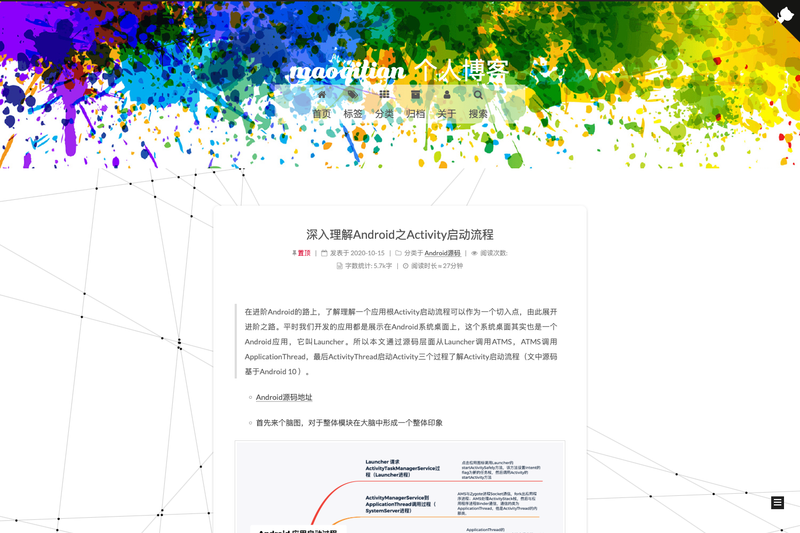
Nice-Knowledge-System is a personal knowledge-base repository on GitHub, authored by developer maoqitian, that curates dozens of original and linked technical articles into a Markdown table of contents spanning Android, Java, Flutter, Gradle, backend engineering, and DevOps. The repository functions as a single index: each section is a Markdown table whose rows link to full-text articles stored either as Markdown files inside the repo or as posts on Juejin, Jianshu, and maoqitian.com. It is organized by topic so a reader can jump from Android framework internals directly to Docker or Kubernetes notes without leaving the same project.
What is Nice-Knowledge-System?
Nice-Knowledge-System is a personal study-and-publishing hub rather than a runnable application: it takes the author's learning notes and presents them as linked Markdown documents grouped by discipline. Inputs are original posts on Android 10 startup flows, View and event dispatch, Handler messaging, third-party libraries, architecture patterns, and more; the output is a browsable index of those posts, most of which are marked original by maoqitian. The repository is hosted on GitHub and references external publications on Juejin, Jianshu, the author's Hexo blog, and maoqitian.com.
Key Features
- Android framework source analysis — Deep dives into Android 10 internals: Activity startup flow, application process startup, Service startup and binding, BroadcastReceiver, and ContentProvider, each as its own Markdown article.
- Third-party library source reading — Articles explain OKHttp3, Retrofit2, and Glide4 by reading their source code, including two separate Glide4 parts.
- Backend and DevOps deployment guides — Step-by-step guides cover Spring Boot, Spring Cloud microservices, Jenkins plus Gitlab plus Maven plus Tomcat continuous integration, Kubernetes 1.14.2 cluster deployment via Kubeadm, FastDFS server cluster, Docker commands, Compose, and image building, and Nexus 3.x Maven private server setup.
- Design pattern catalog — Organized around the six design principles and the classic pattern categories, with original articles on Singleton, Builder, Factory Method, Abstract Factory, Prototype, Proxy, Bridge, Chain of Responsibility, Observer, Strategy, and Command.
- Flutter and Dart learning path — Flutter articles cover Dart syntax, InheritedWidget for data sharing, pull-to-refresh and load-more, waterfall flow, and error-page handling.
- Gradle deep dives — Covers Gradle installation and commands, Groovy basics, custom Gradle plugin development, Android APT code generation, and publishing an aar package to a Nexus private server with Gradle 7.0 maven-publish.
- Licensing and attribution — Original articles are released under Creative Commons BY-NC-ND 4.0, allowing free non-commercial redistribution with attribution and no modification.
Who is it for?
- Android interview candidates — Use the Android 10 startup-flow articles and Handler message mechanism notes to trace framework internals and answer source-code interview questions.
- Flutter newcomers — Use the Flutter and InheritedWidget articles and the pull-to-refresh, load-more, and waterfall-flow implementations to learn practical widgets and data sharing patterns.
- Java and design-pattern learners — Use the Java review notes on collections, IO, multithreading, and annotations, plus the 11 pattern articles, to build a structured foundation.
- Backend or DevOps engineers — Use the Docker, Kubernetes, Jenkins, FastDFS, and Nexus deployment posts to assemble CI/CD and microservice infrastructure.
What can you do with Nice-Knowledge-System?
- Android developers: trace how an Activity starts or how a Service binds under Android 10 by following the linked Markdown walkthroughs.
- Gradle users: learn to write a custom Gradle plugin or publish an aar to Nexus via the Gradle 7.0 maven-publish guide.
- Full-stack learners: move from Android client work into backend by following the Spring Boot, Spring Cloud, and Docker Compose series.
- Technical bloggers: use the Hexo blog setup guide to launch a personal blog from scratch.
How does Nice-Knowledge-System work?
The repository is a hub: each section is a Markdown table whose rows link to an article's full text, either a Markdown file inside the repo or an external post on Juejin, Jianshu, or maoqitian.com. Readers pick a topic, click a title, and read the full article; entries marked as coming soon or continuously updated in the tables are still in progress.
FAQ
Is Nice-Knowledge-System free to use?
The repository is publicly hosted on GitHub and can be read freely. Original articles are licensed under Creative Commons BY-NC-ND 4.0, which permits free non-commercial sharing, requires attribution, and forbids modifications and commercial use.
Can I repost the articles?
Yes for non-commercial purposes, as long as the article text is not changed, the author maoqitian and the original link are clearly credited, and the link does not use the rel nofollow attribute. WeChat official-account reposts are not granted the original badge.
Where are the full articles published?
Links in the repository point to Markdown files on GitHub and to posts on Juejin, Jianshu, and the author's personal blog at maoqitian.com. Some articles also appear inside the repository's own Android, Gradle, and design-pattern folders.
Does the repository pin specific versions?
Yes. Framework articles explicitly analyze Android 10, the Gradle publishing article uses Gradle 7.0 with maven-publish, the Kubernetes guide covers version 1.14.2, and the FFmpeg and NDK article states FFmpeg 4.3.1 with ndk-r21b.