Hugo Admin
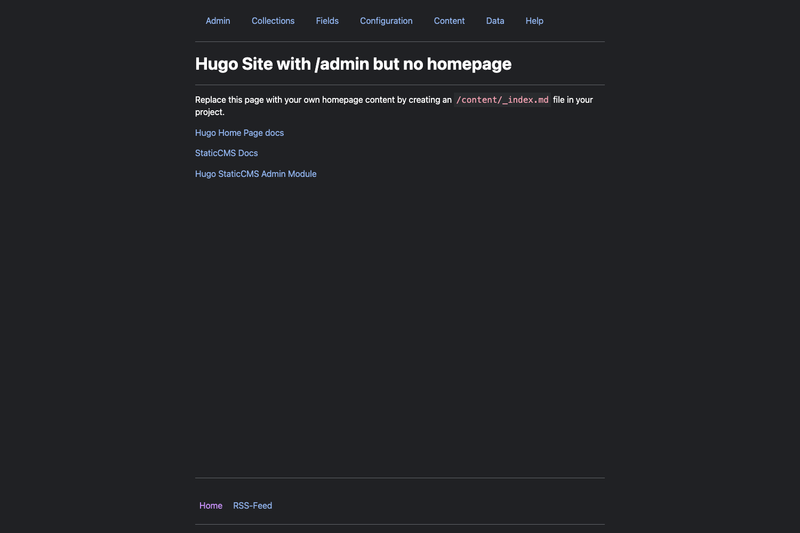
Hugo Admin is a Hugo module that adds an /admin section made of NetlifyCMS pages to any Hugo site, giving editors a browser-based interface for managing site configuration, content, and data. The module imports from github.com/basa-casa/admin-hugo and is distributed as a Hugo module, mountable via config.toml, config.yml, or config.json.
What is Hugo Admin?
Hugo Admin is an open-source Hugo module (20 stars) that mounts an /admin route populated with NetlifyCMS pages. It takes as input a Hugo project with module imports enabled; its output is a working admin interface where editors can modify the site's configuration, content, and data through NetlifyCMS. The repository describes collections and fields for managing Hugo site configuration, content, and data, and the module is designed to be extended or copied into your own project.
Key Features
- Module-based installation — Import the module in
config.toml,config.yml, orconfig.jsonundermodule.importswith the pathgithub.com/basa-casa/admin-hugo. - Three admin modules — The project bundles multiple admin-related modules; installation instructions reference copying
/exampleSite/content/admin/from "all three admin modules" into your project. - NetlifyCMS integration — The /admin section is built as NetlifyCMS pages, providing a static-CMS editing experience directly inside the Hugo site.
- Centralized configuration via cascade — A
cascade.configobject in_index.mdcontrols the static CMS backend and other settings common to each sub-CMS. - Vendoring support —
hugo mod vendoris recommended to vendor module files for easier copying and overriding. - Repository metadata — The GitHub repository (basa-casa/admin-hugo) tracks 20 stars and lists topics including cms, hugo, hugo-module, hugo-starter, netlify, and netlify-cms.
Who is it for?
- Hugo site owners who want a visual editor for their content without a third-party CMS backend — they install the module and get an /admin area served by NetlifyCMS.
- Hugo theme developers who need to expose site configuration options to clients — they can adapt the
cascade.configsettings to their own project. - Static-site teams that already use Git-based workflows but want a friendly interface for non-technical editors to update config, content, and data.
What can you do with it?
- Managing site configuration — Through the CMS collections, editors can adjust Hugo site configuration values without touching TOML or YAML files directly.
- Authoring content — The module provides NetlifyCMS-backed pages for creating and editing content collections, using the fields defined in the repository.
- Handling data files — The collections and fields in the module cover Hugo data files, so structured project data can be edited through the same admin interface.
How does Hugo Admin work?
Installation follows a four-step process: import the module in your Hugo config, run hugo mod vendor, copy the admin example content from the module's example site into your project, then modify the cascade.config object in _index.md to match your project. That cascade.config object wires the admin pages to your static CMS backend and shared settings. Because the module ships as a Hugo module, updates can be pulled by re-vendoring, and files can be overridden locally.
FAQ
Is Hugo Admin free?
Yes. The module is open source on GitHub under the basa-casa organization, with no mention of paid licensing, pricing tiers, or usage limits in the repository metadata or installation docs.
Does it work with all Hugo config formats?
Yes. The installation instructions show importing the module in config.toml, config.yml, and config.json, using each format's equivalent module.imports structure.
What does cascade.config control?
The cascade.config object in _index.md controls the static CMS backend and other settings common to each sub-CMS. You modify it after installation to point the admin interface at your project's backend and configure shared CMS behavior.
Is there a future StaticJsCMS version?
The source hint notes that the module is "soon" adding StaticJsCMS support, indicating the maintainers plan to support that static CMS in addition to NetlifyCMS.