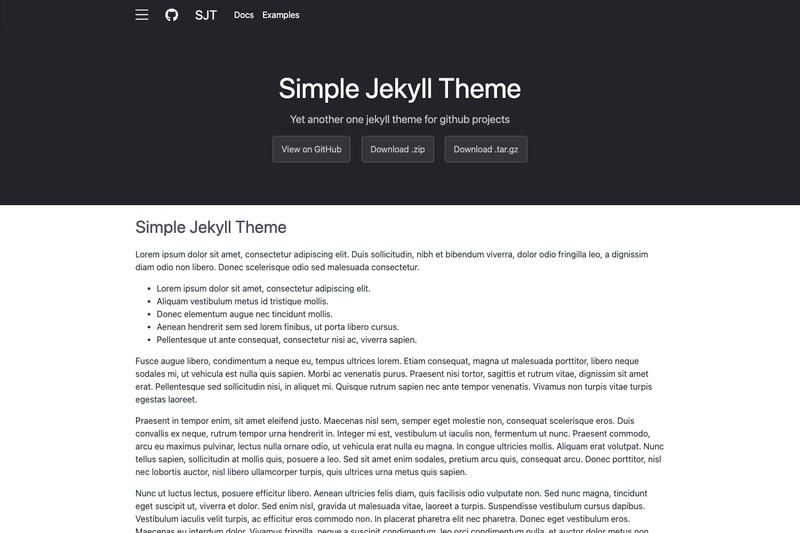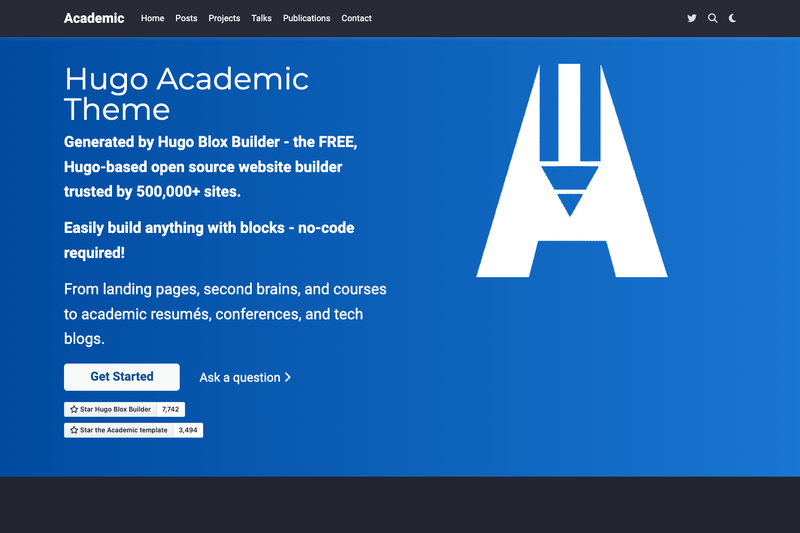
HugoBlox is an open-source Hugo website framework that transforms structured Markdown into professional static sites — landing pages, blogs, portfolios, publications, docs, and more.
What is HugoBlox?
HugoBlox is an open-source framework built on Hugo and Tailwind CSS that turns structured Markdown into static websites. You describe your site or pages in plain English to Hugo Chat AI, it generates Markdown files with correct front matter and HugoBlox blocks, and you deploy the resulting static HTML to any hosting service. The framework is developed by Lore Labs (2016-present) and has been used to create over 150,000 sites, including pages for NVIDIA Research, MIT, Stanford, and Google.
Key Features
- AI page generation via Hugo Chat — describe what you need in natural language and receive structured Hugo pages with proper front matter, shortcodes, and HugoBlox blocks; free messages are included daily.
- Plain Markdown ownership — every page is a readable, editable Markdown file; no database lock-in, no proprietary format, and files remain readable indefinitely.
- 20+ structured content types — includes landing pages, blog posts, portfolios, publication pages with BibTeX/DOI workflows, documentation with sidebar navigation, team profiles, event/talk pages, slide decks, resumes/CVs, and native rendering for Jupyter notebooks and LaTeX.
- Block-based page building — snap together Tailwind-styled sections like hero, features, pricing, testimonials, and CTA blocks to assemble landing pages in minutes.
- Ownable CMS for VS Code — a visual editor inside VS Code with drag-and-drop blocks, live preview, and YAML validation, available from the VS Code Marketplace.
- Deploy anywhere for free — static output requires no database or runtime; deploy to Netlify, Vercel, GitHub Pages, Cloudflare Pages, or any static host.
- MIT licensed open source — the framework code is fully open source and maintained since 2016.
Who is it for?
- Researchers and academics — create publication lists, team and author profiles, and course or research lab sites; Hugo Chat can generate dozens of pages with correct BibTeX metadata.
- Founders and startups — build landing pages with pricing, testimonials, and contact forms that are easy for a whole team to edit as Markdown.
- Developers and developer advocates — maintain a personal site, blog, portfolio, and documentation without a CMS, and keep full control of the files.
- Consultants and freelancers — publish a professional portfolio and blog on free static hosting, with no recurring platform costs.
What can you do with HugoBlox?
- Generate a landing page for a new product — ask Hugo Chat for a page with hero, pricing, and testimonials, and receive a publishable Markdown page with the right blocks.
- Publish academic papers — create publication pages with BibTeX import (Pro) and DOI citation workflows, formatted for research sites.
- Build documentation sites — assemble searchable, versioned docs with sidebar navigation using the documentation content type.
- Create slide decks from Markdown — write presentations with reveal.js without leaving plain text.
How does HugoBlox work?
- Pick a template from hugoblox.com/templates or scaffold a site with the CLI (
npm install -g hugoblox; hugoblox create site). - Use Hugo Chat to generate or customize pages by describing what you need in plain English.
- Edit visually with Ownable CMS in VS Code, or edit the Markdown directly.
- Push to GitHub and deploy to Netlify, Vercel, Cloudflare Pages, or GitHub Pages.
Pricing
HugoBlox is free to use with an MIT license. Hugo Chat includes free messages every day with no credit card. A paid Pro plan adds visual editing, AI automations, BibTeX import, and priority support — see hugoblox.com/pricing for current tiers.
Alternatives
- Lovable, v0, Bolt — AI site builders that generate React code rather than portable Markdown; HugoBlox compares itself to these in its README.
- WordPress and Webflow — CMS platforms that lock content in a database and typically require a server or subscription instead of free static hosting.
FAQ
Is HugoBlox free?
Yes, the framework is MIT licensed and free to use. You can deploy static sites to Netlify, Vercel, GitHub Pages, or Cloudflare Pages on their free tiers. Hugo Chat provides free messages daily, with a Pro plan available for advanced features.
What does HugoBlox do?
HugoBlox is a Hugo-based website framework that generates static sites from Markdown. You describe pages to AI, it outputs structured Markdown files with front matter and blocks, and you host the static HTML anywhere.
How many content types does HugoBlox include?
HugoBlox ships with over 20 structured content types, including landing pages, blogs, portfolios, publications, documentation, team profiles, events, slide decks, resumes, and support for Jupyter notebooks and LaTeX.
Can I edit the generated pages by hand?
Yes, everything is plain Markdown with front matter, so you can read, edit, and version the files in any text editor. The Ownable CMS extension adds visual editing with drag-and-drop blocks within VS Code.
Who makes HugoBlox?
HugoBlox is developed by Lore Labs and has been maintained since 2016. The project is open source, and the repository has over 9,000 stars on GitHub.