Newsletter
Join the Community
Subscribe to our newsletter for the latest news and updates

A Hugo theme for generating, organising, and viewing markdown patient notes for a clinic.
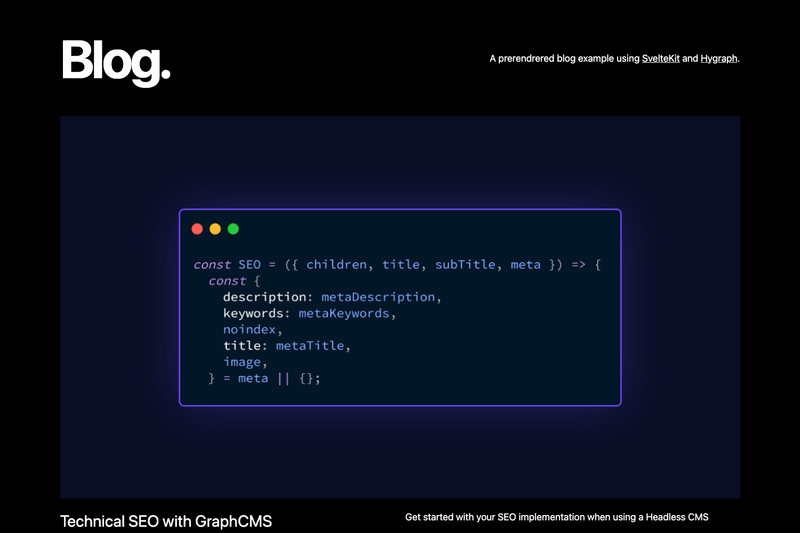
A SvelteKit library for previewing draft CMS content via a secret query parameter and cookie, inspired by Next.js Preview Mode.

Design faster with a collection of prebuilt Figma components with powerful auto layout and resizing constraints.
Deprecated Nuxt.js module providing reactive ResizeObserver-based breakpoints via $breakpoints.
Hugo Clinic Notes is a Hugo theme for generating, organising, and viewing patient notes written in markdown, built for clinics such as physiotherapy practices. It runs on the Hugo static site generator and converts markdown files in the content/all folder into a browsable web interface where notes are listed by date, appointment time, and patient name.
Hugo Clinic Notes is a Hugo theme that produces a static website of patient notes from markdown files. It takes plain markdown notes — each one named according to a strict convention — and automatically extracts patient name, date, appointment time, and a description from the filename to generate the metadata shown on the site. The output is a self-contained set of HTML pages that can be viewed locally via hugo server or built and uploaded anywhere, though the theme's author recommends running it as a local web app to protect patient privacy. The theme is maintained by jmablog on GitHub.
index.md note plus any linked media such as images, PDFs, or scans.@media print will hide the top and bottom menus when a note is printed or saved as PDF.content/docs are rendered as standalone pages and linked from a "Documents" menu item.hugo server on a local machine keeps sensitive records off the public internet.hugo new --kind assessment all/john-smith/2020-01-01-10-00-john-smith-assessment.md to start a first-session note with patient name and time pre-filled.follow-up kind for subsequent sessions; the filename format automatically links the note to the correct patient and date.other note type creates a folder where you can drop x-rays, scans, PDFs, or photos and link to them from the note text.content/docs so it appears in the site’s Documents section.First, install Hugo (via Homebrew on macOS or Chocolatey on Windows), create a new Hugo site, add this theme as a submodule, and copy the example config.toml. To add a note, use hugo new --kind with the appropriate note type and a filename in the format all/patient-name/yyyy-mm-dd-hh-mm-patient-name-note-type.md. Then run hugo server -F to preview the site, including future-dated notes. The theme’s archetypes generate the note template and automatically fill in the metadata from the filename.
There is no separate patient-creation step. A patient is added the first time you create a note for them: use the hugo new --kind command and include the patient’s name in the path, for example all/john-smith/. Hugo creates the patient folder and the note file inside it.
The required format is all/patient-name/yyyy-mm-dd-hh-mm-patient-name-note-type.md. For an "other" note, omit the .md and the note type suffix, and use underscores instead of dashes for the description (e.g., 2020-01-03-14-00-john-smith-description_of_contents), because Hugo creates a folder rather than a file.
Yes. Use the "other" note type, which creates a folder with an index.md file. Place any media files (images, PDFs, scans) directly in that folder and link to them from the markdown. The theme’s example shows this is intended for scans, x-rays, and notes from other professionals.
Yes, if your browser supports the @media print CSS query. When you print a note or choose "Save as PDF" from the print dialogue, the top and bottom menus are removed and only the document text is printed.
Copy the archetype files from themes/hugo-clinic-notes/archetypes into your project’s archetypes folder and edit them there. Your local copies will override the theme’s versions. Do not change the front matter metadata between the --- fences, or the site may stop working.