Jekyll Theme Simple Blog is a Jekyll static-site theme for publishing a simple blog; its repository on GitLab.com shows the GitLab sign-in page to unauthenticated visitors, so the theme files are only reachable after signing in.
What is Jekyll Theme Simple Blog?
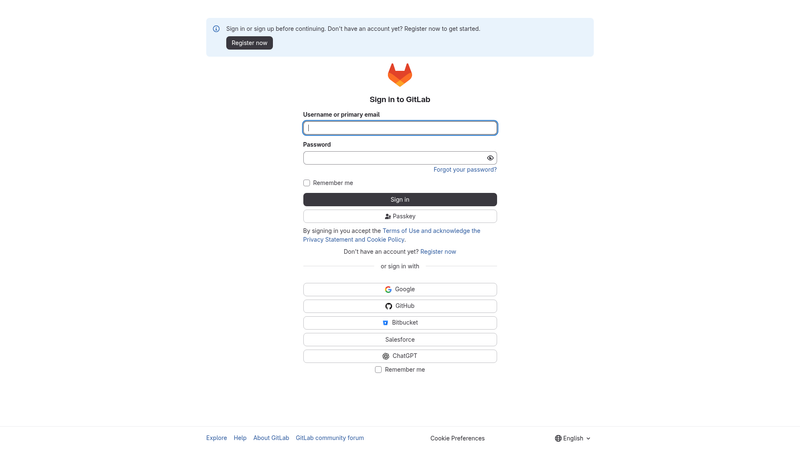
Jekyll Theme Simple Blog is a theme built for Jekyll, a static site generator that converts text-based source files into a plain HTML website, and it targets the specific use case of a simple blog. The project is hosted on GitLab.com, and its public URL serves the GitLab authentication screen rather than any theme content when the visitor has no session. That sign-in page belongs to GitLab rather than to the theme, and it is the only content visible in this view of the project. A visitor who signs in or registers continues on to the repository itself.
Key Features
The concrete features visible on this page are the capabilities of the GitLab sign-in screen that gates access to the theme's repository; the theme's own interface cannot be inspected without authentication.
- Username or primary email authentication — the sign-in form accepts a GitLab username or primary email plus a password, with a "Remember me" checkbox that keeps the session on the device.
- Passkey sign-in — a "Sign in Passkey" option provides passwordless authentication alongside the standard password field.
- Third-party sign-in providers — dedicated authentication buttons are offered for Google, GitHub, Bitbucket, Salesforce, and ChatGPT accounts.
- Registration flow — the "Register now" link points to the GitLab sign-up page so new users can create an account and then access the repository.
- Password recovery — the "Forgot your password?" link opens the GitLab password reset form.
- Multiple interface languages — the page can be displayed in English, 简体中文, português (Brasil), 한국어, 日本語, italiano, Gaeilge, français, español, and Deutsch.
- Terms and privacy acknowledgment — signing in accepts the GitLab Terms of Use, Privacy Statement, and Cookie Policy stated on the same page.
- Exploration and support links — the footer links to GitLab Explore, Help documentation, About GitLab, the community forum, and cookie preferences.
Who is it for?
Anyone who needs to reach the Jekyll Theme Simple Blog repository on GitLab.com without an active session will land on this page. First-time visitors use the "Register now" link to create a GitLab account before continuing. Returning members authenticate with their username or primary email and password, or with a passkey, to proceed into the project. Users with external identities choose Google, GitHub, Bitbucket, Salesforce, or ChatGPT to sign in without a GitLab-specific password. Users who forgot their password follow the "Forgot your password?" link to reset it through GitLab's recovery flow.
Pros and cons
The access page has clear strengths for authentication and one notable limitation for public evaluation of the theme.
- Multiple sign-in options — password, passkey, and five third-party identity providers (Google, GitHub, Bitbucket, Salesforce, ChatGPT) are all available from one screen.
- No public browsing — the repository content is hidden behind authentication, so unauthenticated visitors see only the sign-in page and cannot evaluate the theme before creating an account.
FAQ
These are the questions people most often ask when this page appears instead of the template itself.
Why do I see a GitLab sign-in page instead of the Jekyll theme?
Jekyll Theme Simple Blog is hosted on GitLab.com, and the page is served to visitors who are not signed in. The theme's repository contents appear only after authentication; the sign-in page itself is GitLab's interface, not part of the theme.
How do I access the Jekyll Theme Simple Blog repository?
Enter your GitLab username or primary email and password on the sign-in page and click the sign-in button, or use the passkey option. If you do not have a GitLab account, click "Register now" to create one, then continue to the repository.
Can I sign in without a GitLab password?
Yes. The sign-in page provides a "Sign in Passkey" option and dedicated buttons for Google, GitHub, Bitbucket, Salesforce, and ChatGPT, so you can authenticate with an external identity instead of a GitLab-specific credential.
What happens if I forgot my GitLab password?
Click the "Forgot your password?" link under the password field. It leads to the GitLab password reset flow, where you can set a new password and then sign in to reach the repository.
Does signing in require accepting any terms?
Yes. The page states that by signing in you accept the GitLab Terms of Use and acknowledge the Privacy Statement and Cookie Policy.