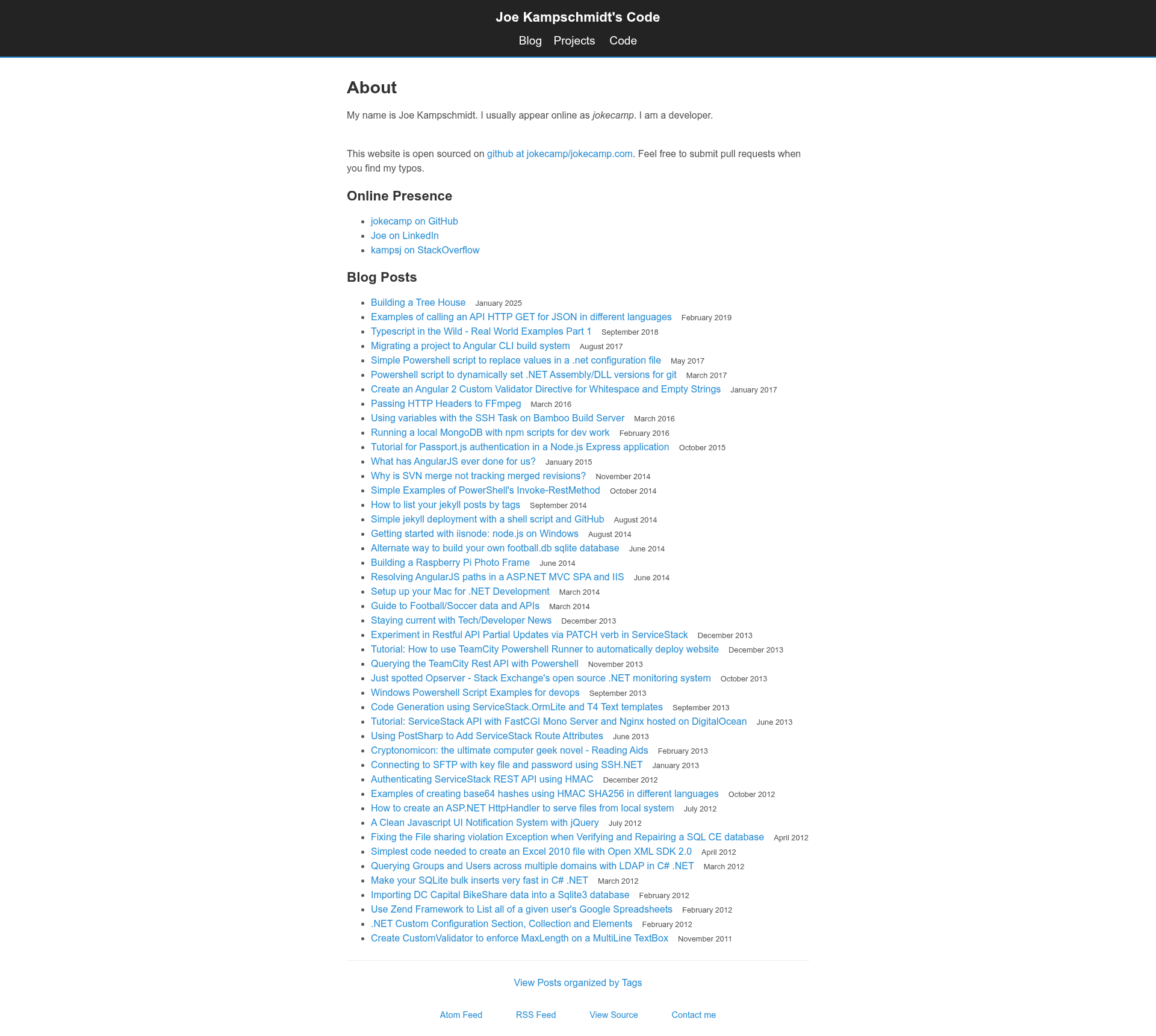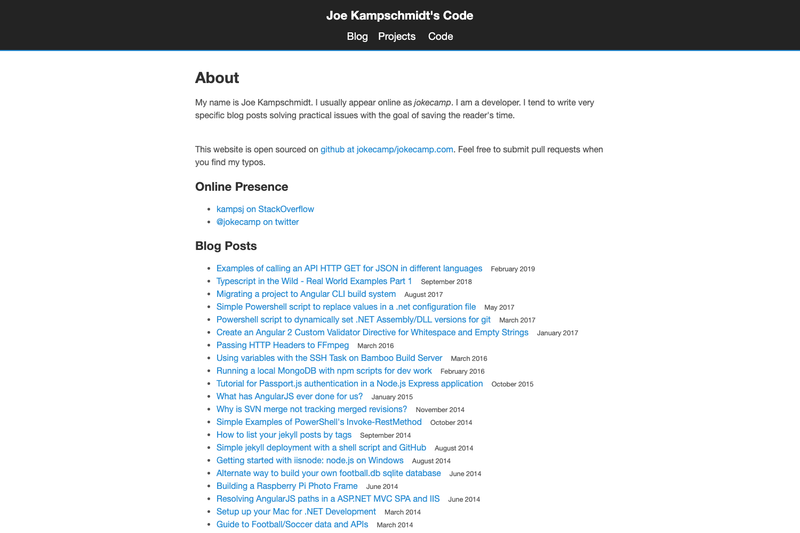
Jokecamp.com is Joe Kampschmidt's personal blog and website, a static site built with Jekyll on the Poole starter theme that publishes developer-focused writing on C#, .NET, and related topics.
What is Jokecamp.com?
Jokecamp.com is the live site powered by Joe Kampschmidt's open-source Jekyll repository. The project takes Markdown-based post files and configuration as input and outputs a fully static HTML site that needs no server-side runtime. It runs on Jekyll 4.3.4 and uses the Poole theme, with the complete source code, build scripts, and deployment tooling stored on GitHub.
Key Features
- Poole/Jekyll foundation — Built on the Poole starter theme and the Jekyll static site generator, producing plain HTML output with no database or backend.
- Markdown authoring — All content is written in Markdown files, letting posts be stored as plain text and rendered to HTML at build time.
- Asset pipeline — Uses jekyll-asset-pipeline to concatenate and minify CSS and JavaScript, with yui-compressor for additional compression.
- Gzip static compression — Includes a Perl script for Unix web servers that gzips HTML, CSS, and JS files to reduce bandwidth.
- Live local preview — Running
jekyll serve --watchserves the site at localhost:4000 and automatically rebuilds on file changes. - Simple production build — The
jekyll buildcommand generates the entire site into a_sitedirectory ready for deployment to any static host. - Deployment automation — A
deploy.shscript coordinates the git commit, push, and site upload after running the Jekyll build. - Open source contributions — The README invites pull requests for typos and edits, with contributors credited for accepted changes.
Who is it for?
- Developer bloggers — A minimal Jekyll setup for programmers who want a personal site with Markdown writing and no database.
- C# and .NET authors — Joe's blog covers C# and developer topics, making the repository a reference for writing in that niche.
- Jekyll learners — This working project demonstrates asset pipelines, gzip compression, and deploy scripts in a real Jekyll site.
- Static-site enthusiasts — Anyone wanting a fast, portable personal site that can be hosted on any web server or CDN.
What can you do with Jokecamp.com?
- Publish technical posts — Write Markdown, build with Jekyll, and deploy static HTML plus the provided gzip script to any server.
- Customize the Poole theme — Modify layout and style files while keeping content in Markdown, then rebuild to update the site.
- Preview edits locally — Use
jekyll serve --watchto see changes in the browser at localhost:4000 while writing. - Contribute fixes — Submit pull requests for typo corrections or content edits, and receive credit in the repository.
How does Jokecamp.com work?
Jekyll processes Markdown content through the Poole theme layouts into static HTML files. Locally, jekyll serve --watch rebuilds and serves at localhost:4000; in production, jekyll build outputs the final site, and deploy.sh uploads it. A Perl script gzips the generated HTML, CSS, and JS files on the web server for faster loading.
FAQ
Is Jokecamp.com free to use?
The repository is public on GitHub, and both Jekyll and Poole are open-source tools, so the code can be forked and reused freely.
What stack does Jokecamp.com use?
It uses Jekyll 4.3.4, the Poole theme, jekyll-asset-pipeline, and yui-compressor. Development setup on macOS uses Ruby 3.3.5 installed via chruby.
How do I run Jokecamp.com locally?
Install Ruby, then run gem install jekyll and jekyll serve --watch in the project directory. The site will appear at localhost:4000.
Can I contribute to Jokecamp.com?
Yes, the README states that pull requests for typos or editing are accepted, and contributors are credited for their work.