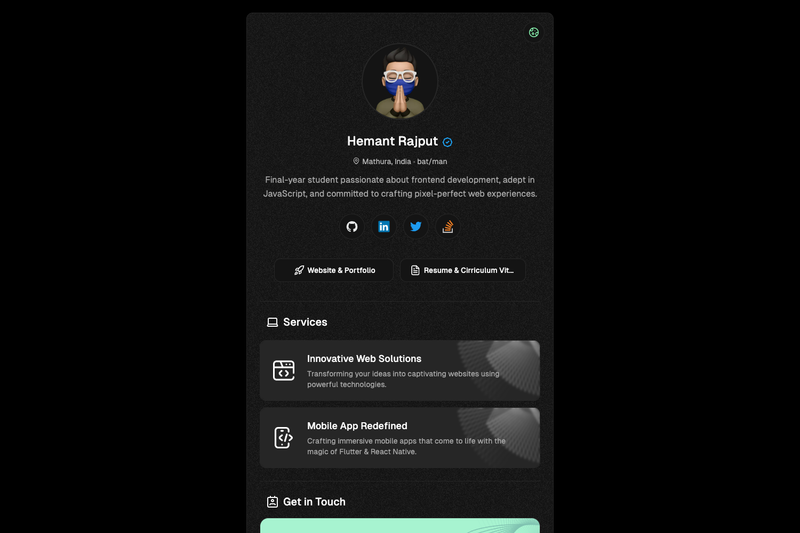
Landing is an open-source personal landing page template built with QwikCity, TypeScript, and Tailwind CSS, designed to give developers a fast, deploy-ready portfolio site.
What is Landing?
Landing is a personal landing page website that was built from scratch using QwikCity, the meta-framework on top of the Qwik runtime. The project is written entirely in TypeScript and styled with Tailwind CSS, and it is published on GitHub by Hemant Rajput. Its core function is to produce a static, performant personal page that can be run locally with bun or deployed to Vercel or Netlify using the included one-click buttons. The repository also provides PageSpeed Insights report links for desktop and mobile, showing its performance focus.
Key Features
- QwikCity framework — The template is built on QwikCity, which leverages Qwik's resumability model for fast initial loading without hydration overhead.
- TypeScript codebase — All source files are TypeScript, providing type safety and editor autocompletion during development.
- Tailwind CSS styling — Styling uses Tailwind utility classes, so you can adjust layout and colors directly in the markup.
- One-click deployment — Official deploy buttons for Vercel and Netlify are included in the README, allowing a new project to go live immediately after cloning.
- Multiple setup paths — The project can be started via
git clone,degit, or thecreate-next-appcommand shown withbunx, giving flexibility in workflow. - Bun package manager by default — Dependencies are installed with
bun i, and the dev server runs withbun dev; instructions exist to switch to npm, pnpm, or yarn by removingbun.lockb. - MIT License — The repository is released under the MIT license, so commercial and personal use is permitted with attribution.
- Performance reporting — The README links to Google PageSpeed Insights analyses for both desktop and mobile, signaling a focus on measurable web performance.
Who is it for?
- Frontend developers who want a minimal personal landing page and are comfortable editing
.tsxfiles insrc/routes. - QwikCity newcomers who want a compact, real-world example of a Qwik application to study and extend.
- Open-source maintainers who need a small project page that can be deployed to Vercel or Netlify without a custom CI setup.
What can you do with it?
- Personal portfolio: turn the template into your own landing page by editing
src/routes/index.tsxand replacing the placeholder content with your name, links, and projects. - Project front page: deploy the template as a clean, fast front page for an open-source project using the provided Vercel or Netlify buttons.
- Performance benchmark: use the included PageSpeed Insights links as a reference when measuring the performance of your own QwikCity pages.
How does it work?
Clone the repository with git clone https://github.com/rajput-hemant/landing, install dependencies with bun i, and start the development server with bun dev. The site is served at http://localhost:5173, and the main page source lives in src/routes/index.tsx. For deployment, click the Vercel or Netlify button in the README, or push the repository to either platform directly.
FAQ
What package manager does this template use?
The template defaults to bun, as indicated by the presence of bun.lockb and the bun commands in the README. If you prefer pnpm, npm, or yarn, you can delete bun.lockb and run the appropriate install command to generate a new lock file.
Is the template free to use?
Yes, the project is licensed under the MIT License, which allows you to use, copy, modify, merge, publish, distribute, sublicense, and sell copies of the software. The license file is included in the repository.
How do I deploy Landing to Vercel or Netlify?
The README includes one-click deploy buttons for both Vercel and Netlify. Clicking the button will guide you through linking the GitHub repository and creating a new project, and the site will be live after the build completes.
Where do I edit the content of my landing page?
The main page is defined in src/routes/index.tsx. You can edit the JSX to change the text, links, and structure, and Tailwind classes control the visual styling.
What is the QwikCity framework?
QwikCity is a meta-framework for Qwik that adds file-based routing, layouts, and server endpoints. This template uses QwikCity to organize the page structure, and it is the core foundation of the codebase.