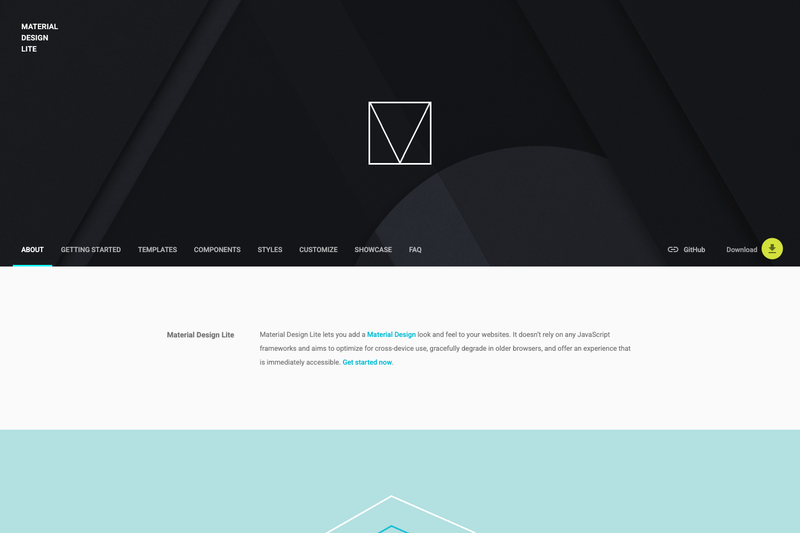
Material Design Lite (MDL) is a Google-authored library that implements Material Design components in vanilla CSS, JavaScript, and HTML, letting you add a Material Design look and feel to static content websites without any JavaScript framework.
What is Material Design Lite?
Material Design Lite (MDL) is a front-end component library developed by Google that provides Material Design components as plain CSS, JS, and HTML files. It takes no framework-specific inputs — you include the prebuilt stylesheet and script and then add MDL's CSS classes and data attributes to your markup, producing a styled Material Design interface. MDL runs in any browser that supports the included standards, and the project is licensed under Apache-2.
What makes Material Design Lite stand out?
- No framework dependencies — MDL is built with vanilla CSS, JavaScript, and HTML, so it works without React, Angular, or any other library.
- Cross-device optimization — Components are designed to work and scale across desktop, tablet, and mobile viewports.
- Graceful degradation — Older browsers such as IE9 receive a B-grade CSS-only experience while A-grade browsers get full functionality.
- Accessible baseline — The components offer an accessible experience from the start, as stated on the project page.
- Multiple delivery options — The v1.3.0 release can be self-hosted from GitHub, loaded from the CDNJS mirror, or installed via the npm package
material-design-lite. - Open-source license — The entire library is released under the Apache-2 license.
- Stable v1.3.0 release — The README recommends using the v1.3.0 release for production and warns that the master branch is unstable.
- Limited support mode — The core team only reviews pull requests and fixes critical bugs; no breaking changes or new core development are accepted.
Who is it for?
- Developers of static content websites — Add Material Design styling to plain HTML pages without introducing a JavaScript framework or build pipeline.
- Front-end developers working on existing sites — Drop MDL's CSS and JS into any project to style buttons, cards, dialogs, and other components with Material Design classes.
- Prototypers and hobbyists — Quickly assemble a Material Design UI from prebuilt component classes without writing CSS from scratch.
- Maintainers of legacy projects — Use a self-hosted v1.3.0 copy to preserve MDL components after the original getmdl.io hosting was retired.
What can you do with Material Design Lite?
- Static site builders: Add Material Design styled forms, buttons, and navigation bars to a brochure site or personal page with just a stylesheet link and a few class names.
- Front-end developers: Prototype interaction patterns like sliders, toggles, and ripples in a plain HTML file, then copy the markup into a larger app.
- Educators and students: Learn Material Design conventions by reading the component source in the GitHub repository, since MDL is a compact, dependency-free codebase.
- Hobbyists: Build a portfolio page with the Material card component and a responsive grid without any build tools.
How does Material Design Lite work?
The README directs users to self-host the v1.3.0 release by grabbing the prebuilt CSS and JS from the GitHub releases page. After including those files, developers add MDL component classes (for example, .mdl-button) and data attributes to regular HTML; MDL's JavaScript then upgrades the elements. The project can also be cloned from GitHub for those who want to compile a custom build, and the README advises configuring git to use LF line endings on Windows to avoid compile issues.
Pros and cons
Pros:
- Zero framework requirements — works with any server-side or static site setup.
- Broad browser support: A-grade for IE10+, Chrome, Opera, Firefox, Safari, and mobile browsers; IE9 degrades to CSS-only.
- Free and open source under Apache-2.
- Still installable via npm and CDNJS despite the retirement of getmdl.io.
Cons:
- In limited support: no new feature development, and only critical bug fixes are accepted.
- The official documentation site and component gallery are no longer available.
- The master branch is unstable, so production use requires the v1.3.0 release.
- IE9 users get a degraded experience.
Alternatives
Material Components for the Web — the official successor from Google, which continues active development and is considered MDL v2 (in early alpha per the README).
FAQ
Is Material Design Lite still maintained?
Material Design Lite is in limited support mode. The core team is not developing new functionality, but they will review pull requests, fix critical bugs, and push out new releases. No breaking changes are accepted. Active development moved to Material Components for the Web.
How do I use Material Design Lite on my website?
The recommended method is to self-host the v1.3.0 release: download the prebuilt CSS and JS from the GitHub releases page and serve them from your own origin. MDL is also mirrored on CDNJS and published on npm as material-design-lite. The old getmdl.io-hosted assets and documentation are no longer available.
Is Material Design Lite free?
Yes, the library is open source and released under the Apache-2 license, so it is free to use, modify, and redistribute. The project is copyrighted to Google, 2015.
What browsers are supported by Material Design Lite?
According to the README, A-grade (full) support is provided for IE10+, Chrome, Opera, Firefox, Safari, Chrome for Android, and Mobile Safari. IE9 is B-grade, meaning it degrades to a CSS-only experience without full JavaScript enhancements.
Can I use Material Design Lite with React or Angular?
Yes, because MDL consists of vanilla CSS, JS, and HTML with no framework dependencies, it can technically be embedded into any framework project. However, the README no longer recommends MDL for new projects; Google's Material Components for the Web is the successor designed around modern framework integration.