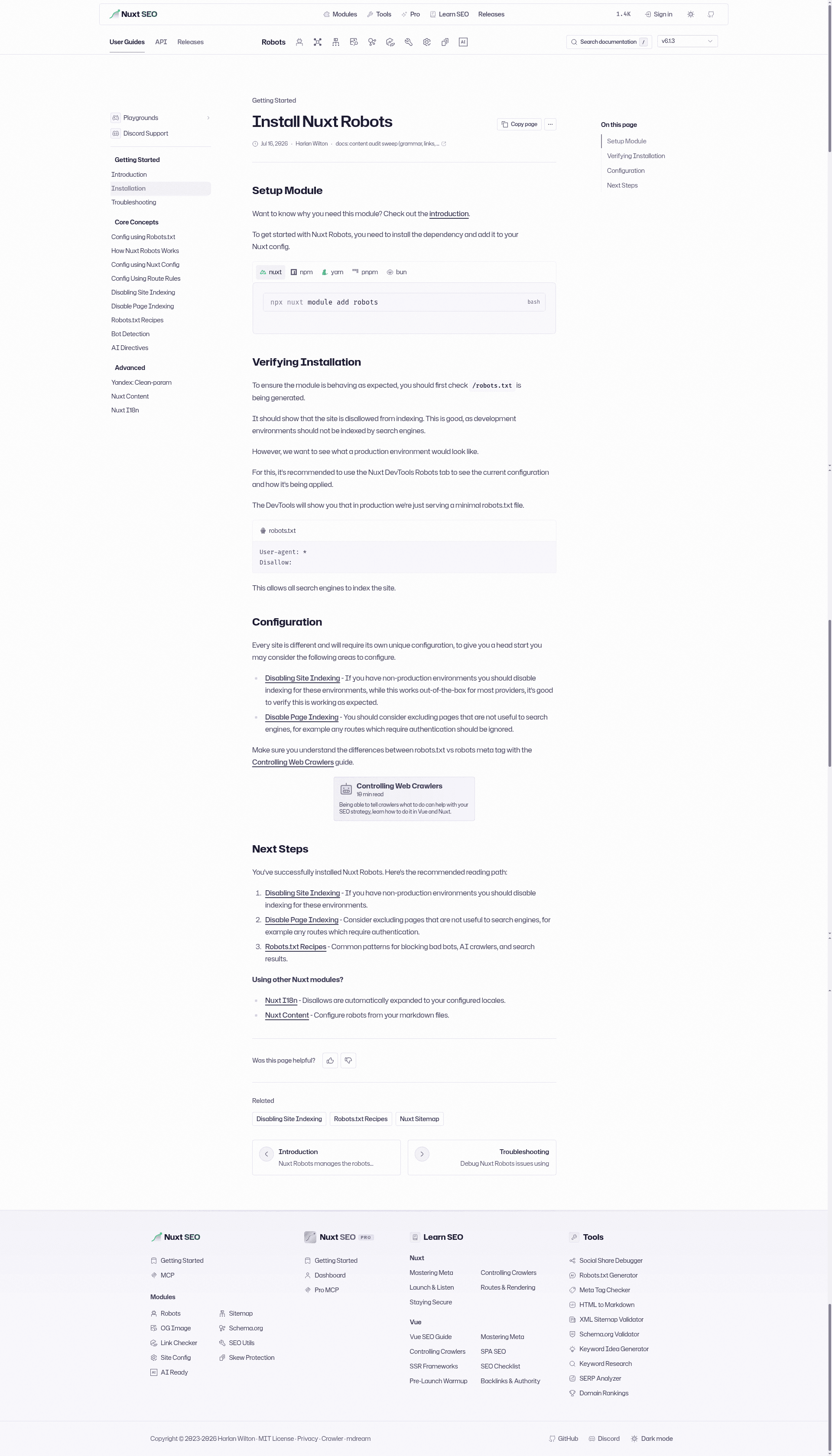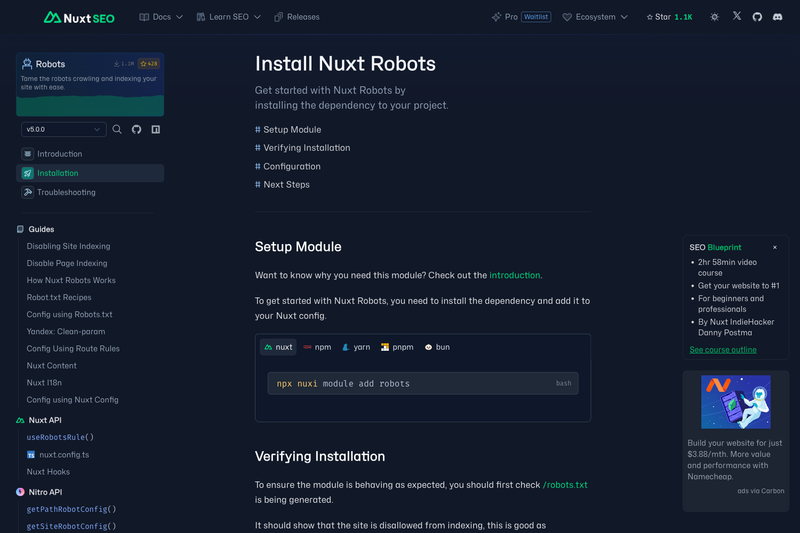
Nuxt Simple Robots is an open-source Nuxt.js module that helps site owners control how search engines crawl and index their Nuxt applications by managing robots.txt and meta robots rules. Originally authored by Harlan Wilton under the MIT License, the project has since been merged into the official @nuxtjs/robots module, and this repository now functions as a migration point for existing users.
What is Nuxt Simple Robots?
Nuxt Simple Robots is a utility module for Nuxt.js, not a website template. It takes your preferred crawling and indexing settings and translates them into the technical outputs that search engine bots read: a robots.txt file at the site root and per-page meta robots tags. The module runs entirely inside a Nuxt project's server and build process, requiring no external service. Because the codebase has been consolidated, the original nuxt-simple-robots package is deprecated; all new development happens under @nuxtjs/robots.
Key Features
- Robots.txt generation — Creates a standards-compliant robots.txt file that tells crawlers which paths they may access on your Nuxt site.
- Meta robots integration — Applies indexing directives such as noindex and nofollow to individual pages, giving you granular control over what appears in search results.
- Nuxt configuration based — All settings are declared in your Nuxt config file, so the module fits the standard Nuxt development workflow without additional UI or dashboards.
- Open-source and MIT licensed — The project is free to use and modify, with source code available on GitHub under the MIT License.
- Clear migration path — Since the module merged into @nuxtjs/robots, existing users can follow the official migration guide to update their configuration with minimal friction.
Who is it for?
- Nuxt site owners who need to prevent search engines from indexing staging or private pages by setting up simple robots rules.
- SEO-focused developers who want to centralize robots control inside their Nuxt configuration rather than managing static robots.txt files by hand.
- Maintainers of existing nuxt-simple-robots websites who must transition to the actively maintained @nuxtjs/robots module and need to know where their current features moved.
Use cases
- Blocking staging environments: Configure the module to disallow all crawlers on non-production deployments, protecting private content from being indexed.
- Granular page control: Mark specific routes, such as admin or user dashboard pages, as noindex so they stay out of search engine results.
- Standard robots policy: Generate a clean robots.txt that allows all bots to access public content and points them to your sitemap, improving crawl efficiency.
FAQ
Is nuxt-simple-robots still maintained?
No. The repository has been merged into @nuxtjs/robots, and the original package is deprecated. The current notice directs users to the migration guide to update their configuration.
What does nuxt-simple-robots do?
It generates robots.txt and meta robots directives for a Nuxt.js site, giving you control over how search engine crawlers access and index your pages.
Is nuxt-simple-robots free?
Yes, the project is open source under the MIT License, so it is free to use, modify, and redistribute.
What should I replace nuxt-simple-robots with?
Replace it with @nuxtjs/robots, the official Nuxt module that continues the functionality. The migration guide at nuxtseo.com/robots/releases/v4 explains how to adapt your configuration.