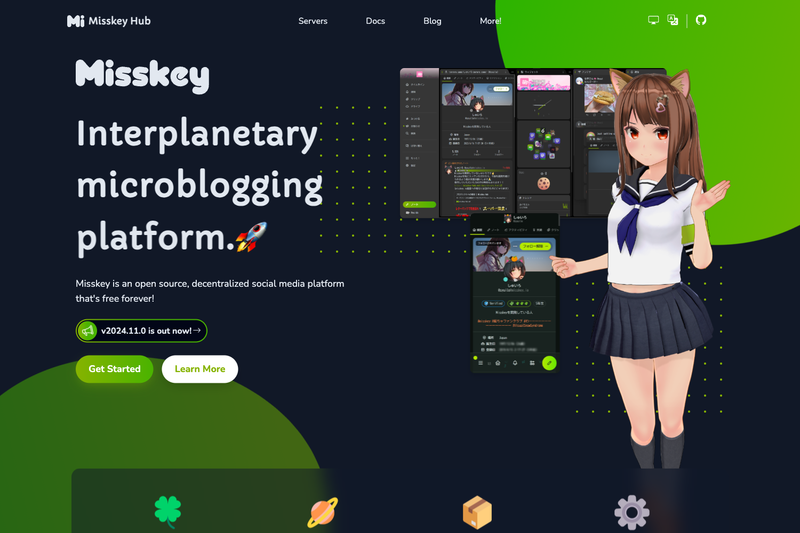
Misskey Hub Next is an open-source Nuxt.js website and documentation hub for the Misskey social media platform, built by the Misskey Project. It turns Markdown docs in /content/ into a multilingual website with locale-aware routing, and it's also the deployable source behind the official Misskey Hub.
What is Misskey Hub Next?
Misskey Hub Next is the official website for Misskey, built on Nuxt. It takes Markdown documentation from the /content/ directory and builds it into a public site with docs and announcements. The project is maintained by syuilo, kakkokari-gtyih, and the Misskey Project, and is released under the GNU Affero General Public License v3.0.
Key Features
- Nuxt & Vue stack — The site is built with Nuxt, the Vue-based framework, and uses a custom
<GNuxtLink>component for enhanced internal/external link handling. - Markdown-driven docs — All documentation lives as Markdown in
/content/, with a dedicated/content/.README.mdguide for contributors. - Crowdin i18n — Translations are managed via Crowdin, and localized paths are generated with the
useGLocalePathcomposable wrapping Nuxt'suseLocalePath. x-mi-web://deep links — Links starting withx-mi-web://followed by a Misskey relative path (e.g./play) are rewritten by<GNuxtLink>into direct Misskey Web links.- Hosting-specific routing — The routing strategy is adapted to the hosting environment, and
useGLocalePathapplies that configuration when creating dynamic links. - Deployment automation — A Google Apps Script program in
/__misc/gas/automates deployment tasks for the Hub. - Multiple package managers — npm, pnpm, and yarn are all supported for installing dependencies and running the dev server or build.
Who is it for?
Misskey Hub Next is meant for the Misskey Project and its contributors. Documentation writers can add Markdown pages and preview them with npm run dev. Translators can localize strings through Crowdin, and developers can use the project as a reference for a Nuxt + i18n site with custom link components.
Use cases
- Misskey contributors: Add or edit documentation by placing Markdown in
/content/and following the.README.mdguide, then submit a pull request. - Translators: Work on translations in Crowdin, and see them rendered on locale-specific URLs thanks to
useGLocalePath. - Open-source learners: Explore how a real Nuxt project implements i18n routing, custom NuxtLink components, and a custom protocol for deep links.
How does Misskey Hub Next work?
Install dependencies with npm install, pnpm install, or yarn install, then start the development server with npm run dev, pnpm run dev, or yarn dev — it listens on http://localhost:3000. For production, run npm run build, then npm run preview to preview the build locally. The project is explicitly designed for Misskey Project's infrastructure and not intended for other environments.
Pros and cons
- Open source — AGPL v3.0 allows study, modification, and redistribution under the same license.
- Full i18n pipeline — Crowdin integration and locale-aware routing make multi-language content straightforward.
- Custom deep-link protocol —
x-mi-web://gives content authors a compact way to link into Misskey Web. - Limited portability — The README states the program is not intended to run outside Misskey Project's infrastructure.
Pricing
Misskey Hub Next is free and open-source under the GNU Affero General Public License v3.0. No paid tiers or commercial licensing are mentioned.
FAQ
Is Misskey Hub Next free?
Yes, it is open-source under the GNU Affero General Public License v3.0, so it can be used, modified, and shared freely under that license.
What is x-mi-web://?
It's a custom URL scheme used in Misskey Hub content. When a link begins with x-mi-web:// and is followed by a Misskey path like /play, the <GNuxtLink> component converts it to a direct Misskey Web link.
How do I add documentation?
Create a Markdown file in /content/, following the rules in /content/.README.md, then start the dev server to preview. Afterward, submit the change to the repository.
Does it run on any hosting?
No — the project explicitly notes it is designed for the infrastructure used by the Misskey Project and is not intended for other environments.
Which package managers work?
npm, pnpm, and yarn are all supported for install, dev, build, and preview commands.