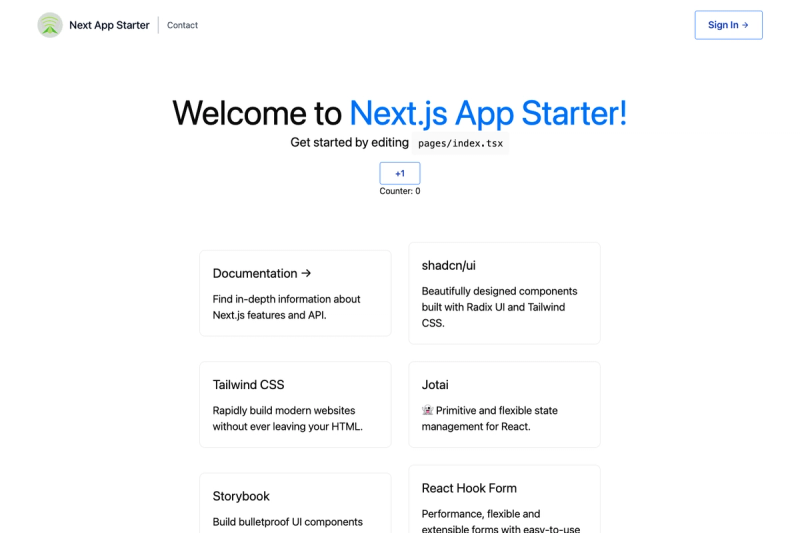
Next App Starter is an open-source Next.js boilerplate that combines a full-stack React toolchain—authentication, database, data fetching, forms, validation, and UI components—into a single starter project.
What is Next App Starter?
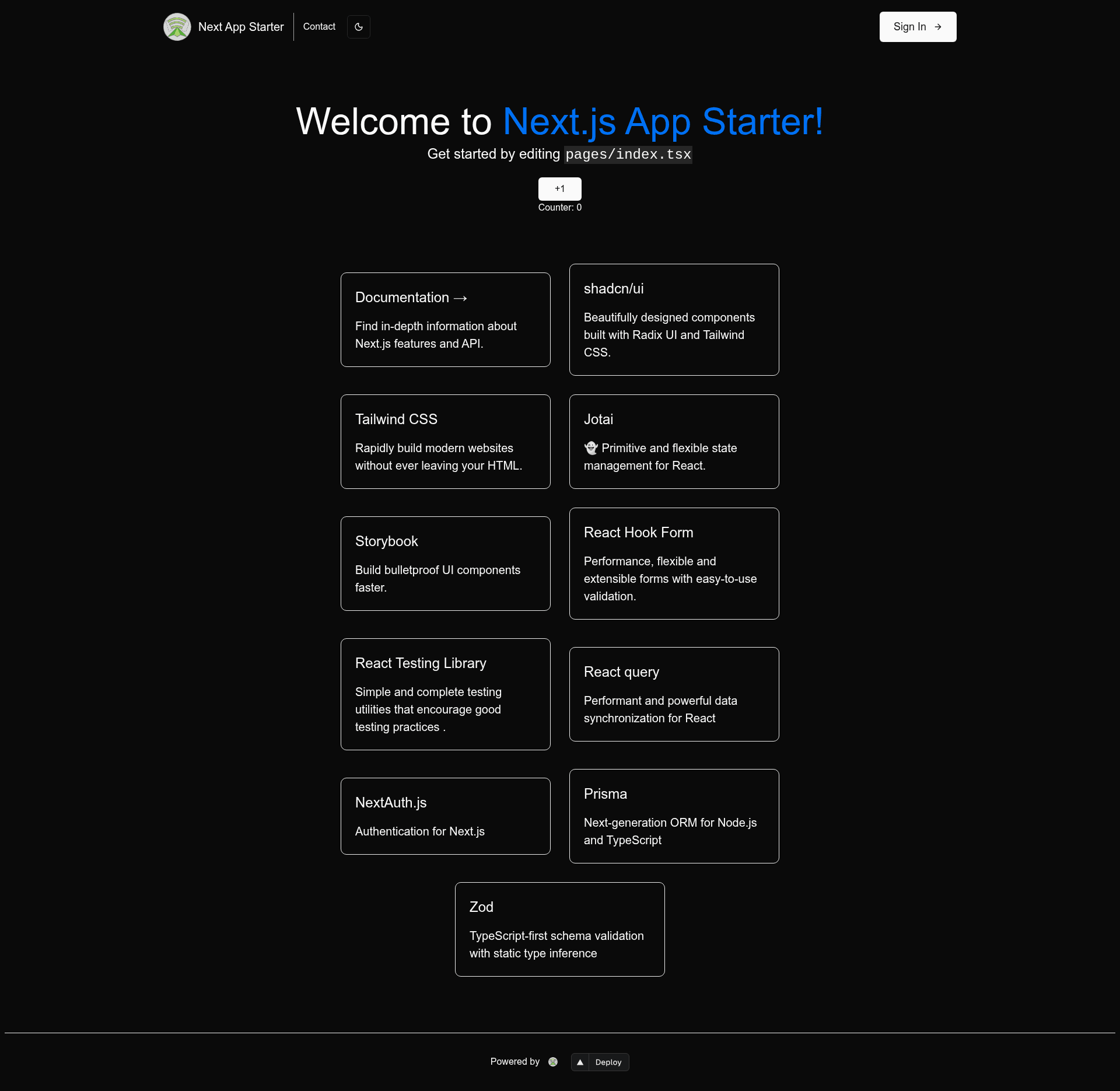
Next App Starter is a version 0.1.0 boilerplate for building full-stack Next.js applications, maintained by Dung Duc Huynh (jellydn) under the MIT License. It provides a working setup with NextAuth.js for authentication, Prisma for database ORM, React Query for data fetching, React Hook Form and zod for form validation, Jotai for state management, and shadcn/ui components styled with Tailwind CSS. The template requires the Bun runtime for installation and scripts, and a live demo is hosted at next-app-starter.vercel.app.
Key Features
- Next.js + Tailwind CSS — The project is built on the React Framework for Production and Tailwind CSS for utility-first styling, both preconfigured.
- Authentication with NextAuth.js — NextAuth.js is included for authentication in Next.js, covering common login flows.
- Prisma ORM — Prisma provides next-generation ORM for Node.js and TypeScript, with a prisma directory for schema and migration scripts.
- React Query integration — TanStack React Query is configured for data synchronization between server and client.
- Form handling with validation — React Hook Form powers flexible forms, and zod or next-validations (which supports Yup, Fastest-Validator, Joi, and more) validate inputs.
- Jotai state management — Jotai offers primitive and flexible state management, with a dedicated store directory for app state.
- UI components with shadcn/ui — Components built with Radix UI and Tailwind CSS that are ready to copy into your app.
- Storybook integration — A storybook directory and bun run storybook command let you build and document UI components in isolation.
Who is it for?
- Full-stack developers who want to skip the repetitive setup of auth, database, forms, and validation when starting a new Next.js project.
- Startup teams building an MVP who need a working baseline with login, a database schema, and API validation to ship quickly.
- Frontend engineers building a design system who can use Storybook to develop and document shadcn/ui components in isolation.
- Developers experimenting with the Bun runtime who want a preconfigured toolchain that runs entirely through Bun scripts.
What can you do with Next App Starter?
- Build a SaaS product with user accounts — Use NextAuth.js for authentication and Prisma for user data, then fetch it with React Query to render dashboards.
- Create an admin panel — Combine Tailwind CSS and shadcn/ui components to lay out tables, forms, and charts quickly.
- Develop and test UI components — Run Storybook to view components in isolation and write tests with React Testing Library before integrating them into pages.
- Learn a modern React architecture — Study how Jotai, React Query, React Hook Form, and zod are wired together in a production-like starting point.
How does Next App Starter work?
The template is installed with bun install, then you create a .env file based on .env.example and start the development server with bun run dev. Tests run with bun run test, and Storybook launches with bun run storybook. The project also includes pre-commit configuration for enforcing code quality via pre-commit install.
FAQ
Is Next App Starter free?
Yes, Next App Starter is released under the MIT License, so you can use, modify, and distribute it freely, including in commercial projects.
What runtime does it require?
The project lists Bun—a fast, all-in-one JavaScript runtime—as a pre-requirement, alongside Biome as the web toolchain. The install and dev commands are written for Bun.
Does it include authentication?
Yes, NextAuth.js is integrated as the authentication library for Next.js, so you have a starting point for adding login and session management.
What form validation options are available?
React Hook Form manages forms, and validation is handled by zod, which is TypeScript-first, or by next-validations, which supports Yup, Fastest-Validator, Joi, and more.
Can I deploy the demo?
A live demo is already hosted at next-app-starter.vercel.app, and since it's a standard Next.js app, it can be deployed to any platform that supports Next.js.