Newsletter
Join the Community
Subscribe to our newsletter for the latest news and updates

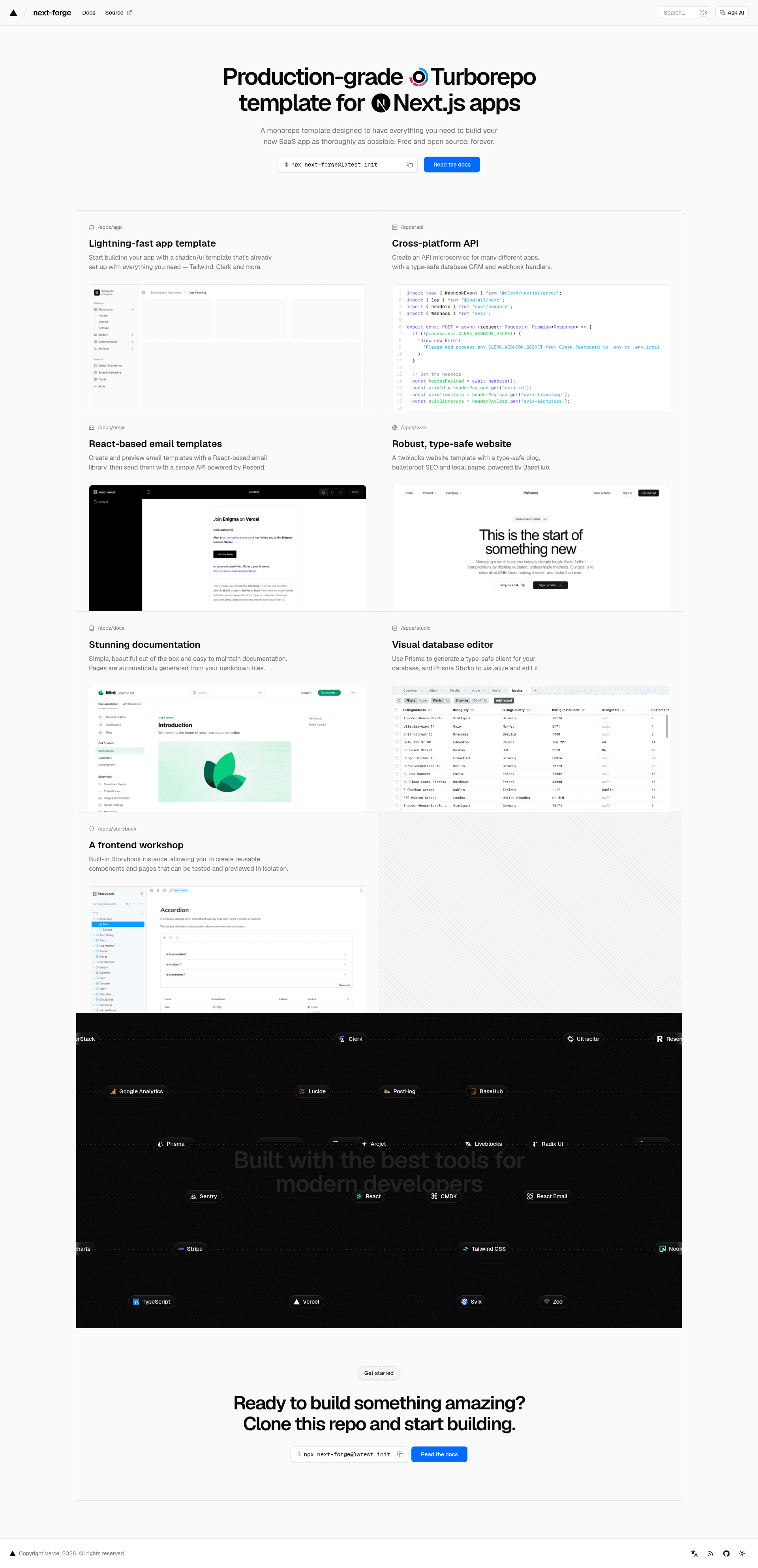
Production-grade Turborepo monorepo template for Next.js SaaS apps, bundling Clerk auth, Stripe payments, Tailwind CSS, email, analytics and monitoring.
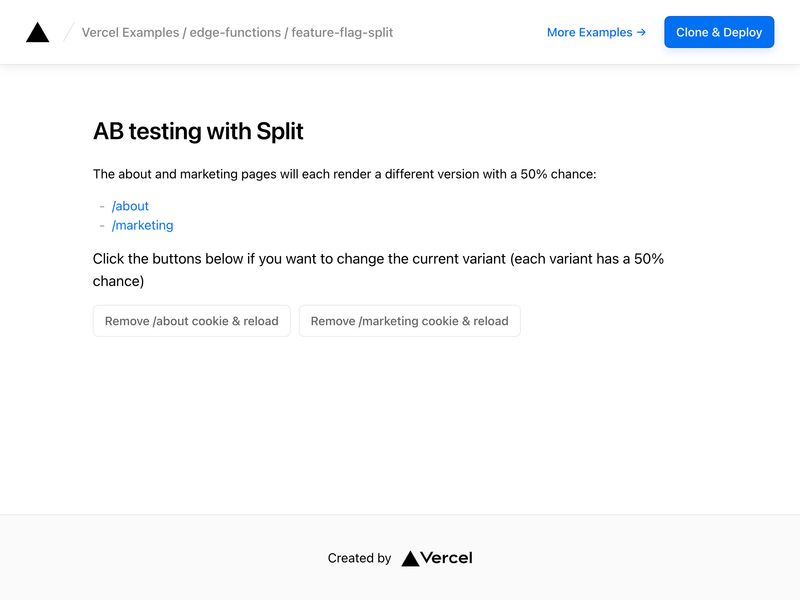
Next.js Edge Middleware example that uses Split feature flags to A/B test a marketing page and an about page, styled with Tailwind CSS.

A minimal Hugo static-site boilerplate from Vercel's examples repository that deploys to Vercel with zero configuration.
Minimal Flask example that runs a WSGI Python API on Vercel Serverless Functions using the Python Runtime.
Vercel example boilerplate that runs an AI SDK backend on a Hono server and deploys with the Vercel CLI.
next-forge is a production-grade Turborepo monorepo template for Next.js applications, published by Vercel, that scaffolds a full SaaS foundation — six independently deployable apps plus roughly twenty shared packages — from a single init command.
next-forge is a Turborepo monorepo starter for Next.js apps, maintained by Vercel and installed with npx next-forge@latest init. Pointed at an empty directory it generates a typed workspace containing six runnable apps (web, app, api, docs, email, storybook) and shared packages covering authentication, database, design system, payments, email, analytics, observability, security, CMS, SEO, AI, webhooks, collaboration, feature flags, cron, storage, internationalization and notifications. Prerequisites are Node.js 20 or newer, a package manager such as Bun (npm, yarn and pnpm also work), and the Stripe CLI for testing webhooks locally.
apps/ folder of deployable applications and a packages/ folder of shared libraries, all orchestrated by Turborepo; every app deploys independently.npx next-forge@latest init to generate the monorepo.next-forge is released under the MIT license and is free to use and modify. Its philosophy is described as "cheap — free to start with services that scale with you", meaning the bundled third-party services (Clerk, Stripe, Resend, Sentry and others) are billed under their own separate plans.
next-forge is a Turborepo monorepo template for Next.js from Vercel. Running its init command generates six deployable apps — web, app, api, docs, email and storybook — plus shared packages for authentication, database, payments, design system, analytics, security and more.
Yes. next-forge is MIT licensed and free to install and modify. The third-party services it integrates, such as Clerk, Stripe, Resend, Sentry and BetterStack, each have their own pricing and free tiers, so account setup is required before those features work.
You need Node.js 20 or newer, a package manager such as Bun (npm, yarn and pnpm are also supported), and the Stripe CLI if you want to test Stripe webhooks locally. You also configure environment variables and create service accounts during setup.
The next-forge documentation includes migration guides for swapping providers, so packages such as authentication, payments or email can be replaced with alternatives rather than being permanently locked in.
create-t3-app, which targets a single Next.js app with tRPC and Prisma rather than a multi-app Turborepo monorepo.