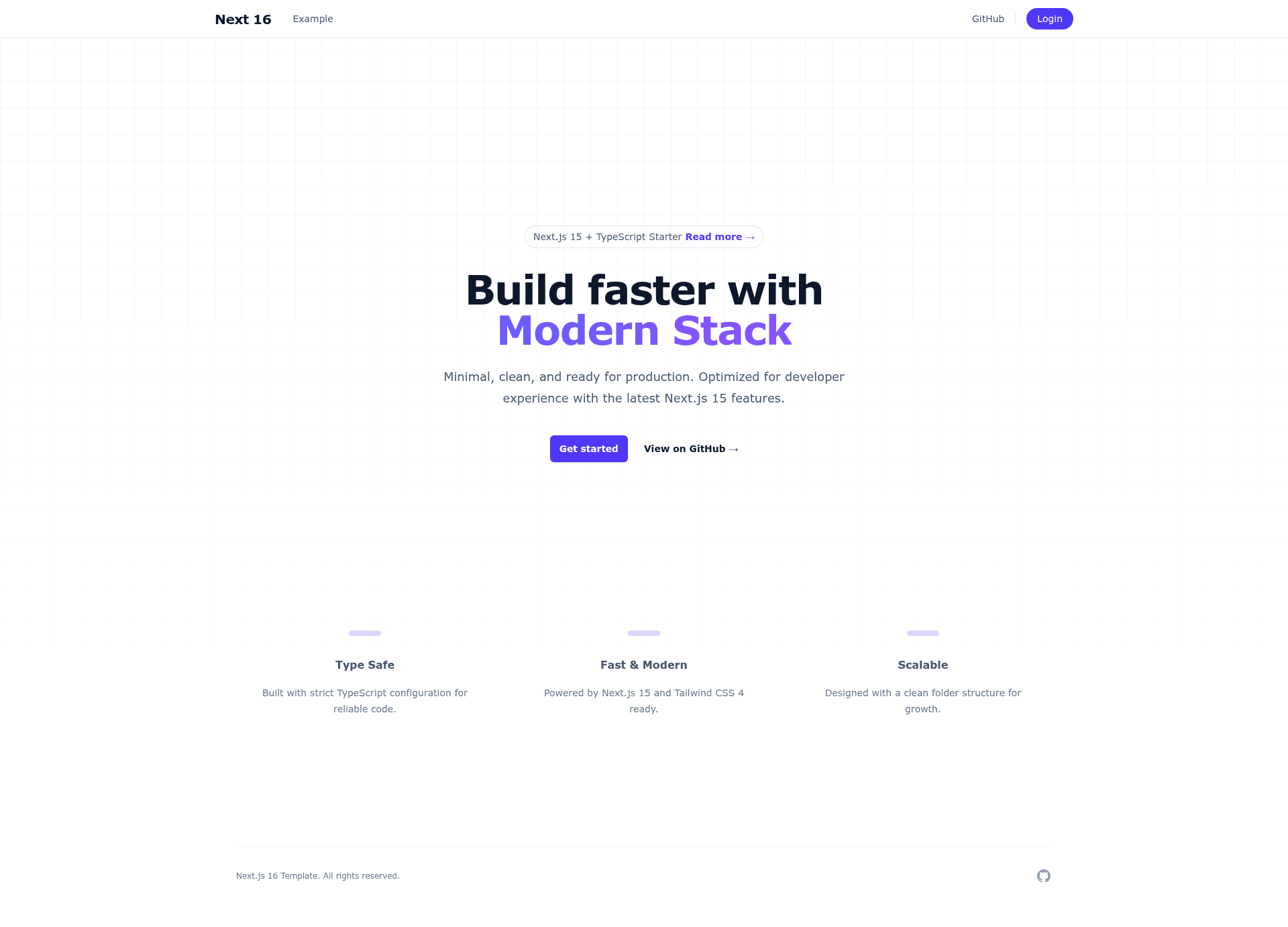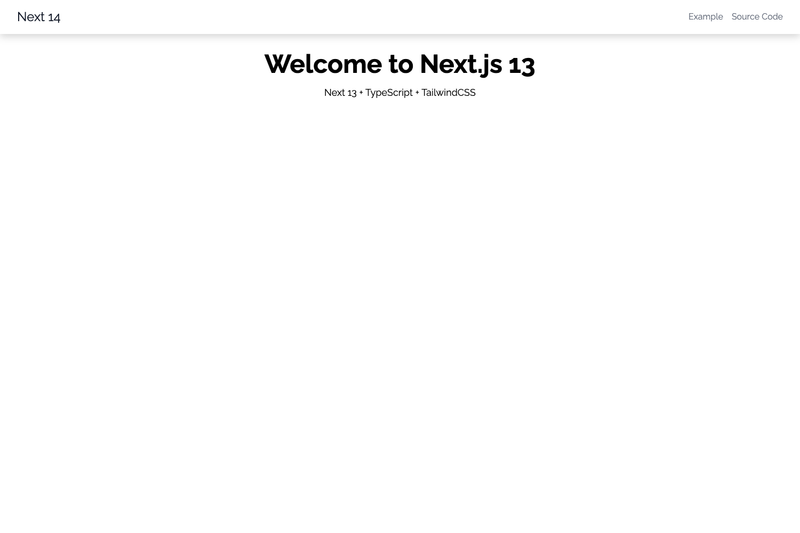
The Next.js 16 Fullstack Template is an open-source boilerplate for building full-stack web applications with the Next.js App Router, TypeScript, MongoDB, and a preconfigured toolchain. It comes from GitHub user bysxx, is licensed under MIT, and is designed to be a production-ready starting point that wires together authentication, data fetching, styling, state management, testing, and linting.
What is the Next.js 16 Fullstack Template?
The template provides a complete project structure for a full-stack Next.js application, taking environment variables (MongoDB connection string, NextAuth secret, and Kakao OAuth credentials) as input and producing a runnable app with session authentication, TypeScript support, and a Tailwind CSS 4 styled UI. It runs on Node.js 18 or higher and is intended for use with the pnpm package manager. The repository has 115 stars on GitHub, indicating community interest.
Key Features
- Framework — Next.js 16 (App Router) with React 19 and TypeScript, and backend logic in Next.js API Routes.
- Authentication — NextAuth.js with the @auth/mongodb-adapter, storing sessions in MongoDB and supporting OAuth providers such as Kakao via environment variables.
- Database — MongoDB as the primary database, connected through the NextAuth MongoDB adapter and accessible from API routes.
- Styling — Tailwind CSS 4 for utility-first styling, configured and ready to customize.
- Data fetching — TanStack Query (React Query) v5 for server-state management, caching, and background updates.
- State management — Zustand for lightweight client-side global state.
- Linting and formatting — Biome with pnpm lint, pnpm format, pnpm check, and pnpm check:fix scripts.
- Testing — Jest with React Testing Library for unit and component tests via pnpm test.
Who is it for?
- Fullstack developers — start with a typed Next.js + MongoDB project that includes auth, data fetching, and state management.
- Startup founders and indie hackers — launch an MVP with Kakao social login and a MongoDB session store in one command.
- Engineering teams — standardize on TypeScript, Biome, Jest, and pnpm workflows with preconfigured scripts.
- Next.js learners — study a realistic App Router project structure combining popular libraries.
What can you do with the template?
- Set up authentication quickly — configure Kakao OAuth credentials in .env.local to enable NextAuth login with MongoDB session persistence.
- Build data-driven interfaces — use TanStack Query v5 to fetch and cache API data in the frontend, with TypeScript types across the stack.
- Maintain code quality — run pnpm lint, pnpm format, pnpm check, pnpm type, and pnpm test to validate the codebase before each deployment.
- Deploy a production app — run pnpm build and pnpm start to create and serve a production bundle as a standard Next.js app.
How does it work?
Clone the repository and run pnpm install to fetch dependencies. Create a .env.local file with the documented variables (NEXTAUTH_SECRET, NEXTAUTH_URL, MONGODB_URI, KAKAO_CLIENT_ID, KAKAO_CLIENT_SECRET), then run pnpm dev to launch the app on http://localhost:3000. The available pnpm scripts cover development, building, starting, linting, formatting, type checking, and testing.
Pros and cons
- Pros — MIT-licensed; includes authentication, database, styling, data fetching, state management, linting, and testing in one scaffold; clear environment variable documentation.
- Considerations — You need to provide your own MongoDB instance and Kakao OAuth app credentials before the app is fully functional; the tech stack table lists Next.js 15 while the header says Next.js 16, so verify the actual version after cloning.
FAQ
Is the Next.js 16 Fullstack Template free?
Yes, the project is published under the MIT license, so it is free for personal and commercial use.
What are the prerequisites to run it?
You need Node.js version 18.0.0 or higher and pnpm installed. You also need a MongoDB connection string for storage and a Kakao OAuth application for social login.
Which authentication providers are configured?
The template uses NextAuth.js and includes Kakao OAuth environment variables. Because it uses the MongoDB adapter, sessions are persisted in MongoDB, and you can extend the providers array to add more.
What package manager does the template require?
The template is built around pnpm; the provided scripts and lockfile assume pnpm. Use pnpm install rather than npm or Yarn.
Does it include tests?
Yes, Jest and React Testing Library are configured, and the test suite runs with pnpm test.