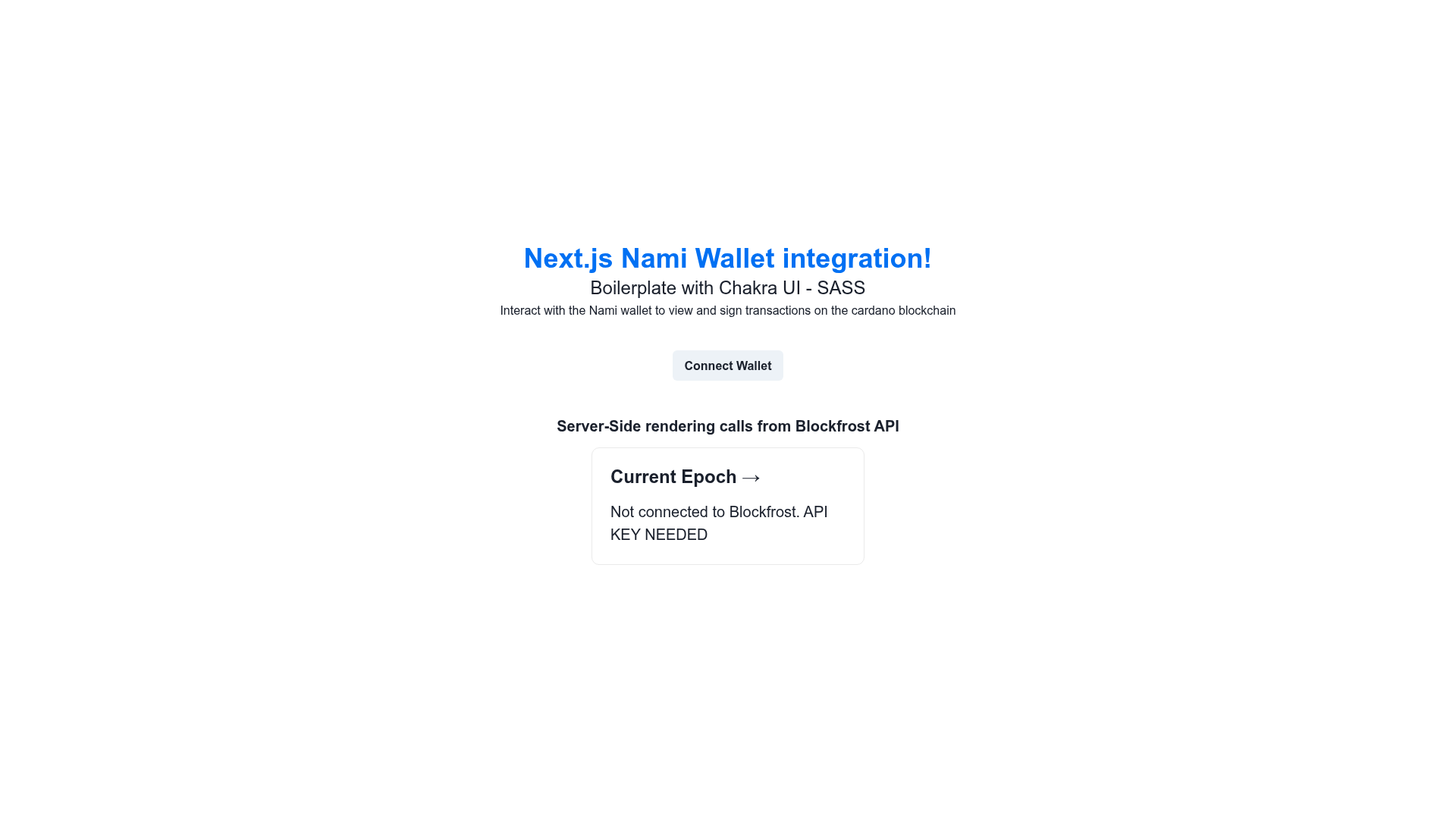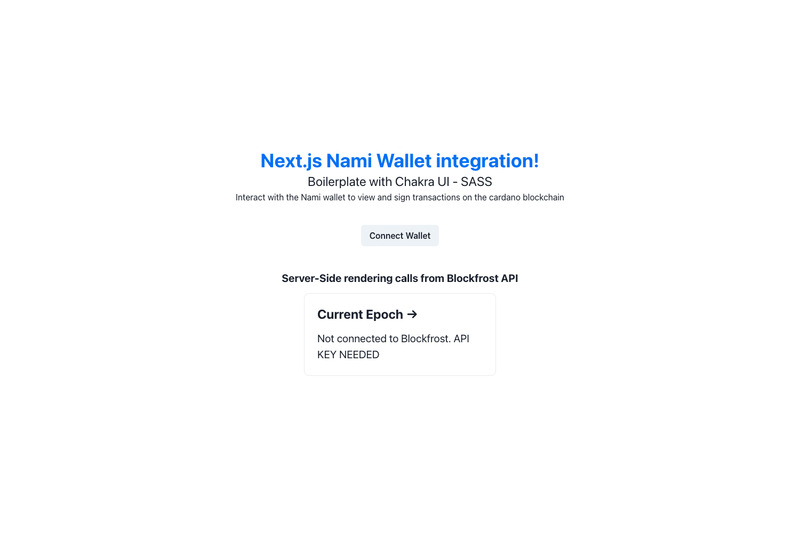
Nextjs Cardano DappWallet Boilerplate is a Next.js and Chakra UI starter template built with TypeScript for integrating Cardano dapp wallets into a web application. It serves as a concrete jumping-off point for developers who want to see how to connect Cardano wallets and query blockchain data using the Blockfrost API.
What is Nextjs Cardano DappWallet Boilerplate?
This template bootstraps a Next.js application with Chakra UI and TypeScript, pre-configured for Cardano dapp wallet integration. It consumes a Blockfrost API key that you supply via a .env.local file and uses it to retrieve Cardano blockchain details. The project outputs a running web app with wallet connection capabilities, based on the community-maintained nextjs-chakra-boilerplate.
Key Features
- Next.js framework — Uses the React-based Next.js framework with file-based routing, server-side rendering, and API routes.
- Chakra UI styling — Includes Chakra UI for accessible, themeable React components, set up out of the box.
- TypeScript support — Written in TypeScript, giving you type safety across components and blockchain data.
- Blockfrost API integration — Pulls Cardano blockchain data, but requires a free API key from blockfrost.io and environment configuration.
- Component generator script — Ships a
createComponent.shshell script that creates new components in the./componentsdirectory using-a ComponentName. - Web3 ready — Repository topics include NFT and web3, positioning it as a base for Cardano NFT dApps.
- Standard project structure — Bootstrapped from
nextjs-chakra-boilerplate, so you get conventional Next.js folders likepages,components, andpublic.
Who is it for?
- Cardano dApp developers — Use it as a scaffold for front-ends that need to display wallet status and on-chain asset data.
- Next.js developers exploring web3 — Take advantage of a pre-configured stack to skip setup and focus on blockchain interactions.
- NFT project teams — Build a marketplace or gallery UI on Cardano by extending the wallet connection and Blockfrost data fetching.
What can you do with Nextjs Cardano DappWallet Boilerplate?
- Cardano developers: connect a dapp wallet to your Next.js app and display wallet-derived information from the Cardano blockchain via Blockfrost.
- NFT creators: start an NFT-focused web app that can query asset metadata and transaction history using the Blockfrost API.
- Technical founders: prototype a Cardano web3 product quickly, with a component script that accelerates building UI pieces.
How does Nextjs Cardano DappWallet Boilerplate work?
First, install dependencies with npm install or yarn install. Next, copy .env.local.example to .env.local and add your Blockfrost API key. Then start the development server with npm run dev or yarn dev. The application runs on http://localhost:3000 and is ready for wallet integration.
FAQ
Does the template require a Blockfrost API key?
Yes, the README states that you need an API key from blockfrost.io to retrieve details about the Cardano blockchain. You add it to a .env.local file.
What stack does this boilerplate use?
It uses Next.js as the React framework, Chakra UI for styling, TypeScript for static typing, and the Blockfrost API for Cardano data.
Can I create components easily?
Yes, it includes a shell script ./createComponent.sh -a ComponentName that generates a new component skeleton in the ./components directory.