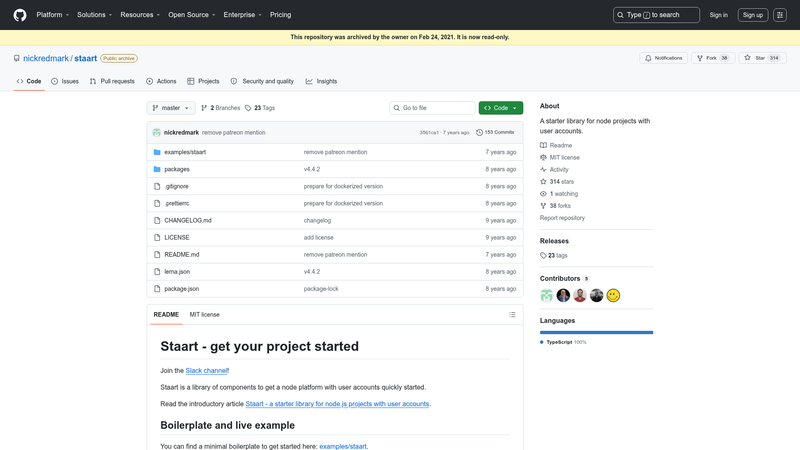
Staart is a starter library for Node.js projects that require user accounts, offering pre-built components for registration, login, account management, password resets, and email verification. It is published as an open-source project by nmaro, with a live demo at staart.nmr.io and a minimal boilerplate under examples/staart in the repository. Staart pairs with Ooth, a separate Node.js user-accounts library, to handle the underlying authentication logic; Ooth can also be used on its own.
What is Staart?
Staart is a library of components that bootstraps a Node.js platform with user accounts, so developers don't need to write common authentication flows from scratch. It accepts a new or existing Node.js project and provides the front-end and routing pieces for email/password registration, email-or-username login, an account settings page, reset-password pages, and email verification. The project maintains a minimal boilerplate in the examples/staart directory and a live example at staart.nmr.io that demonstrates every included flow. Staart was created by nmaro and is closely related to Ooth, its sister library that supplies the reusable user-accounting logic.
Key Features
- Email and password registration — new users can sign up with just an email and password, as shown on the live example.
- Flexible login — users can sign in with either their email or their username, combined with a password.
- Account settings page — authenticated users can set a username, change their password, and request a verification email to be resent.
- Forgot and reset password flow — dedicated pages let users request a reset and set a new password.
- Email verification — a separate verify-email page confirms a user's address after registration.
- Sister library Ooth — a standalone Node.js user-accounts library that Staart uses for authentication logic and that you can adopt independently.
- Live example and boilerplate — staart.nmr.io shows all features in action, and the examples/staart folder provides a minimal starting point.
Who is it for?
- Node.js developers — get a working authentication scaffold for a new platform without wiring up sessions, password hashing, and email flows from scratch.
- Startup founders building MVPs — use the live example and boilerplate to validate signup and login UX before investing in custom auth code.
- Developers learning authentication — study the Staart components and their integration with Ooth to understand how user-account flows fit together in Node.js.
- Teams extending Ooth — use Staart as a reference implementation of the UI and routing that Ooth's logic can power.
What can you do with Staart?
- Scaffold a new platform: clone the boilerplate from examples/staart and customize the registration and login pages for your own product.
- Prototype user flows: run the live example at staart.nmr.io to see how registration, login, account settings, password reset, and email verification behave before committing to a design.
- Combine with Ooth: plug Staart's components into a project that already uses Ooth for its user management, or extend Ooth's behavior and reuse Staart's pages.
FAQ
What does Staart do?
Staart provides reusable components and a boilerplate for adding user accounts to a Node.js project. It includes registration with email and password, login with email or username, an account page for changing username or password, reset-password pages, and an email-verification page, as demonstrated in its live example.
What is Ooth?
Ooth is Staart's sister project: a user accounts library for Node.js that handles the underlying authentication logic. Ooth is independent of Staart, so you can use it directly in your own Node.js application without taking the Staart components.
Where can I find the Staart boilerplate?
The repository includes a minimal boilerplate in the examples/staart folder. It gives you a starting point for wiring up the Staart components, and a fully working live example is available at staart.nmr.io.
Does Staart support email verification?
Yes, Staart includes a verify-email page and a resend-verification-email action on the account page. The live example at staart.nmr.io features both, so you can test the flow.