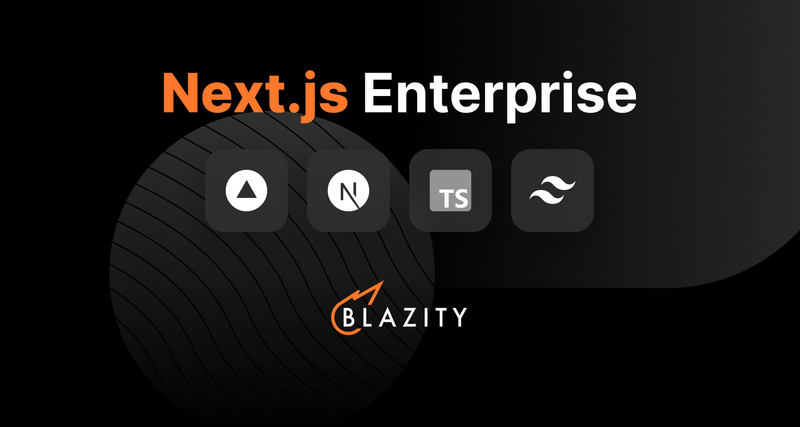
Next.js Enterprise Boilerplate is an open-source, MIT-licensed boilerplate by Blazity that scaffolds a production-ready Next.js 15 application with a pre-configured toolchain, testing suite, and deployment infrastructure.
What is Next.js Enterprise Boilerplate?
Next.js Enterprise Boilerplate is a project template that generates a fully configured Next.js 15 app using the App Directory, Tailwind CSS v4, strict TypeScript, ESLint 9, Prettier, and pnpm via Corepack. It takes an empty repository as input and outputs an application ready for development, testing, and deployment to Vercel or custom AWS infrastructure. The boilerplate is produced and maintained by Blazity, a group of Next.js architects who build and deploy high-performance Next.js applications for enterprise clients.
Key Features
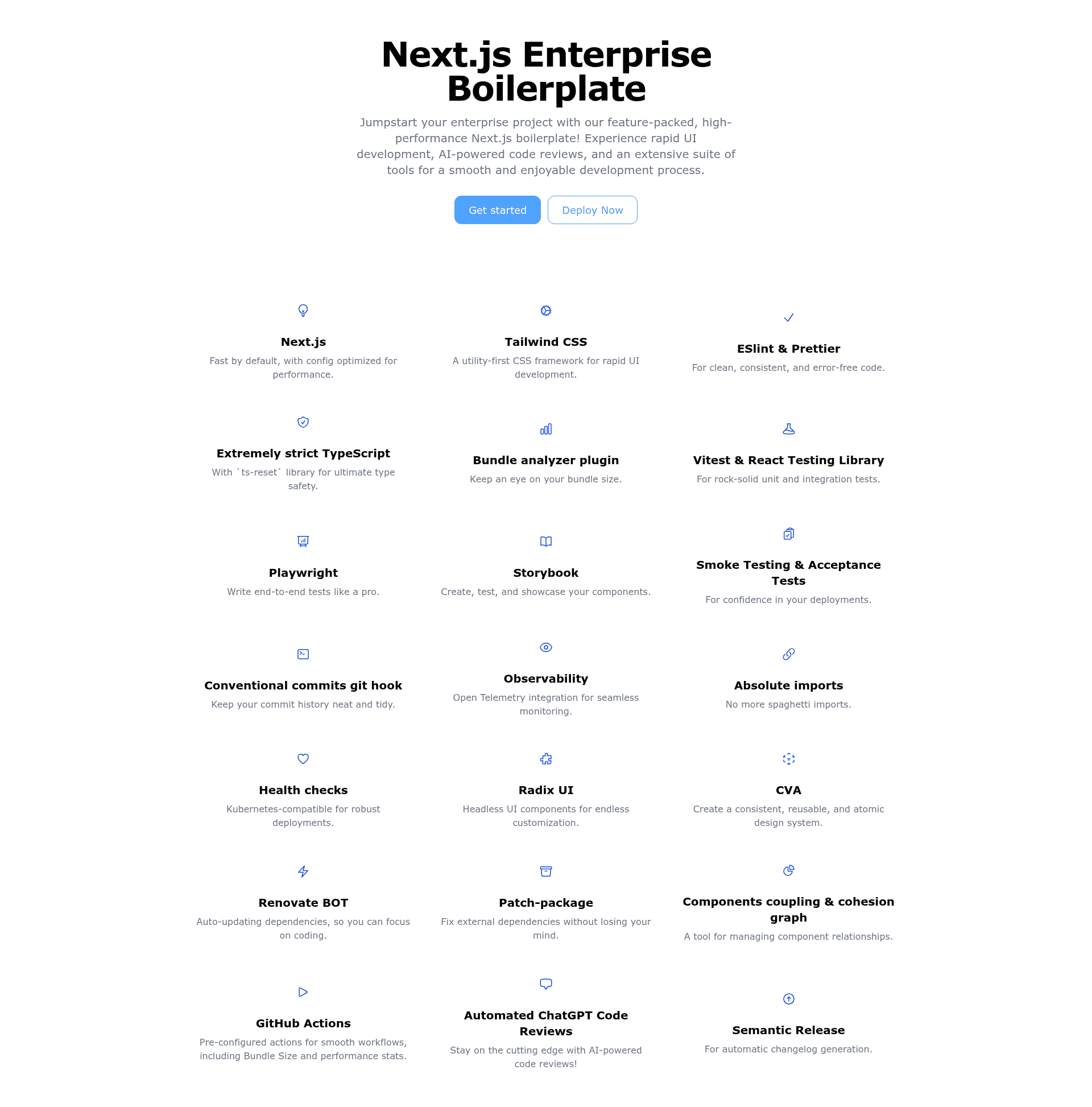
- Framework and styling — Next.js 15 with App Directory, Tailwind CSS v4, strict TypeScript with ts-reset, ESLint 9, Prettier, and pnpm via Corepack.
- Testing suite — Vitest, React Testing Library, and Playwright, plus smoke and acceptance testing capabilities.
- Component documentation — Storybook for developing and documenting components in isolation.
- Infrastructure as Code — Terraform-based AWS infrastructure with VPC, ECS, ECR, Application Load Balancer, S3+CloudFront, AWS WAF, and Redis Cluster, provisioned via a simple CLI.
- Observability and monitoring — OpenTelemetry integration, Kubernetes-compatible health checks, and a bundle analyzer to track bundle size.
- Automation — GitHub Actions workflows for bundle size and performance tracking, Renovate BOT for dependency and security updates, Semantic Release for changelogs, and conventional commits.
- UI primitives — Radix UI headless components and CVA (Class Variance Authority) for building a consistent design system.
Who should use Next.js Enterprise Boilerplate?
- Enterprise engineering teams — they get a consistent, strict codebase and testing setup to start a new product without configuring tooling.
- DevOps and platform engineers — they can leverage the included Terraform and CLI to deploy to AWS with secure, scalable resources.
- Startups and product teams — they can accelerate time-to-market with pre-built CI/CD, Storybook, and observability, plus one-click Vercel deployment.
- Agencies building for clients — they can reuse the same boilerplate across projects, ensuring maintainable and consistent deliverables.
What can you do with Next.js Enterprise Boilerplate?
- Scaffold a new web app — get a Next.js 15 project with linting, formatting, testing, and TypeScript configured in minutes.
- Deploy to Vercel — use the one-click deployment button to push the project to a live URL.
- Provision AWS infrastructure — use the provided CLI and Terraform to set up a production environment with VPC, ECS, and WAF.
- Build and document components — use Storybook and Radix UI to create and showcase UI components with accessible, headless primitives.
How does Next.js Enterprise Boilerplate work?
Deploy the template to Vercel with the one-click button, or run the custom CLI to provision Terraform-based AWS infrastructure. The repository includes GitHub Actions workflows that run on every push, with Renovate BOT keeping dependencies and security patches updated. For local development, use pnpm via Corepack to install dependencies and run the Next.js app.
FAQ
Is Next.js Enterprise Boilerplate free?
Yes, the template is released under the MIT license, so it is free to use, modify, and distribute for personal and commercial projects.
What Next.js version does it use?
The boilerplate is built on Next.js 15 with the App Directory routing convention, and it uses Tailwind CSS v4 for styling.
What testing tools are included?
The template bundles Vitest and React Testing Library for unit and integration tests, and Playwright for end-to-end tests, plus smoke and acceptance testing capabilities.
Does it include deployment infrastructure?
Yes, it offers one-click deployment to Vercel and a Terraform-based infrastructure-as-code solution for AWS, covering VPC, ECS, ECR, Application Load Balancer, S3+CloudFront, AWS WAF, and Redis Cluster.