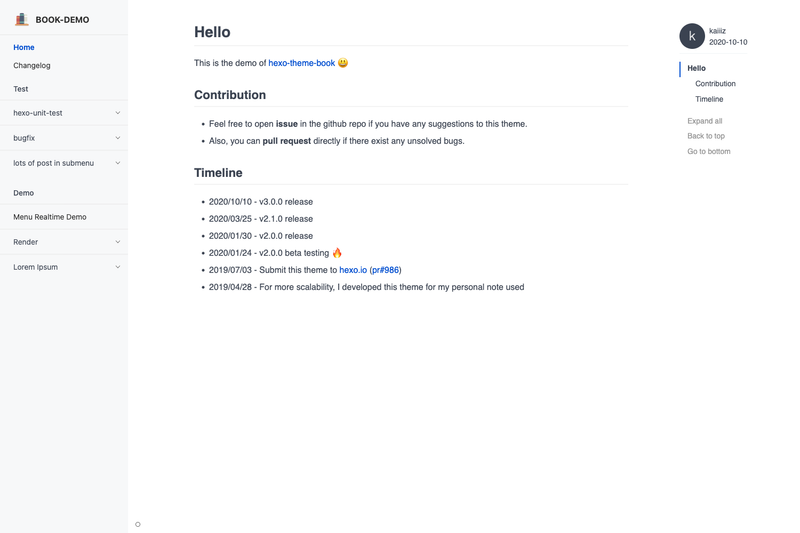
Purelog is a responsive sidebar theme for the Jekyll static site generator, built on the minimal Pure.css framework and designed to run blogs, note-taking, and daily journal sections from a single Jekyll site.
What is Purelog?
Purelog is a Jekyll theme published on RubyGems (gem name purelog) and distributed under the MIT License. It takes standard Jekyll content — Markdown posts organized into _posts, _notes, and _journals collections — and renders a responsive site with a sidebar layout, automatic archive, tags, and category pages. The theme was created by Brennan Brown as a successor to his Watery theme.
Key Features
- Lightweight Pure.css base — Styling comes from the Pure.css framework rather than a heavier framework like Bootstrap or Tailwind, keeping the theme minimal.
- Separate content collections — Ships with
_posts,_notes, and_journalsfolders so blog posts, short notes, and journal entries stay organized and can be styled differently. - On-site search — Uses Simple Jekyll Search to provide client-side search without a third-party service.
- Auto-generated archive and taxonomy pages — An archive page displays entries from all collections, and tag/category pages are generated automatically.
- Author bio include — An author box appears at the end of each post, powered by
_includes/author.html. - Rouge syntax highlighting — Code blocks are highlighted with Rouge using the
base16.solarized.lighttheme. - Built-in SEO and feed support — Integrates
jekyll-feed,jekyll-seo-tag,jekyll-paginate-v2, andjekyll-sitemapas plugins. - Optional Google Analytics 4 — Add a GA4 measurement ID in
_config.ymland the snippet loads only in production builds.
Who is it for?
Purelog is aimed at writers and bloggers who want a Jekyll theme that separates long-form posts from short notes and daily journals. It's also suited for developers who want a minimal, configurable starting point that can be deployed to Netlify with a single click.
What can you do with Purelog?
- Bloggers: Publish Markdown posts in
_postsand get an auto-generated archive, tags, and RSS feed. - Note-takers: Use the
_notescollection to keep short-form thoughts separate, with its own listing. - Journal keepers: Maintain daily entries in
_journalsand have them auto-included in the archive. - Jekyll developers: Install Purelog as a theme gem in an existing project or use it as a starting template, then customize the
_BLANK_config.ymlfile.
How does Purelog work?
Purelog runs as a standard Jekyll site: install Ruby 2.5.0 or higher, add the theme to your Gemfile, run bundle install, then bundle exec jekyll serve to preview at http://localhost:4000. You can also deploy directly to Netlify using the provided Deploy to Netlify button, which clones the repository and builds it in the Netlify pipeline.
FAQ
Is Purelog free to use?
Yes. Purelog is open-source under the MIT License, so you can use it for personal or commercial projects without attribution.
How do I install Purelog?
Add gem "purelog", "~> 0.1.0" to your Gemfile, set theme: purelog in _config.yml, then run bundle install and bundle exec jekyll serve.
Does Purelog include search?
Yes, it uses Simple Jekyll Search to provide on-site, client-side search without external services.
Can I use Google Analytics with Purelog?
Yes, set google_analytics to your GA4 measurement ID in _config.yml; the tracking snippet only loads in production builds.