r-hugo-theme is a lightweight Hugo theme for building static websites such as portfolios, documentation libraries, and blogs, with responsive layouts and automatically generated navigation.
What is r-hugo-theme?
r-hugo-theme is a Hugo static-site theme that suits portfolios, documentation libraries, and blogs. It takes content authored in Hugo's standard structure and renders a fully-themed static site. The theme is available on GitHub and can be added to a Hugo project as a Git submodule. Configuration happens through a config.yaml file, and the repository includes example-site and example-site-multilingual directories for quick setup.
Key Features
- Responsive layout — Layouts adapt to desktops, tablets, mobile, and print output.
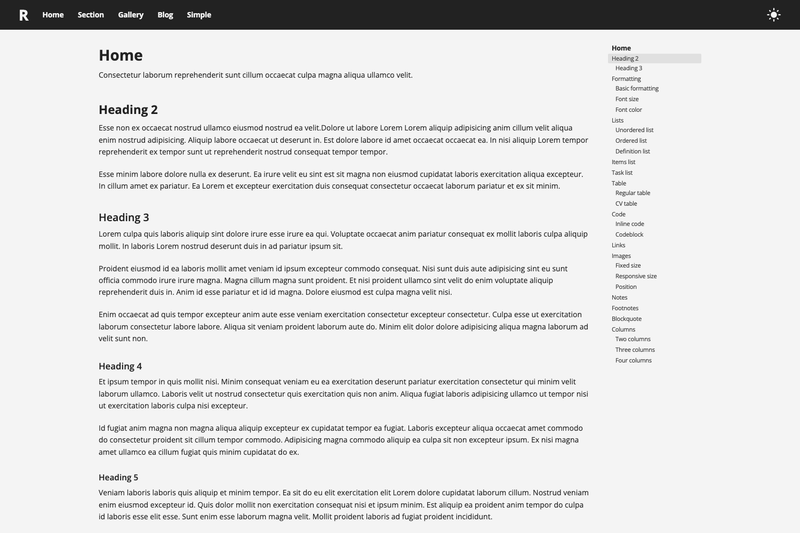
- Light and dark mode switch — A built-in control lets visitors toggle between light and dark appearances, with mobile and desktop previews shown in the README.
- Extensive auto-generated navigation — Includes section navigation ("In this section"), page navigation ("On this page"), breadcrumbs, next/previous page links, and related links derived from keywords.
- Customizable footer contact info — Footer content is easily editable for adding contact details.
- Blogging support — Include categories, tags, and estimated reading time for posts.
Who is it for?
- Portfolio owners — Showcase projects and work samples with a clean, responsive layout and simple navigation.
- Documentation writers — Leverage the breadcrumb, page-level, and related-content navigation to organize guides and references.
- Bloggers — Publish posts with categories, tags, and reading time estimates, plus built-in light/dark toggling.
What can you do with r-hugo-theme?
- Launch a personal site — Use the example-site content as a starting point, then edit
config.yamlto customize site info and navigation. - Create a documentation hub — Structure content into sections that automatically generate breadcrumbs and in-section/page navigation.
- Run a multilingual site — The repository includes an
example-site-multilingualdirectory to start a multi-language Hugo website.
How does r-hugo-theme work?
To start, create a new Hugo site with hugo new site site_name, initialize a Git repository, and add the theme as a submodule with git submodule add https://rafalkaron.github.io/r-hugo-theme. Then move the files from example-site or example-site-multilingual into your root folder and run hugo server. You can preview the site at http://localhost:1313/. The theme’s configuration lives in config.yaml.
FAQ
Is r-hugo-theme free?
The theme is open source and available on GitHub; you can use it as a Git submodule in your projects.
Does r-hugo-theme support multiple languages?
Yes, the repository includes an example-site-multilingual directory, indicating that r-hugo-theme can be used to set up a multilingual Hugo site.
What static site generator does r-hugo-theme work with?
r-hugo-theme is built for Hugo, a popular open-source static site generator. You need to install Hugo and Git to use it.
Can I customize r-hugo-theme?
Yes. The theme is configured through config.yaml, and you can edit the theme's templates and styles. The README also points to the Hugo documentation for further customization.