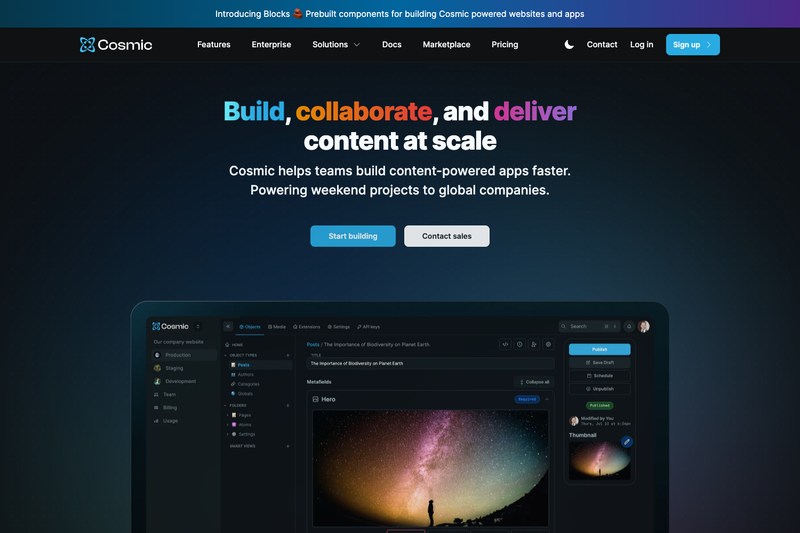
React Starter is a React application boilerplate powered by the Cosmic JS headless CMS, designed to get a content-driven React site running in seconds via the Cosmic CLI. It pairs a standard React front end with content stored in a Cosmic JS Bucket, and the whole install flow is driven by command-line tools rather than manual configuration.
What is React Starter?
React Starter is a starter app for React that uses Cosmic JS, a headless CMS, as its content backend. It takes a Cosmic JS Bucket as its input data source and outputs a runnable local React application that cosmic start serves for development. The template is distributed by Cosmic JS and is documented through the company's React CMS knowledge-base page, which explains how to use the headless CMS with React websites and apps. The repository's own topics list cosmicjs, javascript, react, and reactjs, confirming the stack.
Key Features
- Cosmic JS headless CMS integration — Content is stored in a Cosmic JS Bucket and delivered to the React app through the Cosmic JS API.
- One-command CLI setup — Running
cosmic init react-starterinstalls example content into a new or existing Bucket and downloads the app locally in one step. - Cosmic CLI authentication — The
cosmic logincommand connects your terminal to your Cosmic JS account before initialization. - Local development server —
cosmic startlaunches the downloaded React app locally after installation. - Official React CMS documentation — The project links to the Cosmic JS knowledge base article on React CMS for further guidance.
- Example content included — The init command installs sample content into the Bucket, so the app has data to render immediately.
Who is it for?
- React developers who want a headless CMS-backed starter without wiring a backend themselves: they run the CLI commands and get a project that reads content from a Bucket.
- Teams evaluating headless CMS options who need a concrete React example: they can install React Starter, inspect how content is fetched, and compare the workflow.
- Existing Cosmic JS users who want to scaffold a new React project quickly: they can reuse their Bucket and focus on building features.
- Hackathon or prototype builders who need a running React app with sample content in under a few minutes, using only the Cosmic CLI.
What can you do with React Starter?
- Content-driven website prototypes: Spin up a React app and populate its pages by editing entries in a Cosmic JS Bucket rather than editing JSX.
- Learning headless CMS workflows: Use the starter to see how a React front end consumes content from a headless CMS and how the CLI manages the data layer.
- Starting point for production apps: Use the installed project as a base, then add routing, styling, and components on top of the CMS integration.
How does React Starter work?
First, install the Cosmic CLI globally with npm i -g cosmic-cli. Second, authenticate with cosmic login. Third, run cosmic init react-starter, which installs example content to a new or existing Bucket and downloads the app locally. Finally, move into the project folder with cd react-starter and start the server with cosmic start.
FAQ
What commands do I need to install React Starter?
You need the Cosmic CLI. Run npm i -g cosmic-cli, then cosmic login, cosmic init react-starter, and cosmic start inside the downloaded folder.
Does React Starter require a Cosmic JS account?
Yes. The installation uses cosmic login, which authenticates your terminal to your Cosmic JS account, and content is stored in a Cosmic JS Bucket tied to that account.
What content does the starter include?
The cosmic init react-starter command installs example content into a new or existing Bucket, so the React app renders sample data right after setup rather than starting empty.
Is React Starter a full website or just a codebase?
It is a starter application, not a finished website. It provides the React app structure and CMS connection, and you add your own pages, routing, and styling on top.
Where can I learn more about using React with Cosmic JS?
The project links to the Cosmic JS knowledge-base article on React CMS, which explains how the headless CMS powers React websites and apps.