
Template details
ResuLLMe
ResuLLMe enhances your résumé with Large Language Models, converting it to JSON Resume and rendering a LaTeX PDF.
About this template
ResuLLMe is an open-source Streamlit application that uses large language models — OpenAI and Gemini — to enhance résumés and render them as LaTeX PDFs.
What is ResuLLMe?
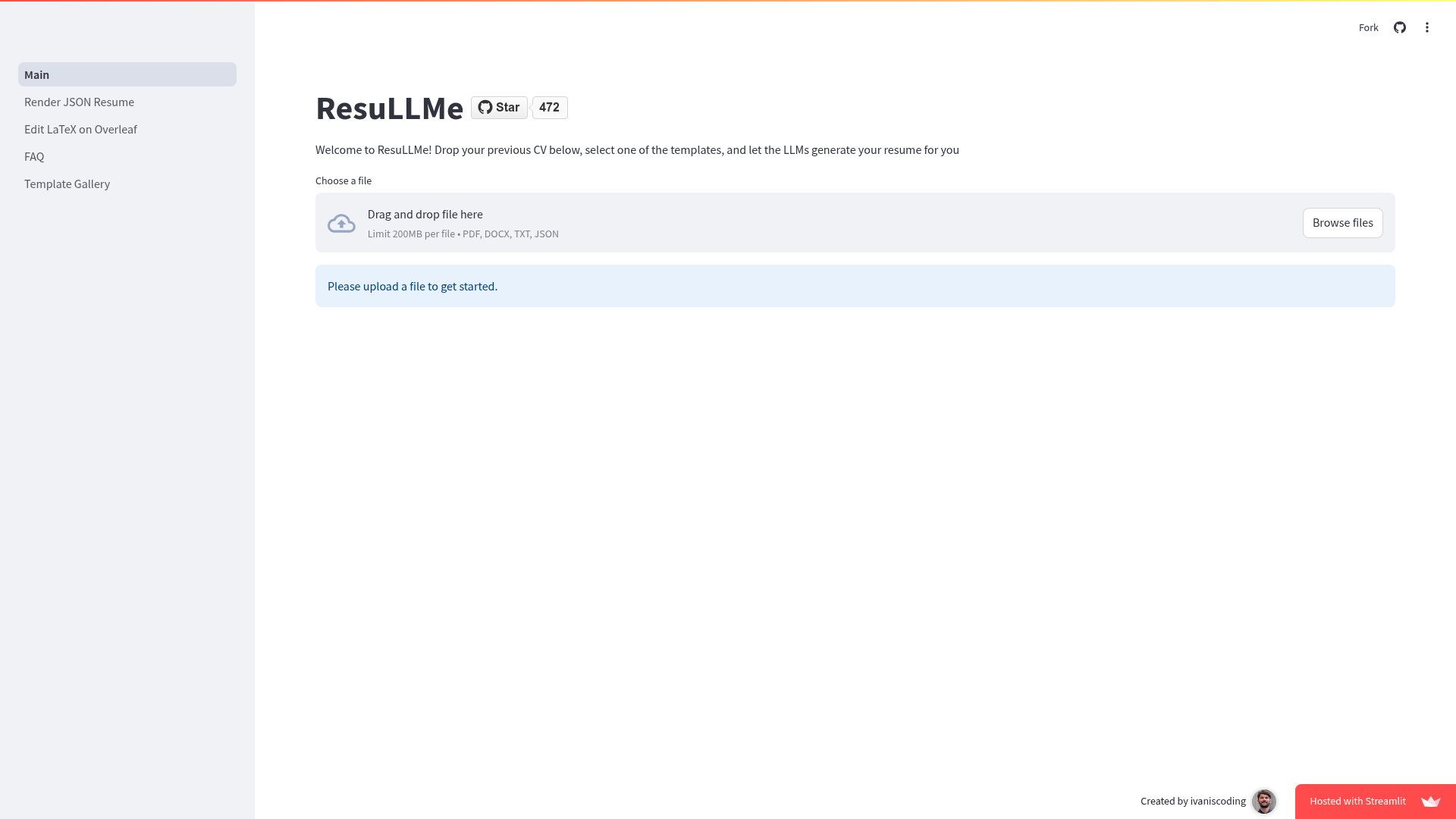
ResuLLMe is a résumé-enhancement web app built with Streamlit and available to run live at resullme.streamlit.app. It accepts a CV as a PDF or Word document, improves the text using either OpenAI or Gemini following résumé guidelines published by well-reputed schools, converts the result to the JSON Resume format, and renders a new PDF via LaTeX. The project is open source under the MIT license and is hosted on GitHub under IvanIsCoding/ResuLLMe.
Key Features
- Dual LLM support — Works with both OpenAI and Gemini, giving users a choice of language model for résumé rewriting.
- PDF and Word input — Uploaded résumés are parsed from PDF or Word documents, and the extracted content is fed to the LLM.
- JSON Resume conversion — The improved résumé is structured into the JSON Resume standard, making the data portable to other résumé tools.
- LaTeX PDF rendering — The JSON Resume is compiled with LaTeX into a clean PDF; sample outputs are linked in the repository.
- Manual fallback tab — If automatic extraction fails, users can download the intermediate JSON, edit it, and re-render from the "Render JSON Resume" tab.
- Cross-platform LaTeX engine — The project recently switched LaTeX engines to support macOS and Windows; the previous rendering behavior is preserved in the v1 branch.
- Local and Docker deployment — Run the app natively with Pixi via
pixi run run-app, or in a container withdocker-compose up -d, both serving on localhost:8501.
Who should use ResuLLMe?
- Job seekers who want an automated second opinion on their résumé before applying, using guidelines from reputable universities.
- Developers who want to build or fork an LLM-based document-processing pipeline, with contributions welcomed for new LaTeX templates and improved prompts.
- JSON Resume users who need a LaTeX renderer and a workflow that goes from unstructured CV to structured JSON and back to PDF.
What can you do with ResuLLMe?
- Upload a messy résumé and receive an improved version that follows established formatting and content guidelines.
- Convert between formats — turn a PDF or Word CV into JSON Resume, then into a clean LaTeX-generated PDF.
- Self-host for privacy — deploy locally with Docker or Pixi so résumé contents stay on your own machine.
- Contribute improvements — add LaTeX templates, fix existing ones, or extend support to other LLMs like Bard, Claude, or LLaMA.
How does ResuLLMe work?
Upload a CV as PDF or Word. ResuLLMe extracts the text, sends it to OpenAI or Gemini with prompts based on school-published résumé guidelines, and receives improved content. That content is converted to JSON Resume and compiled with LaTeX to produce a downloadable PDF; if extraction fails, you can manually edit the intermediate JSON and re-render it.
FAQ
Is ResuLLMe free?
The hosted app is available at resullme.streamlit.app, and the source code is MIT-licensed, so you can run it yourself for free. Running locally requires you to supply API keys for OpenAI or Gemini; the repository does not mention billing for the hosted service.
Which LLMs does ResuLLMe support?
ResuLLMe currently supports OpenAI and Gemini. The project welcomes contributions for additional models such as Bard, Claude, and LLaMA.
What file formats can I upload?
ResuLLMe accepts résumés as PDF or Word documents. If text extraction fails, you can manually download the JSON output, edit it, and re-render from the "Render JSON Resume" tab.
How do I run ResuLLMe locally?
Install Pixi from prefix.dev and run pixi run run-app, or use Docker with docker-compose up -d. The application will be available at http://localhost:8501/.