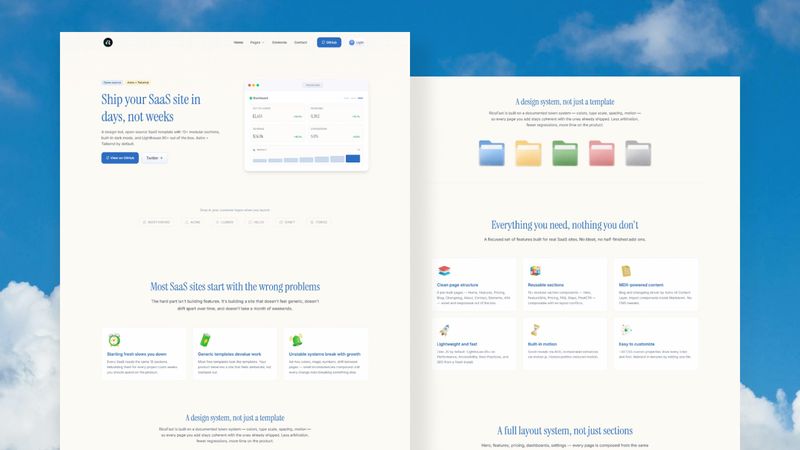
RicoFast is an open-source SaaS website template built with Astro 6 and Tailwind CSS v4, designed by ricoui to give indie hackers and dev-tool teams a polished, design-forward product site.
What is RicoFast?
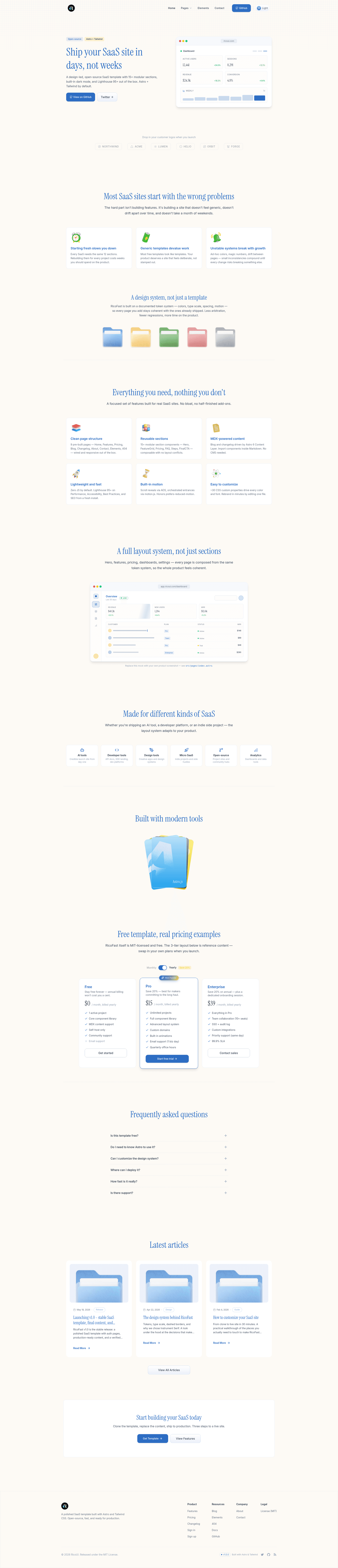
RicoFast is an MIT-licensed SaaS marketing template built with Astro 6.4.2 and Tailwind CSS v4.1. It takes a simple JavaScript config file for site-wide settings and MDX files for blog and changelog content, and outputs a fully static site with 11 production-ready pages. The template is created by Rico, a web/UI designer, and includes a documented design system in docs/DESIGN.md that AI coding tools like Claude can interpret via the provided CLAUDE.md.
What makes RicoFast stand out?
- 11 production-ready pages — Home with 12 sections, plus Features, Pricing, Blog, Changelog, About, Contact, Sign in, Sign up, Elements, and 404.
- 15+ reusable section components — Hero, FeatureGrid, FeatureDetail, Pricing cards, Comparison table, FAQ, Steps, Tech stack, Use cases, and FinalCTA.
- Auth page templates — Sign-in and sign-up pages in two layout variants (split-screen and centered card), ready to wire to any auth provider.
- MDX-powered content — Blog and changelog use Astro 6 Content Layer API with astro/loaders; adding a new MDX file in src/content/post automatically creates a page.
- Token-driven design system — Roughly 30 CSS custom properties documented in docs/DESIGN.md, covering colors, typography, spacing, and motion.
- Built-in dark mode — Class-based dark mode with no flash on load, and contrast-audited palettes.
- SEO and performance ready — Includes Open Graph, Twitter cards, sitemap, RSS feed, and Lighthouse scores above 95 across the four categories.
- Modern tech stack — Astro 6.4.2, Vite 7.3, Tailwind CSS v4.1, AOS and motion.js for scroll animations, Lucide icons, TypeScript with astro check, and Biome for linting.
Who should use RicoFast?
- Indie hackers who want to launch a SaaS product site in a day, with a professional design that doesn't look like a default starter.
- AI and dev-tool teams who need a design system that AI assistants can parse — the repo ships docs/DESIGN.md and CLAUDE.md specifically for that workflow.
- Open-source maintainers who want a blog, changelog, and pricing page under an MIT license with no attribution required, deployable to any static host.
What can you do with RicoFast?
- Launch a marketing site: Set your brand name, URL, and social links in src/config/site.js, adjust the Tailwind @theme tokens in src/styles/global.css, and deploy the static dist folder to Cloudflare Pages, Vercel, Netlify, or GitHub Pages.
- Publish a product blog and changelog: Drop new MDX files in src/content/post and src/content/changelog; the build collects them automatically through the Content Layer API.
- Create account pages: Use the included sign-in and sign-up layouts in split-screen or centered-card variants, then connect your own auth backend.
How does RicoFast work?
The quick start is a three-step process: clone the GitHub repository, install dependencies with pnpm, and run pnpm dev to start a local server at localhost:5200. For production, run pnpm build, which runs astro check and biome lint before outputting a static dist directory ready for any hosting platform.
Is RicoFast free?
Yes. RicoFast is open source under the MIT license, so you can use it for personal and commercial projects with no attribution. The author accepts optional support via Ko-fi.
What are the requirements to run RicoFast?
You need Node.js version 22.12.0 or higher and pnpm version 9 or higher, because the repository uses pnpm-lock.yaml as the source of truth. Set the PUBLIC_SITE_URL environment variable before deploying so that the sitemap, RSS, and canonical URLs point to your real domain.
Does RicoFast include a blog?
Yes, the template includes an MDX-powered blog and changelog. Add new entries as MDX files under src/content/post and src/content/changelog, and they are automatically collected. Each entry supports full frontmatter schemas defined in src/content.config.js.
Can I use RicoFast for commercial projects?
Yes, the MIT license permits commercial use without attribution. You can fork the repository, ship the site, and sell what you build on top of it. The only requirements are included in the license file in the repository.