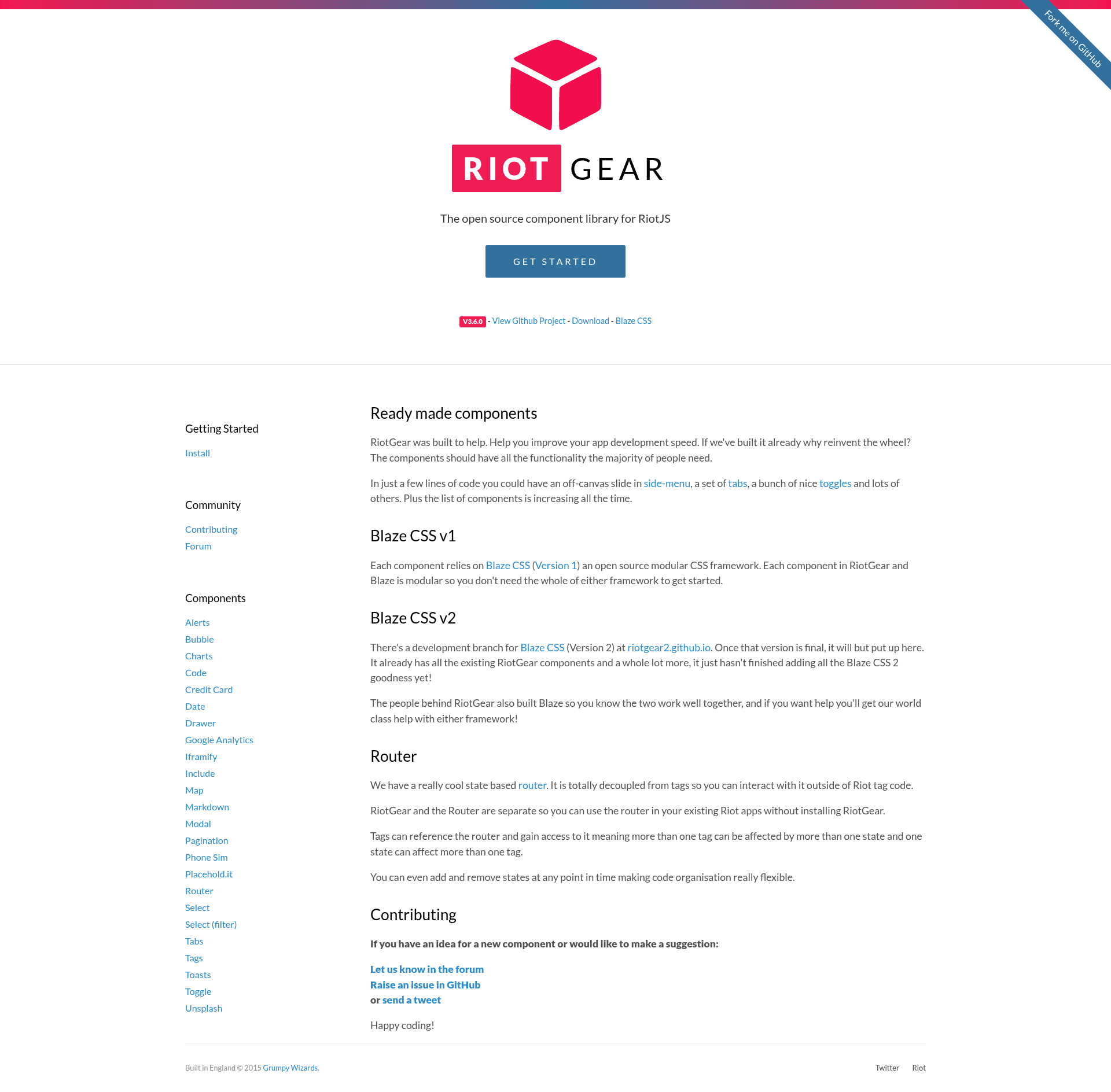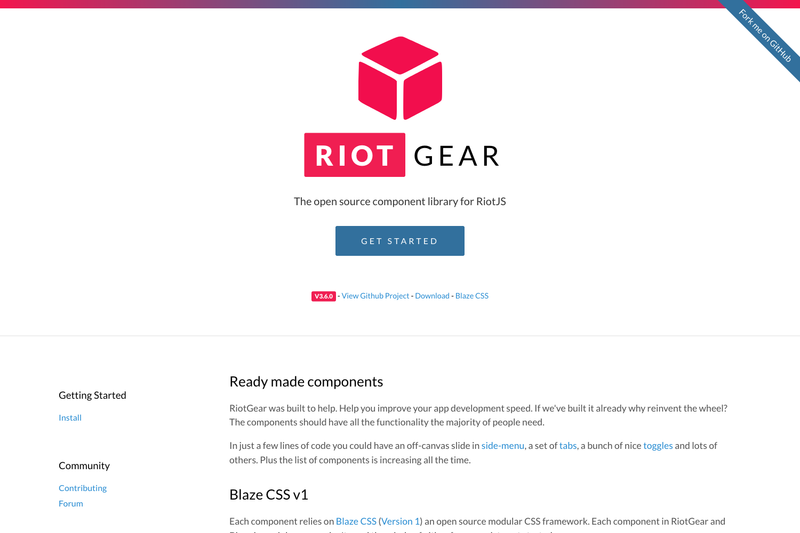
RiotGear is an open source component library for Riot.js that provides reusable HTML-like tags for building web applications. It is distributed as the npm package riotgear, with its documentation hosted at riotgear.js.org and source code maintained on GitHub under the RiotGear organization (repository RiotGear/rg).
What is RiotGear?
RiotGear is a collection of reusable UI components designed specifically for Riot.js, a minimalist JavaScript library for building user interfaces. The library takes the form of custom tags that developers can import into their Riot.js projects, saving time by avoiding the need to hand-code common interface elements. The project is open source, licensed under MIT, and actively maintained by the community through a public contribution guide.
Key Features
- Open source license — Released under the MIT license, as shown by the license badge in the repository, allowing free use and modification.
- npm distribution — Installable via the npm package
riotgear, with version and download counts visible through shields.io badges on the repository page. - Continuous integration — The project uses CircleCI for automated testing and build verification, with a badge linking directly to the CI pipeline.
- Documentation website — A dedicated site at http://riotgear.js.org provides documentation and usage examples for the components.
- Community contribution — A CONTRIBUTING.md file offers guidance for developers who want to run the repo locally and submit pull requests.
- Riot.js integration — Components are built as Riot.js custom tags, meaning they integrate natively with the framework's reactive data binding and rendering model.
Who is it for?
- Riot.js developers — Front-end developers building applications with Riot.js who want ready-made components instead of writing custom tags from scratch.
- Open source contributors — Developers interested in improving a component library, following the contribution guide to set up the repository locally and submit changes.
- Teams preferring lightweight frameworks — Groups that choose Riot.js for its small footprint and want a component set that aligns with that philosophy.
What can you do with RiotGear?
- Rapid prototyping: Install the
riotgearpackage and import existing components to quickly build out UI prototypes without writing every tag manually. - Consistent UIs: Standardize on RiotGear's components to keep behavior and styling uniform across a Riot.js application.
- Learn Riot.js: Study the library's source code to see real-world examples of how Riot.js custom tags are implemented and structured.