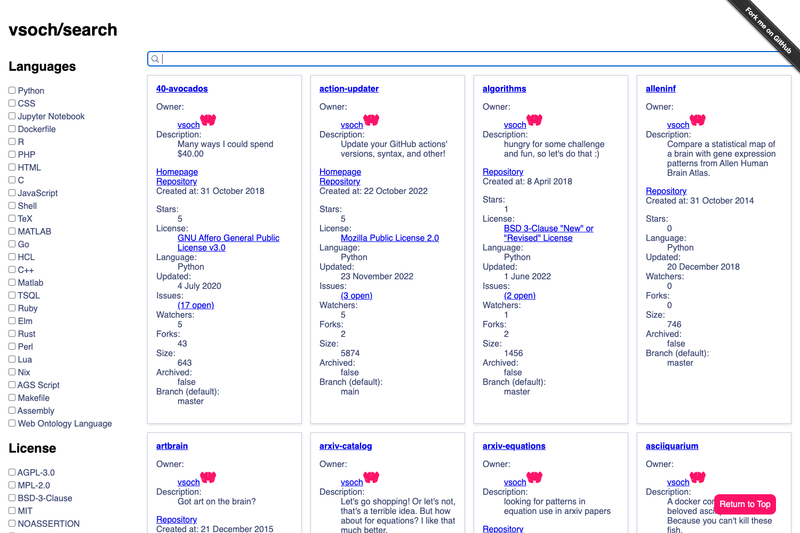
Search is a Jekyll template that creates a searchable interface for the GitHub repositories of any user or organization, deployed free on GitHub Pages.
What is Search?
Search is a Jekyll-based template that uses the GitHub API to render a searchable list of repositories for a GitHub account. It takes your username or organization name (configured by forking the repository and enabling GitHub Pages) and produces a static site where visitors can search across your repositories. The template runs on GitHub Pages, which means no separate server or database is required. It is maintained by vsoch and published in the vsoch/search repository.
Key Features
- GitHub Pages deployment — Fork the template and enable GitHub Pages to publish the interface under your account's Pages domain; renaming the repository changes the base URL.
- Jekyll framework — Built with Jekyll, so all configuration lives in a single
_config.ymlfile that controls the title, baseurl, repository variable, and scroll-to-top color. - GitHub API integration — The site queries the GitHub API to fetch repository metadata and render it into a searchable index, with no backend beyond the static host.
- Searchable output — Visitors get a search box that filters repository results for the target user or organization directly in the browser.
- Local development support — Use the included
Gemfilewithbundle installandbundle exec jekyll serveto preview changes on your own machine before pushing to GitHub. - Customizable color — The scroll-to-top button color is set with the
scrolltop_colorvariable, letting you match your GitHub profile branding.
Who is it for?
Search is for GitHub account holders who want a dedicated, public-facing directory of their repositories without manually maintaining HTML. Developers who already use Jekyll or GitHub Pages will find it especially easy to adapt. Organizations can use it as a simple project discovery page, and anyone wanting to learn how to pull data from the GitHub API into a static site can treat it as a reference implementation.
What can you do with Search?
- Individual developers — fork the template, set your username, and publish a searchable portfolio of your repositories on GitHub Pages.
- Open-source organizations — create a custom repository hub for your org's projects, with a search box and a pink scroll-to-top button that you can recolor to match your brand.
- Jekyll learners — study how the template connects to the GitHub API and reuse that logic in other static-site projects.
How does Search work?
According to the README, you fork the repository to your own account and turn on GitHub Pages. To change the URL from the default account.github.io/search, rename the repo and update the baseurl in _config.yml. Install the Ruby dependencies with bundle install, then run bundle exec jekyll serve for local development. Once deployed, the site fetches repository data from the GitHub API to populate the searchable interface.
FAQ
Is Search free to use?
Yes. The template is open source on GitHub, and GitHub Pages provides free hosting for public repositories, so you do not need to pay for the template itself. You only need a GitHub account.
How do I deploy Search for my organization?
Fork the vsoch/search repository into your organization's GitHub account, enable GitHub Pages under Settings, and optionally change the baseurl in _config.yml if you renamed the repository. The interface will then be published under your organization's GitHub Pages domain.
Can I customize the title and colors?
Yes. The title and scrolltop_color variables in _config.yml let you change the site name and the color of the scroll-to-top button. You can edit other Jekyll files too, since the template is fully open source.
Does the template work without GitHub Pages?
No, it is designed for GitHub Pages and relies on the GitHub API. While you can run it locally with Jekyll, the README warns that local rendering can quickly consume your API rate limit, so it recommends using GitHub Pages for the public deployment.