
Template details
SimSim
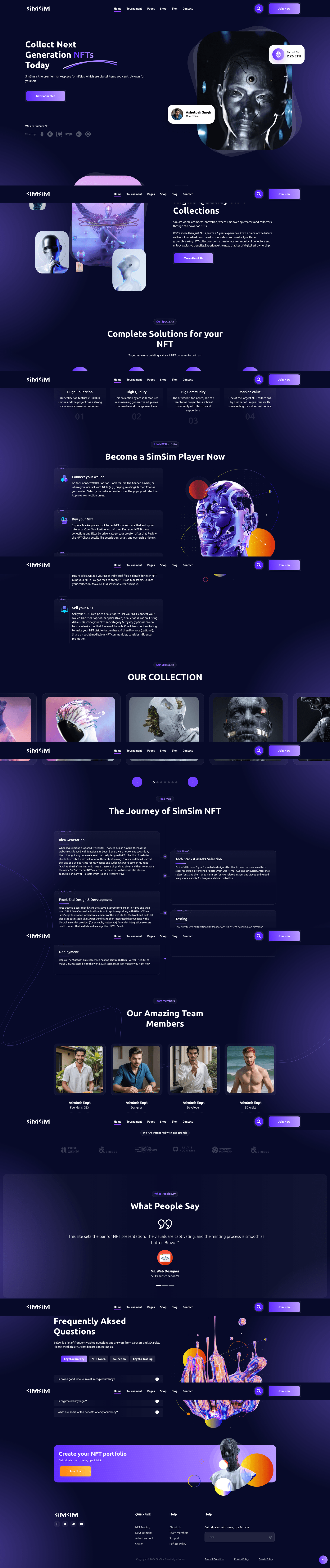
SimSim is a static NFT marketplace website template built with HTML, CSS, JavaScript, Bootstrap, GSAP, and jQuery UI.
About this template
SimSim is a static front-end website template for an NFT marketplace, built with HTML5, CSS3, and JavaScript and bundled with jQuery UI, GSAP, Bootstrap, Owl Carousel, LocoMotive Animation, and Swiper. It delivers a responsive, animated landing page for showcasing digital collectibles, and it was designed by Ashutosh Kumar (aashuu) of 2C Labs. The full source is on GitHub with a live demo at simsim-nft.vercel.app.
What is SimSim?
SimSim is a pure front-end website template that presents an NFT marketplace interface without any backend or blockchain logic. It takes static content such as NFT collection images, titles, and descriptions and renders them into a polished, mobile-friendly storefront layout. The template runs entirely in the browser using plain HTML, CSS, and JavaScript, and it was created by Ashutosh Kumar, founder of 2C Labs. The repository includes a Figma design file and a live Vercel demo.
Key Features
- Responsive layout — The design adapts to desktops, tablets, and mobile phones; the README shows screenshots on a MacBook, iPhone X, and other screen sizes.
- Animation libraries — Uses GSAP, LocoMotive Animation, Owl Carousel, and Swiper Bundle for scroll effects, carousels, and interactive motion.
- Bootstrap and jQuery UI — The UI is built on Bootstrap components plus jQuery UI widgets for drag-and-drop and themes.
- 61,794 total lines of code — Breakdown: 1,333 HTML, 10,245 CSS, 5,663 JavaScript, plus library-specific files for jQuery UI, Bootstrap, Swiper, and Owl Carousel.
- Figma design file — A community Figma file (link in the repo) provides the original design for customization before coding.
- Web3-focused content — The template is positioned as a marketplace for NFTs, with sections for collections and community engagement.
- No backend required — All files are static, so the template can be hosted on any static host like Vercel or GitHub Pages.
Who is it for?
SimSim suits frontend developers who need a ready-made NFT storefront design to customize and extend with their own content and branding. Web3 startups and NFT artists can use it to launch a professional-looking landing page quickly without starting from scratch. It is also a useful learning resource for students — the repo is tagged as a college project — to study how multiple frontend libraries combine in one codebase.
What can you do with SimSim?
- Frontend developers: Reuse the layout and animation patterns to build NFT discovery pages, swapping in real collection data and wiring up wallet connections separately.
- NFT creators: Showcase a drop with animated hero sections, collection grids, and carousels to attract collectors before launch.
- Students: Explore the codebase to learn how GSAP, Bootstrap, jQuery UI, and Owl Carousel work together in a real project.
Pros and cons
- Pros: No build step or server required; relies on well-known libraries; includes a matching Figma design for quick edits.
- Cons: No actual NFT minting, wallet, or transaction functionality — it is purely a visual presentation layer; content is hardcoded in HTML.
FAQ
Is SimSim a fully functional NFT marketplace?
No. SimSim is a front-end template only. It provides the visual interface and animations but does not include blockchain integration, wallet support, or the ability to buy, sell, or mint NFTs. To make it functional you would need to add backend and Web3 logic.
Which technologies does SimSim use?
SimSim is built with HTML5, CSS3, and JavaScript, incorporating Bootstrap, jQuery UI, GSAP, Owl Carousel, LocoMotive Animation, and Swiper Bundle. The original design was created in Figma and is available in the repository.
Can I use SimSim for free?
The repository is publicly available on GitHub, and the live demo is hosted on Vercel. The README shows a star count of 26 and does not mention a license, so you should check the repo before commercial use.
Does SimSim include real NFT collections?
The template displays placeholder or sample NFT collections — the content is static and meant to be replaced with your own data. High-quality NFT collection visuals are featured in the design.