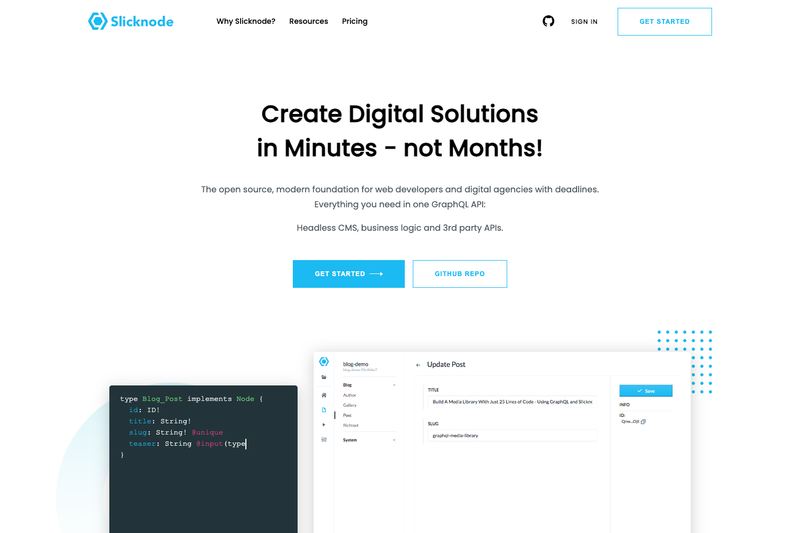
Slicknode's Gatsby Blog Starter is a boilerplate for building a blog site with Gatsby and Slicknode, a headless GraphQL CMS, designed to get a new project running with minimal configuration.
What is Slicknode's Gatsby Blog Starter?
This starter is a GitHub repository that pairs the Gatsby static site generator with Slicknode as a managed headless CMS backend. It takes the repository URL and produces a working blog application with a configured GraphQL data layer. The starter runs on top of Gatsby and Slicknode's CLI tools and is maintained by Slicknode. It includes configuration files such as slicknode.yml, a modules directory for data modeling, and Gatsby's standard gatsby-config.js, gatsby-node.js, and gatsby-ssr.js files.
Key Features
- Gatsby framework — Built on Gatsby, a React-based static site generator, with ready-made
gatsby-browser.js,gatsby-node.js, andgatsby-ssr.jsfiles for browser, node, and server-side rendering APIs. - Slicknode headless CMS integration — Ships with
slicknode.ymland amodulesfolder; thenpm run setupcommand creates a new Slicknode project and writes the API endpoint to.env. - GraphQL content queries — The starter imports Slicknode fragments into Gatsby's GraphQL schema, so you can query blog posts directly from components. A GraphiQL explorer is available at
http://localhost:8000/___graphql. - Live development environment — Running
gatsby developlaunches the site athttp://localhost:8000with hot reloading; editingsrc/pages/index.jsupdates the browser in real time. - Deployment buttons — The README includes deploy buttons for Netlify and Vercel, allowing one-click hosting setup.
- Open source license — Released under the 0BSD license, so you can replace the LICENSE with your own license without restrictions.
Who is it for?
- Developers starting a new blog — Use the starter to skip manual setup of Gatsby and Slicknode and get a working base in a few commands.
- Content teams — Editors can manage blog posts in the Slicknode console (
slicknode console) while developers keep the frontend in Gatsby. - Gatsby learners — The included GraphiQL tool and minimal codebase make it a small, readable example of wiring Gatsby to a headless CMS.
What can you do with it?
- Launch a blog quickly: Run the quick start commands (
gatsby new,npm run setup,gatsby develop) to have a local blog running on port 8000 with content added via the Slicknode console. - Extend the data model: Edit the Slicknode
modulesdirectory to add new content types beyond the default blog post structure. - Deploy the site: Use the Netlify or Vercel deploy buttons in the README (note: the button URLs point to the Gatsby hello-world starter as a placeholder, so you may need to update the repository link).
How does it work?
After installing the Gatsby and Slicknode CLIs, you create a new site with gatsby new, then run npm run setup inside the project. This command creates a Slicknode API project and stores the endpoint in .env. You open the Slicknode console to add posts, then run gatsby develop to serve the site.
FAQ
Is the Slicknode Gatsby Blog Starter free?
Yes, the starter is open source under the 0BSD license, which permits unrestricted use and modification without requiring attribution.
What is Slicknode?
Slicknode is a headless CMS that provides a GraphQL API. In this starter, it handles the content backend, exposing blog posts to the Gatsby frontend through GraphQL fragments imported into the schema.
How do I set up the Slicknode API?
Run npm run setup in the project directory. This command creates a new Slicknode project, configures the dependencies in slicknode.yml, and adds the API endpoint to a .env file.