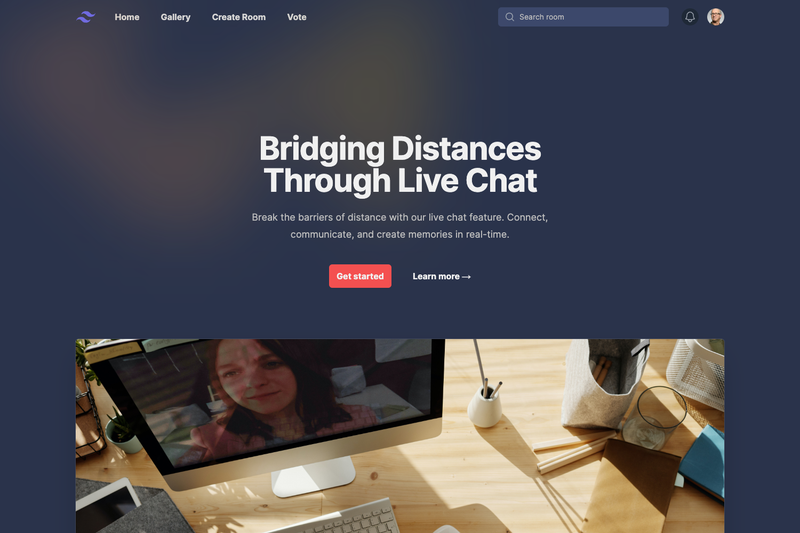
TalkRealm is a Next.js landing-page template for a video chat service, built with Tailwind CSS and Headless UI and bootstrapped with create-next-app. Its core function is to give developers a ready-made marketing and landing page for a video-calling product, starting from the standard create-next-app structure.
What is TalkRealm?
TalkRealm is a Next.js project that serves as a landing page for a video chat application, as stated in the repository description "Video chat landing page." The codebase is a create-next-app starter, meaning it includes the default pages/index.tsx entry point, pages/api/hello.ts API route, and the standard project layout. It runs on Node.js and is optimized for deployment on the Vercel Platform, with the official Next.js deployment documentation linked from the README.
Key Features
- Next.js framework — Built on the Next.js React framework, the template uses file-based routing under the
pages/directory and ships with an API route example at/api/hellothat can be edited inpages/api/hello.ts. - Tailwind CSS — The repository topics list
tailwindcssand the source hints confirm a Tailwind and PostCSS setup, giving utility-first styling without writing custom CSS. - Headless UI — The repository topics include
headlessui, meaning the template integrates Headless UI components for accessible, unstyled interactions like dialogs and menus. - Optimized fonts — The project uses
next/fontto automatically optimize and load Inter, a custom Google Font, as stated in the README. - Developer tooling — Includes standard npm scripts:
npm run devstarts the development server athttp://localhost:3000with hot-reload, and production builds are handled by Next.js's built-in compiler. - Vercel deployment — The README explicitly provides a link to the Vercel Platform for deploying the app, plus a link to the Next.js deployment documentation.
Who is it for?
- Video chat startups — Founders and developers building a video-calling product can use this template to create a professional landing page that explains the service and captures user interest.
- Next.js developers — Developers who want a pre-configured Next.js and Tailwind CSS starter can use TalkRealm as a base, then modify
pages/index.tsxto add their own content and components. - Freelance web developers — Freelancers can deploy this landing page for clients quickly, since the stack is widely known and the template is designed for easy Vercel hosting.
What can you do with TalkRealm?
- Launch a marketing site: Run
npm run devto see the landing page locally, edit the homepage inpages/index.tsx, and push the project to Vercel for a live URL. - Prototype a video chat UI: Use the starter's page structure and Tailwind classes as a foundation to prototype feature sections for a video calling service.
- Learn Next.js basics: Follow the README's links to Next.js Documentation and the interactive Learn Next.js tutorial to understand how the framework works while customizing this template.
How does TalkRealm work?
TalkRealm works exactly like a standard create-next-app project. After cloning the repository, install dependencies with npm install (or your preferred package manager), then start the development server with npm run dev. The site is served at http://localhost:3000 and updates live as you edit files. For production, run a Next.js build and start command, or deploy directly to Vercel.
FAQ
How do I start the TalkRealm development server?
Run npm run dev (or yarn dev or pnpm dev) in the project directory. The server starts at http://localhost:3000, and the page auto-updates when you modify pages/index.tsx.
Does TalkRealm use TypeScript?
Yes, the main entry point is pages/index.tsx, which indicates the project uses TypeScript by default. This file is the starting point for editing the landing page.
Can I deploy TalkRealm to Vercel?
Yes. The README includes a link to the Vercel Platform and directs users to the Next.js deployment documentation. Connecting the repository to Vercel provides automatic builds and previews.
What is the purpose of the /api/hello route?
The pages/api directory maps to /api/*. The included pages/api/hello.ts file defines a sample API route that can be edited to create your own backend endpoints for the landing page.