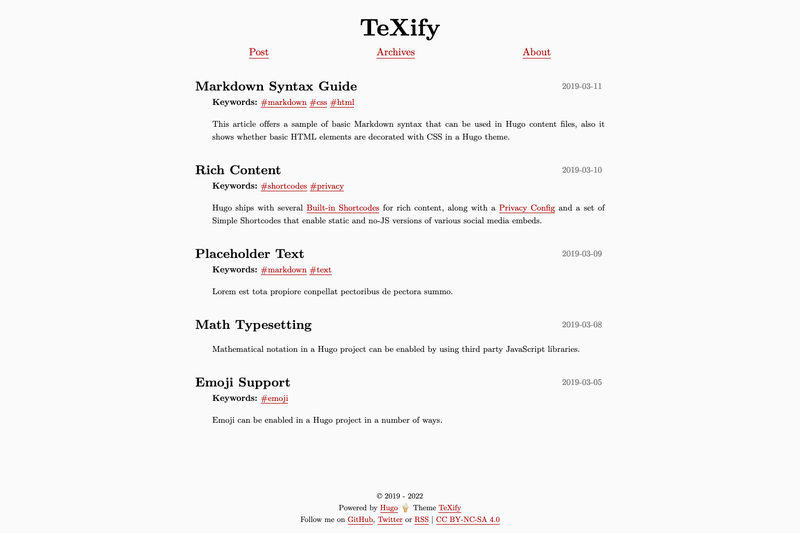
TeXify is a minimal, LaTeX-inspired Hugo theme for personal blogging, turning Markdown content into a fast static site with a print-like academic look.
What is TeXify?
TeXify is a Hugo theme that applies a LaTeX document aesthetic to personal blogs. It takes Markdown posts and renders them as static HTML through Hugo's build pipeline, with optional math equation rendering. The theme was created by queensferryme and is hosted on GitHub, where it has received 149 stars. Its design draws inspiration from latex-css, HugoTeX, and the Typora Academic theme.
Key Features
- No JavaScript — The theme ships with zero JavaScript, relying entirely on Hugo's server-side rendering for speed.
- Minimal CSS — A small stylesheet mimics LaTeX typography, keeping page weight low.
- Math equations — Choose between KaTeX or MathJax to render LaTeX math in posts.
- Disqus integration — Add comments to posts by enabling Disqus in the site config.
- Google Analytics — Built-in support for tracking site traffic with your analytics ID.
- Responsive design — Layout adapts to mobile screens without extra scripts.
- Custom stylesheets — Add your own CSS via a custom.css file to override the theme's defaults.
- Simplified Chinese font support — Recommended Noto Serif SC import via Google Fonts for better Chinese typography.
Who is it for?
- Personal bloggers — Academic writers, researchers, or students who want a clean, paper-like presentation for their posts.
- Math-heavy content creators — People who write equations or technical notation need a theme that renders LaTeX math cleanly.
- Speed-conscious developers — Developers familiar with Hugo who want a fast, dependency-light blog without frontend build steps.
What can you do with TeXify?
- Write academic-style posts — Publish Markdown articles formatted like a LaTeX document, complete with math, lists, and code blocks.
- Run a multilingual blog — The theme's CSS suggestion for Noto Serif SC helps Simplified Chinese content render with proper serif typography.
- Self-host a zero-JS blog — Use Hugo's static output to deploy a blog that loads without JavaScript, which can improve performance and privacy.
How does TeXify work?
- Install the theme by adding its repository as a git submodule under
themes/hugo-theme-texify. - Configure Hugo by copying the example from
config.tomlin the theme's repo. - Write Markdown content in the
content/directory and run Hugo to generate the static site.
Alternatives
- HugoTeX — Another LaTeX-styled Hugo theme that directly inspired TeXify's design.
FAQ
Is TeXify free?
Yes, TeXify is an open-source Hugo theme available on GitHub at no cost. You can download or clone it, then use it for any personal or commercial blog without paying a license fee.
How do I install TeXify?
Add the theme as a git submodule with the command git submodule add https://github.com/queensferryme/hugo-theme-texify.git themes/hugo-theme-texify, then copy the example config from config.toml into your Hugo site's configuration file.
Does TeXify support math equations?
Yes. TeXify lets you choose between KaTeX and MathJax to render LaTeX-style mathematics in your posts. Enable one of them in your site configuration, and math written in Markdown will display as formatted equations.
Can I add my own styles to TeXify?
Yes. The theme supports custom stylesheets: place a custom.css file in your site's static/css/ directory, and TeXify will load it. This is also how you import Google Fonts like Noto Serif SC for Chinese text.
Does TeXify require JavaScript?
No. TeXify is built with no JavaScript of its own. That reduces page weight and loading time, though third-party integrations like Disqus or Google Analytics will add their own scripts when you enable them.